
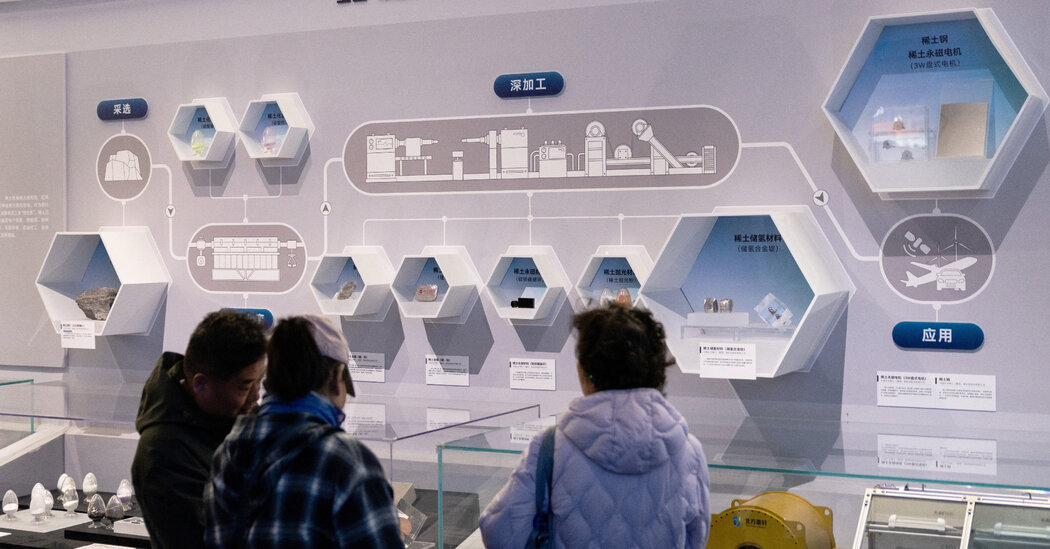
AdvertisementSKIP ADVERTISEMENTManufacturers are struggling with constrained supplies as U.S. and Chinese officials negotiate over export restrictions with consequences for global industry.A display about rare-earth production at the National Museum in Beijing.Credit...Maxim Shemetov/ReutersKeith BradsherKeith Bradsher, who has covered the rare-earths industry since 2009, reported from Beijing and Shanghai.Sept. 21, 2026, 10:00 p.m. ETChina’s restrictions on exports of crucial rare-earth metals and rare-earth magnets remain one of the most difficult unresolved issues as President Trump and Xi Jinping prepare to meet this week.For months, manufacturers in the United States, Europe, Japan and India have complained about difficulties in obtaining enough rare-earth metals from China, which dominates global production. The materials are essential for making products ranging from cars and wind turbines to semiconductors, computer displays and military equipment.China imposed export controls in April 2025 on seven kinds of rare earths and magnets made from them. It later announced a broader set of restrictions, now scheduled to take effect Nov. 10. And in a political dispute, China has slashed shipments of rare earths and magnets to Japan, disrupting supply chains that also serve American manufacturers.All three issues — the existing controls, the Nov. 10 restrictions and the curbs on Japan — are expected to loom over the meeting between Mr. Trump and Mr. Xi, China’s top leader. There is little indication so far of how they might be resolved.Rare earths have become a critical trade issue between the two countries since Beijing introduced export licensing rules two days after Mr. Trump imposed steep tariffs in April 2025 on China and dozens of other countries. China’s rare-earth shipments slowed to a trickle, and some manufacturers from elsewhere had to cut output of their products.The experience last year demonstrated the leverage China derives from its near monopoly on the production of the important materials.The White House says China has not fully followed through on previous discussions about issuing more export licenses. Deliveries have “not been up to par of what we would expect, and that, I’m sure, will be a topic of discussion,” a senior U.S. official said at a briefing on Friday.American and European business groups say shipments are frequently delayed or incomplete or never arrive. China’s Ministry of Commerce scrutinizes every export application.ImageRare-earth refineries in Baotou in northern China.Credit...The New York Times“While most of our members report getting the majority of the rare-earth supplies they need, the restrictions around the sector have given many doubts about relying on China as a dependable long-term supply chain partner,” said Michael Hart, the president of the American Chamber of Commerce in China.Guo Jiakun, a spokesman for China’s foreign ministry, said on Monday that Beijing remained committed to maintaining stable and secure supply chains for critical minerals.The restrictions set to begin on Nov. 10 present another challenge. Current and former American officials said the United States and China had discussed postponing the rules but had been unable to agree on how long such an extension should last. They spoke on the condition of anonymity because of diplomatic sensitivities.The United States has proposed a delay of six months to a year as part of a broader freeze on American tariffs and other trade actions, the officials said.Such a deal would push renewed trade tensions beyond the U.S. midterm elections while leaving the Trump administration time to press Beijing before the 2028 presidential campaign over its trade surplus, import restrictions and industrial subsidies.But Beijing has its own political calendar. The Communist Party is expected to hold its once-every-five-years national congress next autumn, when it chooses the country’s top leadership. China typically seeks to minimize disputes ahead of the gathering, meaning a six-month or one-year deal could expire at an awkward time.China has instead sought a halt to further American tariffs and other trade actions for the remainder of Mr. Trump’s presidency, current and former American officials said. Chinese officials have declined to confirm that position and claim that the export controls are intended to prevent rare earths from being used in military equipment.Mr. Guo declined on Monday to discuss a possible extension of the Nov. 10 rules.Those rules would impose controls on five additional rare-earth elements, including erbium, which is vital for fiber-optic communications in artificial intelligence data centers and transoceanic cables. Even before the rules take effect, China appears to be restricting or delaying erbium exports, industry experts said.ImageA display of magnetic materials at the National Museum. Credit...Maxim Shemetov/Reuters“You’ve had bottlenecks building up at several Chinese ports,” said Ellie Saklatvala, metals director at Argus Media, a commodities pricing firm in London.The most difficult dispute may be China’s sharp reduction in shipments of rare-earth magnets to Japan and its near suspension of some particularly important rare earths, including dysprosium, which is widely used in magnets for cars and in the most advanced chips.China began imposing the restrictions in December after Prime Minister Sanae Takaichi of Japan said her country could help defend Taiwan if China invaded. Taiwan is an island democracy that Beijing considers part of its territory.China has generally handled the sales of rare earths with each country separately, and it is unclear whether Mr. Xi will discuss the restrictions on Japan with Mr. Trump. Asked Monday about shipments to Japan, Mr. Guo, the Chinese government spokesman, said China prohibited exports of dual-use items intended for Japan’s military, as well as other items that could strengthen its military.China’s dominance of the industry gives it considerable leverage. Its refineries produce about 90 percent of the world’s supply of four rare-earth elements widely used in oil refining, glass polishing and low-end magnets: lanthanum, cerium, neodymium and praseodymium. Beijing has not restricted their export.It also produces nearly all of the global supply of a dozen other rare-earth elements needed for a range of products, from semiconductors and lasers to wind turbines and robots. The export of seven of those have required special licenses since April 2025, and the Nov. 10 rules call for export licensing on the other five.Beijing says its rare-earth controls are meant to prevent weapons proliferation, rather than to exert economic pressure. But military uses account for only a small share of global rare-earth consumption.The Department of Defense estimated in 2024 that American military demand accounted for only 0.1 percent of global rare-earth demand. But that figure is skewed lower because it includes enormous volumes of common rare earths used in civilian applications like oil refining and glass polishing.Even when the comparison is limited to the scarcer rare earths most important to weapon production, industry estimates put military uses at roughly 2 to 5 percent of overall demand.Ana Swanson contributed reporting from Washington and Ruoxin Zhang contributed research from Beijing.Keith Bradsher is the Beijing bureau chief for The Times. He previously served as bureau chief in Shanghai, Hong Kong and Detroit and as a Washington correspondent.Related ContentAdvertisementSKIP ADVERTISEMENT
China’s Continued Control of Rare Earths Looms Over Trump-Xi Meeting
Full Article
Original Source
Read the full article at Nytimes →KhanList aggregates and links to publicly available news content. We do not host full articles from third-party sources. Always verify important information with original sources.