
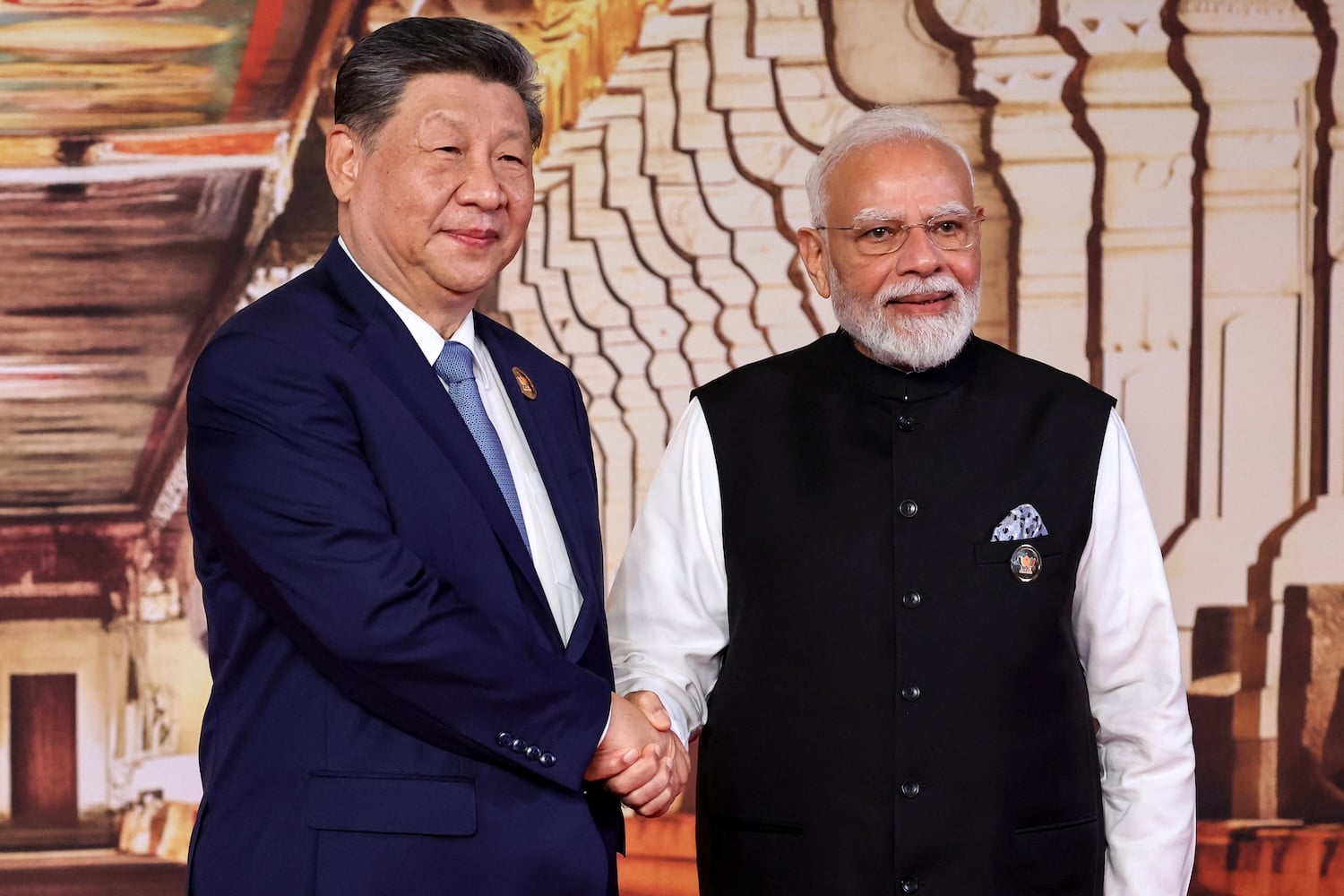
Last month’s BRICS summit marked the pinnacle of an ongoing reset in China-India relations. Chinese President Xi Jinping made his first visit to India in almost seven years for the summit. That visit followed Indian Prime Minister Narendra Modi’s trip to China last year—also his first in seven years—to attend the Shanghai Cooperation Organisation (SCO) summit in Tianjin. The partial renormalization of relations comes after the two countries’ border conflagration in 2020, which was the worst flare-up of hostilities between both countries in more than four decades. Steps taken to revive relations have included the resumption of direct flights and a relaxation of visa and investment restrictions. Even the intractable border issue has seen substantive progress, as noted by the meeting between Indian National Security Advisor Ajit Doval and Chinese Foreign Minister Wang Yi in August, which produced an eight-point consensus as part of their Special Representatives framework. The same month, trade along three border passes resumed after a gap of six years. Last month’s BRICS summit marked the pinnacle of an ongoing reset in China-India relations. Chinese President Xi Jinping made his first visit to India in almost seven years for the summit. That visit followed Indian Prime Minister Narendra Modi’s trip to China last year—also his first in seven years—to attend the Shanghai Cooperation Organisation (SCO) summit in Tianjin. The partial renormalization of relations comes after the two countries’ border conflagration in 2020, which was the worst flare-up of hostilities between both countries in more than four decades. Steps taken to revive relations have included the resumption of direct flights and a relaxation of visa and investment restrictions. Even the intractable border issue has seen substantive progress, as noted by the meeting between Indian National Security Advisor Ajit Doval and Chinese Foreign Minister Wang Yi in August, which produced an eight-point consensus as part of their Special Representatives framework. The same month, trade along three border passes resumed after a gap of six years. On a global level, too, China’s and India’s leaders have had something of a meeting of minds on many issues to do with the international order. At the BRICS summit in India, the 140-point New Delhi Declaration made several references to the Trump administration’s disruptive foreign policies. These included the need for strengthening a “predictable and rules-based multilateral trading system,” condemning the “imposition of unilateral coercive measures that are contrary to international law,” and expressing “concern about ongoing conflicts in many parts of the world and the current state of polarization and fragmentation in the international order.” Yet while engagement at the bilateral and global level continues to gain momentum, an overlooked area of engagement is the need for greater cooperation at the regional level. The recent flash floods in Nepal triggered by a glacial collapse near the Chinese border, for example, highlighted the need for a shared Himalayan water diplomacy framework. After initial apprehension from Kathmandu to accepting foreign aid, China and India have emerged as key sources of humanitarian assistance following that disaster. However, this is being done in parallel rather than in coordination. Speaking at the U.N. General Assembly in late September, Nepali Prime Minister Balendra Shah called for a Himalayan Climate Resilience Mechanism, led by Nepal, China, and India, to share satellite data and expertise to monitor glacial lakes and strengthen joint early-warning systems. Forums such as the International Centre for Integrated Mountain Development—based in Nepal and comprising eight member states, including China and India—are well positioned to play such a role. Given the long-standing climate of mistrust in the bilateral relationship, projects will need to be assessed on a case-by-case basis and avoid disputed or sensitive territories. But this approach offers a “win-win” solution. It helps prevent India becoming further marginalized in its own neighborhood while facilitating a greater degree of transparency and accountability for an expanded roster of Chinese initiatives in the region. Over the last decade, China has emerged as a leading trade, investment, and defense partner for most countries in South Asia. Beijing’s keen interest in the region is fueled by a combination of the need to maintain a stable periphery, seeking markets for its exports and investments, and securing alternative trade routes to overcome what then-Chinese President Hu Jintao referred to as a “Malacca Dilemma.” From New Delhi’s perspective, Beijing’s interests in South Asia are also driven by latent efforts to challenge India’s position in the region, once referred to as a “String of Pearls” strategy of strategic encirclement. To its credit, New Delhi has moved away from the era of viewing South Asia as its exclusive sphere of influence while demonstrating a growing willingness to partner with like-minded countries on development and infrastructure initiatives in South Asia. For example, it is working with Japan through the Act East Forum on infrastructure projects in India’s geopolitically sensitive northeast. But New Delhi still maintains an aversion to an expanded Chinese role in South Asia, given the history of bad blood in the Sino-Indian relationship. New Delhi’s futile attempts to keep China out of the region have prompted Beijing to develop its own regional initiatives that exclude India. The China-Pakistan Economic Corridor, established in 2015, was an early example of this, forming a key pillar of its Belt and Road Initiative. This has now been supplemented by newer initiatives, such as trilateral dialogues with Bangladesh and Pakistan as well as with Afghanistan and Pakistan. China’s engagement with South Asia has also served to strengthen regional connectivity through infrastructure projects. An example is the Colombo International Container Terminal in Sri Lanka, which is financed and operated through a joint venture between China Merchants Holdings and the Sri Lanka Ports Authority. In Bangladesh, China is also overseeing the modernization of Mongla Port, the country’s second-largest seaport. This engagement extends to a people-to-people level. When visiting Kathmandu recently, I was surprised to find a dedicated immigration line at the airport for Chinese nationals (alongside separate lines for Indian and Nepali nationals). China has been convening the China-South Asia Expo trade fair in Kunming since 2013, and several Chinese academic institutions also maintain South Asia institutes. Beijing is even playing an increasingly active mediation role, as noted in the case of recent hostilities between Afghanistan and Pakistan. Beijing also claims to have played such a role during the brief India-Pakistan conflict in 2025 (although New Delhi has disputed this). South Asia’s hub-and-spokes political geography—with India being the only country that shares a border with every other state in the region—makes India central to South Asia’s regional architecture. However, New Delhi’s often strained relations with its neighbors and China’s expanded role in the region have prompted some to ponder a South Asian regional architecture without India. Such views have been fueled by the fact that South Asia’s primary regional forum—the South Asian Association for Regional Cooperation (SAARC)—has not held a summit since 2014, following a breakdown in India-Pakistan relations. India’s resistance to working with Pakistan has been the primary obstacle to SAARC’s revival (although New Delhi argues that Islamabad’s support for terrorism is the original sin). In reality, most countries in the region seek to maintain cordial relations with both China and India. Much is said about India’s commitment to strategic autonomy in its foreign policy. However, other South Asian countries also have a long-standing tradition of pursuing a multialigned foreign policy. While a handful of countries are in the “China camp” (Pakistan) or “India camp” (Bhutan), most seek to engage both as a means of meeting their development needs while preserving their autonomy. In this context, regimes in the region remain averse to any push to choose between major powers or, worse, carve the region (or for that matter the world) into competing spheres of influence. Indeed, historically, the smaller states of South Asia have sought to leverage the Sino-Indian rivalry to extract concessions from both countries. This has not always worked in practice, amid concerns about Beijing’s opaque lending practices; Sri Lanka’s Hambantota project, for instance, became synonymous with China’s “debt trap” diplomacy. Greater China-India alignment in South Asia offers a means to alleviate these concerns. When considering specific projects the two countries could work on together, water is one area of particular need. As an upper riparian state, China should be included in discussions about shared river systems in South Asia. So far, these efforts have been largely bilateral: the Indus Waters Treaty between India and Pakistan and Ganga Water Treaty between India and Bangladesh, for example. Both of these happen to be in limbo, with New Delhi putting the former in abeyance following last year’s India-Pakistan hostilities, while the latter is due to expire in December. Still, a multilateral approach that includes China is required—particularly given the fact that most of the major river systems of South Asia originate in China. India has direct interests in this given China’s construction of the world’s largest hydroelectric power project across a river (the Brahmaputra/Yarlung Tsangpo) that traverses both countries. And a recent agreement to resume sharing hydrological data between both countries, alongside reviving an expert-level mechanism on trans-border rivers, is a step in the right direction. Another area of alignment is development. As with the response to the Nepal floods, both countries are often pursuing development initiatives in parallel. An example of this is the Koshi Corridor, a highway and power transmission project in eastern Nepal, with India’s Export-Import Bank providing a line of credit to finance the electricity transmission line and China pledging to finance portions of the road project. Ideally, this should be an area of cooperation, especially given that the road project aims to connect India and China through Nepal. There are two near-failed states in the region—Afghanistan and Myanmar—both of which share land borders with China and India. This warrants a joint approach by both countries in helping to stabilize these countries. Again, these efforts have been pursued separately, with Beijing and New Delhi often supporting different ethnic or political factions as part of broader geopolitical and security imperatives. However, the endpoints for both countries are the same: maintaining a stable periphery and seeking economic opportunities through resources, markets, and connectivity initiatives. The reset in China-India relations predates the second Trump administration, but it has gained velocity since Donald Trump’s return to the White House. Beijing and New Delhi have both been direct targets of his policies, including tariffs and sanctions for purchases of Russian energy. Washington’s military action against Venezuela and Iran has also deeply impacted both. At the same time, another area of concordance is that Beijing and New Delhi are independently seeking to keep relations with Washington on an even keel. India hopes to conclude a bilateral trade agreement with the United States (despite recent reports that talks have hit a plateau), while the Trump-Xi meeting in September (following their earlier meetings in Busan, South Korea, and Beijing) maintained a proverbial guardrail in the relationship. Despite these ongoing ties, South Asia has arguably lost the strategic significance it once had in the West, particularly after the U.S./NATO withdrawal from Afghanistan in 2021. This has been exacerbated by competing foreign-policy priorities, cutbacks in development aid, and fiscal pressures in several Western countries. China and India therefore have an opportunity to step up. Despite becoming more risk-averse in its outbound investment in recent years, China remains a leading source of infrastructure investment for countries in the global south. While India is not in the same league as China in the global south, it is the elephant in the room in South Asia. In the 2026-27 budget, more than 70 percent of India’s foreign aid was allocated to South Asian countries. New Delhi is also a first responder to humanitarian and financial crises in the region. In this context, South Asia provides a test case for the ability of China and India to align in the global south. Having developed a willingness to work with like-minded countries in South Asia, India should consider extending this willingness to work with extraterritorial powers to China. In adopting a two-pronged approach of engaging Beijing on some issues while collaborating with neighbors to shape China’s involvement in South Asia, New Delhi can ensure that it remains a party to regional initiatives while also helping to strengthen the economic resilience of recipient states to Chinese pressure. Doing so would show that the ongoing reset in Sino-Indian relations is long-term and strategic rather than short-term and tactical. It would also add substance to long-standing claims of “third-world solidarity.”
China and India Want Much the Same Things From South Asia
Full Article
Original Source
Read the full article at Foreignpolicy →KhanList aggregates and links to publicly available news content. We do not host full articles from third-party sources. Always verify important information with original sources.