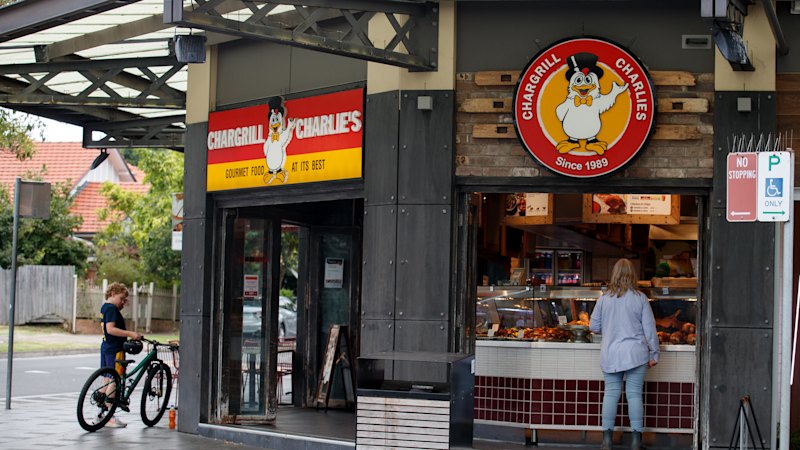
On an early Thursday evening in June, Mosman Mayor Ann Marie Kimber slipped into her local Chargrill Charlie’s, the neighbourhood rotisserie chicken and takeaway shop, to bring home her usual fortnightly order: cauliflower cheese bake, sweet potato fries (“most delicious things in the world”), and a half-and-half salad mix.The food is still just as good as she remembers from when the outlet opened in the early 2010s. “It’s certainly stood the test of time and done very well,” says Kimber, who was visiting at the same time as this masthead.Chargrill Charlie’s has perfected the model of the local chicken shop.“It’s the sort of family-run establishment that it was 20 years ago, with that fresh quality food, and doesn’t feel like there are any corners being cut.”The Lower North Shore councillor wishes them every success, but also doesn’t want to be seen playing favourites within her local community. In any case, right next door is a Guzman y Gomez, and Fishbowl has just opened up around the corner.“There are other amazing and locally run takeaway restaurants, you know,” she says. “We want them all to be successful, and it’s not easy being a small business.“[Chargrill Charlie’s is] no longer a small family business, it’s a big corporate that’s running it. And sometimes there are small family businesses competing with that.”Chargrill Charlie’s is the story of the little chicken shop that could. Established in Sydney’s coastal suburb of Coogee in 1989 by South African migrants Maon and Saul Sher, the brothers and their family took the pokey corner chicken takeout, perfected the model, and turned it into a drop-in destination for gourmet, home-style cooking that satisfied family gatherings with its small mountain ranges of salads, roast vegetables, slow-cooked meats, and a melange of other dinner dishes.In terms of international reputation, the chicken chain also punches above its weight (the chair that Justin Bieber sat on when he came to visit the Mosman store can still be found if you flip over the right chair and find the date scrawled underneath).Chargrill Charlie’s spread across Sydney with 17 outlets and had cracked Melbourne with two by the time it was noticed and gobbled up in mid-2023 by Big Chicken, or fast-food franchise group Craveable Brands, which operates Oporto, Red Rooster and WA chain Chicken Treat.Beyond pockets of eastern and northern Sydney, the renown of Chargrill Charlie’s as a local institution wanes. Chief executive Scott Bradley, a former executive at Grill’d, is charged with juicing up Chargrill Charlie’s with the competence of corporate franchising (its app just relaunched, for instance) and weaving the Sydney-founded brand into the fabric of communities where there is no legacy to draw upon.Scott Bradley, a former executive from Grill’d, is Chargrill Charlie’s new CEO.Janie BarrettEvery aspect of the operation, run as a family business for three decades, is being combed over in the name of consistency and efficiency. Food is washed, prepared, and cooked in store, which comes with bigger wage bills. The challenge is to become more streamlined – ordering just enough food, minimising waste – without cutting corners.Bradley calls it a “menu optimisation project”. “We’re looking at everything from equipment to systems to processes to the way we order, to different suppliers, everything, as fresh eyes coming in,” he says.There are some compromises he won’t make: Chargrill Charlie’s will never move to a centralised kitchen, he vows. “We know that this model has to be really carefully monitored,” he says. “We pride ourselves on that product quality.”No Chargrill Charlie’s is identical to another. About four in five menu items are consistent across the chain; the remaining 20 per cent is left up to the operator’s discretion. (Coogee, for example, does free ice-creams on Thursday afternoons.) Outlets with franchisees or staff from Indian or Nepalese backgrounds might feature curries in their rotation more frequently.The trouble for head office is that it can’t see what each of the outlets is serving at any given time. “I don’t want to promote 80 per cent of the menu,” says Bradley. “I want to promote everything.”Chargrill Charlie’s, now at 30 stores, has for the most part grown deliberately slowly. Members of the Sher family worked in the business (and still do), opening new locations and hiring loyal staff who themselves became like family. “It was an unwritten rule. You had to work in a Charlie’s for two, three, four years to earn the right to maybe get your own restaurant,” says Bradley. He concedes that rule isn’t feasible any more. “But we do have really strict quality control about who the new franchisees are.”There is a ceiling to just how big the chicken chain can get. In the world of fast food, chicken (deep-fried, bite-sized, tenders, even for breakfast) is the hottest protein to be selling right now. Even Domino’s is offering five different ways to order a side of chicken to save its tepid pizza sales. Then there’s the rising popularity of Korean fried chicken and the ever-growing number of air fryer-friendly options in the supermarket aisles.Around the country, chicken chains are on the march: Lebanese charcoal chicken sensation El Jannah, one of Chargrill Charlie’s direct competitors, intends to run 200 restaurants, led by former Craveable chief Brett Houldin.In Sydney’s harbourside suburb of Rose Bay, where Chargrill Charlie’s has been for a decade, competitor and Portuguese favourite Frango had lines out the door while plenty of chairs and tables at Chargrill Charlie’s remained unoccupied at lunchtime on Tuesday.Chargrill Charlie’s in Rose Bay was quiet after Portuguese chicken chain Frango, which recently opened up across the road, brought new competition.Janie BarrettThere are plenty jostling for supremacy in the chicken wars. “You’ve got [Chargrill Charlie’s], Nando’s, Frango, El Jannah, Ogalo ... You’ve got a lot of strong competition, all wanting the same sites,” says retail food consultant and Titanium Food director Suzee Brain.Frango Rose Bay, which opened in late May, had a queue of people outside.Janie BarrettAbout 80 per cent of the branded chicken market is swallowed up by KFC (817 outlets) and Red Rooster (325), she adds, and then there are nearly as many independent chicken shops as there are KFCs. “Australia runs into this [problem] all the time. We’re a duopoly,” Brain says. “To what scale can they scale?” A Chargrill Charlie’s outlet isn’t set up for the speed of traditional fast food. “We’ve got our food ready to rock and roll, you can just dump it out the window really quickly, but the challenge will be the ordering piece,” says Bradley. Brain says the ordering experience can be cumbersome.“You’ve got to take your number, wait to be called, you’ve got to tell the cashier what you want, but then they only ring it up, and then you’ve got to go down to the counter and point at all the things you want in your pack with a different server, and everyone’s milling around because they’re waiting for their tickets, you’re bumping into the people that are trying to sit down and eat,” she says. “It’s a very clunky and uncomfortable experience.”Bradley isn’t interested in setting the bar too high. Sixty outlets is a more realistic number; maybe 100 one day. “I don’t see Chargrill Charlie’s having 500 restaurants because there’s probably not 500 locations where this brand would work,” he says.Those calling the shots are based abroad. Craveable Brands is owned by Hong Kong private equity firm PAG Capital and, after seven years of ownership, may be looking for an off-ramp for the investment, which is making less money.As a group, Craveable Brands isn’t growing: revenue dipped slightly to $226.8 million (down from $228.4 million the year before) and net profit plunged 21 per cent to $17.2 million in fiscal 2025, according to its latest financial report filed to the corporate regulator, which doesn’t give a full picture of its accounts.An $800 million deal to sell Craveable Group to a different Asian private equity firm fell over in early 2025 after Affinity Equity partners walked away. In September that year, PAG Capital co-head of private equity Lincoln Pan resigned as a Craveable company director, followed by then-Craveable group CEO Karen Bozic the following day.Chargrill Charlie’s represents only 5 per cent of the whole network of over 630 stores – for now. “They’re all making good money. The franchisees are profitable,” Bradley says of Chargrill Charlie’s. “The turnover of this particular business [Mosman] is unbelievable, which is gonna pick up.”The pursuit of growth will never come at the sacrifice of quality, Bradley insists.“There are so many brands that have scaled really big, and they’ve lost their DNA, they’ve lost their magic,” he says. “I don’t want to ever do that.”The Business Briefing newsletter delivers major stories, exclusive coverage and expert opinion. Sign up to get it every weekday morning.
Chargrill Charlie’s is the little chook shop that could. It’s just not so little any more
Full Article
Original Source
Read the full article at Smh →KhanList aggregates and links to publicly available news content. We do not host full articles from third-party sources. Always verify important information with original sources.