
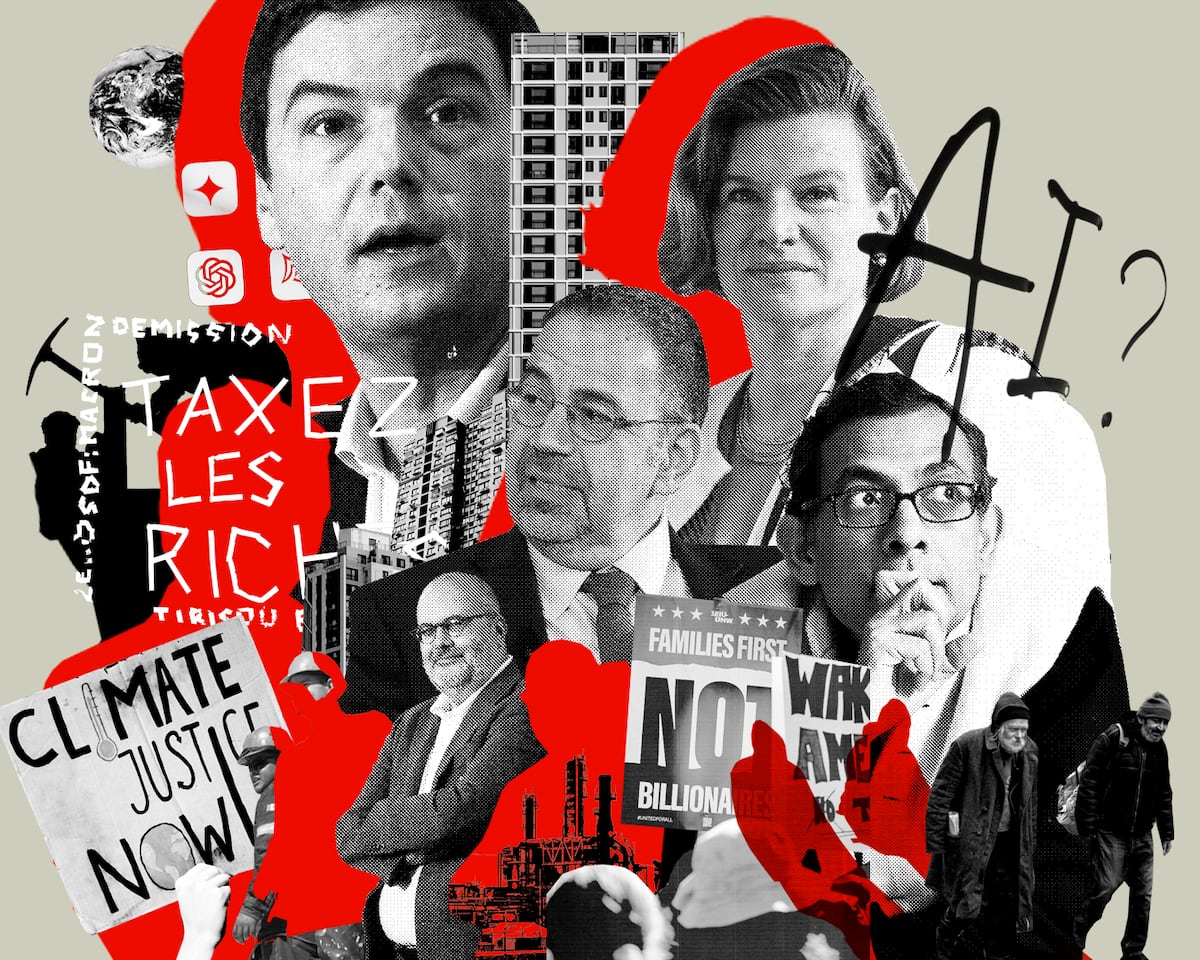
Between global warming, a rampant inequality whose clearest expression is the housing crisis, and artificial intelligence (AI), much of the world lives with a sword of Damocles hanging over its head. No wonder. The era we live in is seasoned with forest fires that make even the most stubborn believe in a climate hell, professionals who fear imminent replacement by server farms that neither get sick nor protest, young people moving back in with their parents because they cannot afford their own homes, billionaires talking about sending us to Mars, and a global south of 3.5 billion poor people who increasingly have less to lose.Faced with so much fear, the far right is growing in the ballots and in the polls. Why? Is the left lacking proposals to meet these challenges? EL PAÍS contacted some of the world’s leading progressive economists to learn their prescriptions. Is a 2% tax on fortunes over $100 million — proposed by French economist Gabriel Zucman — enough? Or can inequality not be addressed without including in the package a fight to keep the planet habitable, as argued in June by the French economist Thomas Piketty during the presentation of the Global Justice Project report?“Without that dual approach, governments risk repeating the mistakes that sparked the Yellow Vest protests in France against a carbon tax that would have hit the middle and working classes harder than the rich,” Piketty said during the presentation of the report, where he is a co-author along with 44 other academics. The report lays out a path to reach the year 2100 while keeping global warming below two degrees Celsius and multiplying incomes for a large majority of the planet.If the reactionary right feeds on fear of regression, the struggles that improve the lives of majorities have always needed the hope of progress— however utopian ideas like a five-day workweek or a month of paid vacation once sounded to many. That is the terrain of the Global Justice Project, which aims to halve hours worked by the end of the century, raise global spending on education and health from 13% to 38% of world GDP, and multiply the incomes of 89% of the world’s population up to €5,000 per month per person.Limiting warming to 1.8 degrees is technically possible, the report’s authors write, if we reform the global financial architecture, reduce meat consumption, and tax the richest with rates up to 20% to fund a sovereign fund to compensate for the injustice of the current global distribution by investing in the energy transition and redirecting a significant share of today’s capital flows — currently going to industrial and mining activities — toward education and health, which have lower material impact.In a section that seems written to preempt skeptics, the report includes the possibility of corrective tariffs of up to 180% for countries that do not join the large international coalition it requires (for inflicting ecological damage on others) and recalls the history of the 20th-century social-democratic revolution, when public spending rose from about 10% to nearly half of GDP and universal education and health systems were created. “A habitable and equitable era in the 21st century is materially possible,” the report concludes. “What stands in the way is not a technical impossibility but a political choice and the difficult but crucial work of building the coalition to get there.”“Piketty’s approach is very clever because for the first time it tries to include all these existential problems in a single package and put numbers on them,” Branko Milanovic, an economist at the CUNY Graduate Center in New York, told EL PAÍS by phone. “It would be wrong to take the report’s numbers separately to dismiss it as totally unrealistic, such as the claim that the entire world population will have the same monthly income of €5,000 [$5,600] in 2100.” Milanovic, a specialist in economic inequality, says the report’s main contribution is showing the interconnection between all the problems: taxation of high incomes and wealth, the creation of a reparations fund, the reduction of within-country inequalities and, among those, the reduction of emissions and the reallocation of GDP toward health and education sectors.“If the current world situation improves and major countries truly agree on reforming multilateral organizations — something the Piketty report also highlights — we will need a conceptual framework, an idea of what to do, and the report is a very good first approach to integrate the various aspects of the problem,” Milanovic explains. “More than stopping to judge whether the numbers are feasible and achievable, the report’s great usefulness is to serve as a blueprint for future thinking.”In any case, taking more decisive steps against global warming does not require waiting for the large coalition of nations that the Global Justice Project aspires to. According to Abhijit Banerjee, co-founder of the Abdul Latif Jameel Poverty Action Lab and a Nobel laureate in economics alongside his wife Esther Duflo, the European Union is already large enough to demand carbon taxes from the powers that fail to include them at the required level. “The European Union is a gigantic market for U.S. technological products and services, which gives it bargaining power it is not using right now to make the U.S. incorporate the carbon emissions of its production into prices for the environmental cost they impose on the whole planet,” Banerjee said during a Zoom conversation.The current European approach is very odd, this economist adds, because it penalizes European producers with high carbon taxes without demanding the same from their main trading partners. In his view, increasing that demand is politically viable within Europe if framed as a nationalist concern as well as an environmental one, thereby including the sensitivities of right-wing governments. “The message would be, ‘we don’t want the United States doing whatever it wants with us,’” he explains. “Right now we are in the worst of all worlds, allowing the U.S. to deny the values our European governments have pledged to uphold,” Banerjee adds.It’s not only the European Union that needs to get its act together. According to Italian-American economist Mariana Mazzucato, learning to recognize their own power is also a pending lesson for many national governments that, after decades of neoliberal thinking, have reduced their role to mere facilitators of private activity. Moving beyond the era of large private consultancies setting the course for administrations — or isolated ministers with their small personal projects at best — toward a coherent approach in which the national government sets the missions that align all ministries and steer private-sector activity is essential.Mazzucato, who directs the Institute for Innovation and Public Purpose at University College London, cites the classic example of the 1960s space race, when NASA clearly defined what it needed to put a man on the Moon, and aerospace companies worked to win the contract. Or the more recent example of the Brazilian government, she says by phone, “when it put the ecological transition at the center, forcing even the finance minister, Fernando Haddad, to recalibrate the roles of public banks to help achieve it.”“Instead of the current passivity, which only puts band-aids where markets cause harm, governments must create value from the start and set the conditions,” says Mazzucato, who has just published the Spanish edition of her book The Value of Everything: Making and Taking in the Global Economy. “Think of it as a reward: do you want to work with the government on a sustainable green transition? Fine — here’s a loan for your steel production, but only if you lower the material intensity of the process,” she explains as an example.According to Mazzucato, such an agreement fails when governments have nothing good to offer in return and limit themselves to imposing rules. “A government that has not invested in public research, a strong education and health system, or good infrastructure cannot impose conditions on companies because it has nothing to offer,” she said. “The mission-oriented approach also helps governments realize they must abandon absurd fiscal rules that ignore the value public investment creates for long-term growth,” she adds.To some extent, the industrial policy defended by economist Dani Rodrik in his book Shared Prosperity in a Fractured World is also a story of governments reclaiming their transformative power. For Rodrik, an officially communist country like China is an example of entrepreneurial innovation addressing the ecological challenge. “Economists have long advocated carbon taxes and equivalent systems like carbon markets as the most efficient mechanisms to reduce emissions, but the most spectacular and real advances in this field have come from China’s green industrial policy,” Rodrik wrote in October. Rodrik is a professor of international political economy at the John F. Kennedy School of Government at Harvard. “Oriented around national goals but implemented locally by municipal authorities, this policy has reduced the cost of solar, wind and battery energy to levels that have made renewables cheaper than fossil fuels.”According to Rodrik, China’s much-publicized subsidies to its companies are only one leg of a broader industrial policy in which public procurement contracts and the support of state venture-capital firms also matter. There is also a lot of experimentation, where many projects fail along the way. Is a trial-and-error approach more viable in an autocracy like China, where public opinion does not exert as much pressure when those errors occur?“It all depends on how you present it,” Rodrik told this newspaper by email. “In the U.S., people accept that not all technologies and companies supported by DARPA [Defense Advanced Research Projects Agency] have to work — the venture-capital ethos is implicit in how that agency operates,” he explains. “That is what must be achieved with industrial policy initiatives: present them as a package that works overall even if some parts fail, and avoid the mistake the Obama administration made when it singled out support for Solyndra, the solar panel company that then failed and became an image problem.”Fighting climate change is another power some attribute to artificial intelligence, for its potential to improve waste management, optimize energy use and sharpen weather forecasts, among other advances. Nobel laureate and MIT professor Daron Acemoglu is not among those who believe that. “So far, the only thing we know about AI models is that they are negatively affecting the fight against climate change because they have very large energy demands, even if we improve efficiency; what we need are advances in batteries and solar and wind energy, and all that is possible with more investment,” he said in a Zoom interview.For Acemoglu, AI can also produce undesirable outcomes in the business world, not only through possible job losses but also a loss of competitiveness. His thesis is that AI still performs worse than humans in a large majority of jobs, and a too-rapid replacement of humans by machines can produce what he calls “mediocre automation.” To avoid that, he proposes changing tax laws that in the U.S. and other countries disincentivize hiring and encourage excessive automation. In 2020, Acemoglu published a study with Andrea Manera and Pascual Restrepo showing that the average effective tax rate U.S. firms paid on employees was 25%, compared with 5% on capital. “If we remove that bias in taxes, we won’t need to discern something that is very hard to know right now: which AI improves productivity and which causes mediocre automation,” he explains.And if we are still replaced by robots that do improve productivity, where will governments find the money to finance the transition to new jobs of the future? According to Acemoglu, rather than imposing a specific AI tax that could have distortive side effects, it is better to raise taxes on income or wealth. “The option for governments to take equity stakes in AI companies cannot be ruled out given the technology’s absolutely transformative potential, but it should be considered with its costs in mind,” the Nobel laureate says.Those costs include protests that AI companies would legitimately mount against such a measure as a change in the rules of the game, and the effects government ownership would have on free-competition systems. “You could not expect impartiality from a government with stakes in an AI firm; it would be normal that when it needs to find an AI provider it ends up favoring its own models,” Acemoglu says. “We could end up promoting the development of AI with far worse safety measures, for example, simply because it belongs to the government.”Acemoglu says another necessary advance is developing a competitive AI in the EU, although at present Europe is completely outside the race between the U.S. and China in this sector. In his view, Europe has the human resources needed to achieve it (“mostly working in American companies”) and better democratic instincts than Beijing and Washington to put AI at the service of workers rather than against them. “It would require creating neural hubs for AI development — you can’t have a company in every European capital — and a financial structure to channel funds so medium-sized companies can scale,” he told this newspaper. “There is a lot of private wealth in Europe, and private fortunes have financed a significant share of global AI investment,” he adds. “A viable model for Europe would be to develop its own version of the U.S. venture-capital industry, less obsessed with scale and expansion.”But there was no need to wait for AI to see how productivity gains from new technologies were implemented without improving workers’ lives. According to Rodrik, that is exactly what has happened in a large part of the service sector in recent years. “Just think of the effect that technologies introduced by companies like Uber or Amazon have had on traditional sectors such as retail and taxis, not to mention the profits restaurants have recorded thanks to online orders and delivery services,” he explains. “The problem is that workers, so far, have not been able to capture those gains.”Raising taxes or taking stakes in new-technology companies are not the only ways to ensure productivity gains benefit workers. Rodrik believes policies that increase workers’ bargaining power are especially important — “allowing collective and sectoral bargaining and engaging companies in a quid pro quo relationship that gives preferential treatment in state dealings to those that commit to improving how they treat employees.”Banerjee says AI will pose a major challenge even in the best possible futures, such as the scenario where AI only enhances worker productivity by assisting rather than replacing them. “The elasticity of demand for many services where productivity will improve is not infinite: people will not suddenly buy 20 times what they used to buy just because it is easier to produce,” he said. “Those who used to need one accountant and can now do the job in 10 minutes with AI are not going to hire more accountants.”He argues we must begin asking now what to do if that happens. Not only about how to channel the benefits companies gain from AI to citizens, but about what a “world where people have a lot of free time and nothing to do” might mean. The main population experiments with something like a basic income and nothing to do, Banerjee says, are in U.S. Native American reservations. “It is not clear they have led to great happiness,” he explains. “We haven’t thought much about this because the world is tilting to the right and there seems to be little space to talk about redistributing AI-generated wealth. But imagine we want and can do it — how would we?” he asks.For Banerjee, one possible answer is to train and certify citizens for emerging sectors. “Governments could choose to expand the social sector, for example, with more eldercare, better childcare, and other services where people usually prefer a person rather than a machine to care for grandparents and children,” he suggests. “People will also demand that those who care for their relatives are properly trained, so I think it is important to understand that governments will not only have to redistribute money, they will also need to invest in redesigning society.”Possible abandonmentIn Piketty’s Global Justice Project, solving inequality solves a lot. Not only because of the global funds that would channel part of the revenue raised by higher taxes on millionaires to poor countries, but also because it would help the worst-off areas of rich countries — such as northern France or eastern Germany — where feelings of abandonment have translated more clearly into anti-immigration politics.Of course, the project does not need to be implemented to take effect. According to Banerjee, “it is already possible to create a mechanism, aimed especially at young people in those areas, to help them move and find work elsewhere.” “It is true that if we have not achieved this so far, part of the reason is the scarcity of public coffers and the resistance wealthy people show whenever their taxes are discussed,” he stresses.Perceptions of migration in host countries can also change if information improves. As Banerjee said, “much of the unrest is due to the mistaken idea that immigrants cost the treasury a lot of money, when the truth is they are usually young, of working age, and contribute more than they receive.” In his studies, Banerjee has shown that the arrival of large numbers of low-skilled workers does not lower local wages. “People find it hard to believe, but the evidence shows it is because these workers also increase overall demand—they are not living off thin air, and many are entrepreneurs who create jobs,” he emphasizes. “In fact, it is high-skilled immigrants who lower local wages, paradoxically the very people every country wants to attract.”With a birth rate that reached a low of 1.34 children per woman for the EU in 2024 (and 1.1 for Spain), immigration is essential for sustaining the economy and pension systems. Banerjee says planning arrivals well is key to managing them. “Germany achieved notable integration of Syrians simply by creating a mechanism that distributed them across different parts of the country, avoiding the creation of settlements isolated from the rest,” he says. “But migration has become such an uncomfortable issue that we fail to recognize it exists and do not adopt a policy to address it, just as happens with many criminal activities.”According to the economist Ha-Joon Chang, a professor at SOAS University of London, the housing access difficulties faced by citizens in many countries would also be alleviated by reducing inequality. His analyses show that “billionaires’ upward bids for the most exclusive real estate drive up general price levels for other properties.”Although the problem has no quick fix, Chang favors learning from places that have managed it better, such as Singapore. “The Singapore government controls 85% of the housing market, from small rental units for young people to luxury apartments, which means that in the remaining 15% — handled entirely by private developers — prices cannot be pushed to extremes if they do not want customers to shift to the official supply,” he says in a videoconference.“There are two lessons from Singapore: one is that housing standards are quite good — you cannot just build blocks without gardens, parks, or decent public facilities, because as soon as people improve their purchasing power they leave and the area deteriorates,” he says. “The other is that the government increased land under its control from 50% in 1965, when the country began its independence, to 90% today, acquisitions carried out gradually that now allow it to provide affordable housing to its population.”Sign up for our weekly newsletter to get more English-language news coverage from EL PAÍS USA Edition
Challenging the neoliberal agenda from the left: The proposals of the world’s leading progressive economists
Full Article
Original Source
Read the full article at English →KhanList aggregates and links to publicly available news content. We do not host full articles from third-party sources. Always verify important information with original sources.