
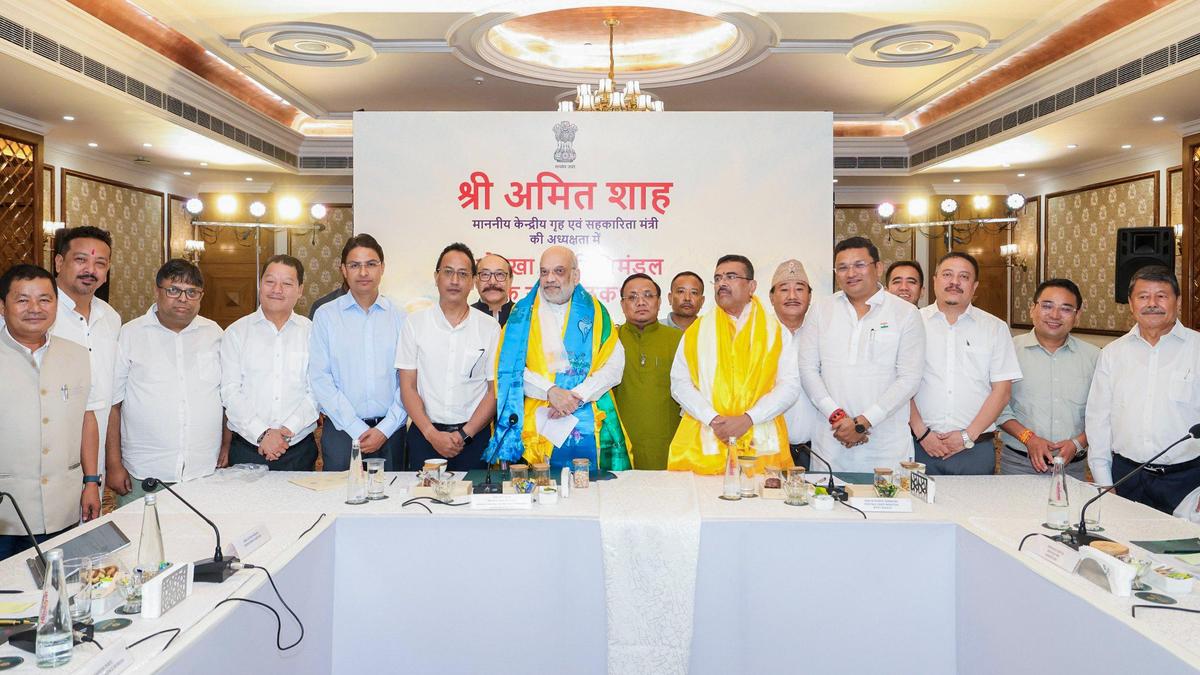
Union Home Minister Amit Shah with West Bengal Chief Minister Suvendu Adhikari and MPs, MLAs, and political leaders from the Gorkha community during a meeting, in Siliguri on August 22, 2026. | Photo Credit: ANI The story so far: On Saturday (August 22, 2026) Union Home Minister Amit Shah held a meeting with different stakeholders of Darjeeling hills in West Bengal. In the meeting, the Home Minister announced the setting up of a committee to draft an agreement and finalise modalities for “permanent political solution” sought by the people of Darjeeling hills and adjoining areas in north Bengal.“It was decided to constitute a committee, chaired by the former deputy National Security Advisor and current interlocutor Shri Pankaj Kumar Singh, to finalize the modalities,” a statement from the Union Home Ministry said. According to the Home Ministry, during the meeting on Saturday (August 22, 2026), all issues concerning the hill population of West Bengal were discussed in detail, and “demands regarding their identity, a permanent political solution, and recognition under the Constitution of India were taken up”.The statement added that Union Home Minister Amit Shah promised a permanent political solution soon under the umbrella of the Constitution of India and promised to sympathetically look into all other demands of the Gorkha community.Several stakeholders from Darjeeling, including BJP MP Raju Bista, MLAs from the region, leaders from hill parties like the Gorkha Janmukti Morcha and the Gorkha National Liberation Front, former Foreign Secretary and BJP MP Harsh Vardhan Shringla and West Bengal Chief Minister Suvendu Adhikari were among those who were present at the meeting.Also Read | Will resolve Gurkha issues as a priority once BJP comes to power in West Bengal, says Amit ShahDemand for GorkhalandThe people of Darjeeling hills have been demanding a separate State of Gorkhaland, to be carved out territories of Darjeeling hills and parts of Terai and Dooars for the past several decades.The region has witnessed several periods of shut down and violence over the Statehood demand since the late 1980’s. The last time when the region witnessed 100 days of shutdown and violence was in 2017. The violence, nine years ago, had claimed 11 lives. The earlier arrangements of regional autonomous bodies like Darjeeling Gorkha Hill Council (DGHC) in 1988 and Gorkhaland Territorial Administration (GTA) in 2011 have failed to live up to the aspirations and expectations of the people. The demand of creation of separate state of Gorkhaland and self-rule is based on the premise that the region is ethnically and linguistically different than rest of West Bengal.The term ‘permanent political solution’ means addressing the demands of self-rule of the people of the region. The term has featured in the manifesto of the Bharatiya Janata Party for 2019 Lok Sabha polls and since then it has become part of the political discourse. The people of the region have been electing BJP MPs and MLAs over the past two decades on the promise of meeting the expectations of the people. After May 2026, when the government in West Bengal and the Centre are both run by the BJP, it is most opportune time to make a decisive step in the direction. The Trinamool Congress government over the past 15 years has opposed any attempts at division of West Bengal.Political Line | Partition of Bengal: New Demands and Old MemoriesTripartite talks and interlocutorThe setting up of a committee to draft an agreement and finalise modalities for “permanent political solution” is not the first time that the Union government has taken a step to address the demand of people of the region.The Centre had, in October 2025, appointed former Deputy National Security Adviser Pankaj Kumar Singh as the interlocutor to hold talks with Gurkha representatives to address their political demands. Before this, there have been several rounds of tripartite talks involving the Union Government, the representatives of Darjeeling hills and the State government.State of Play | A new political alignment in DarjeelingPossible solutionEvery stakeholder including the representatives of political parties of Darjeeling hills say that the permanent political solution will be under the ambit of the Constitution. The creation of a separate State of Gorkhaland, will have political ramifications in West Bengal politics as majority of people of West Bengal, who are not from the Darjeeling region, are opposed to any division or bifurcation of the State.Darjeeling is strategically located, sharing borders with Nepal to the west, Bhutan to the east, and close proximity through the Siliguri sub-division area with Bangladesh in the south. The region is close to Siliguri Corridor, known as the “Chicken’s Neck,” close to the sole land link connecting mainland India to its north-eastern States.Therefore, any decision on the permanent political solution will have to keep not only political interest but also strategic interests in mind. Along with the option of a separate State, the committee may look into whether alternative arrangements such as creation of Union Territory works for the region. Any decision on the permanent political solution of the Gorkha issue will have long term implications for the people of West Bengal. Published - August 24, 2026 11:44 am IST
Centre’s committee on ‘permanent political solution’ for Gorkha issue | Explained
Full Article
Original Source
Read the full article at Thehindu →KhanList aggregates and links to publicly available news content. We do not host full articles from third-party sources. Always verify important information with original sources.