
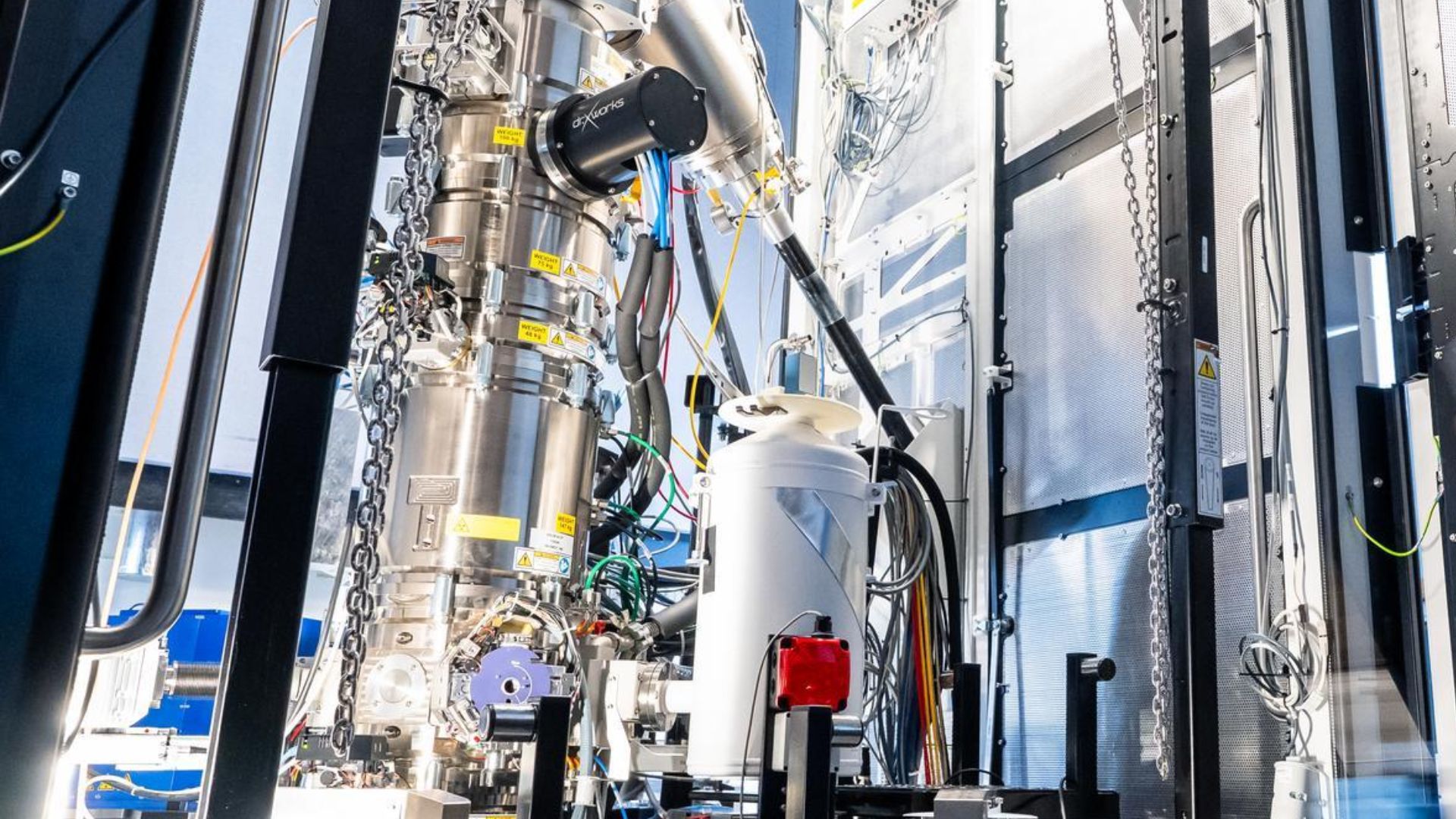
Scientists have recorded what happens inside a crystal in the split second before a quantum bit forms. A team at the US Department of Energy’s Argonne National Laboratory tracked structural changes within silicon carbide in three dimensions. They used one of the world’s most powerful X-ray sources for the experiment. Their findings, published in the journal ACS Nano, allow researchers to watch how a material’s atomic lattice responds to laser strikes beneath the surface in real time. Building a solid-state quantum device often involves deliberate damage. Physicists fire a blindingly fast laser pulse into a crystal lattice. The flash lasts only a fraction of a picosecond, and the beam knocks individual atoms out of place. This process leaves behind tiny empty spaces known as vacancies. “Far from being flaws, these vacancies can behave as qubits — the fundamental building blocks of quantum information,” noted the ANL. Qubits hold and process quantum information. For that reason, they serve as the basic building blocks for quantum computers, secure communication networks, and advanced medical sensors. A game of trial and error Until now, the exact physics of this laser strike remained a blind spot. Older methods used beams of ions or electrons, but they offered little control over position. Lasers can target specific spots, but researchers could only guess how energy moved through the lattice. Creating qubits was largely a game of trial and error. “Before you can precisely engineer quantum defects, you have to understand exactly what the laser is doing inside the material,” said Argonne scientist Haidan Wen, an author of the paper. “This technique lets us watch that process unfold, especially how atoms move in ways that weren’t possible before.” To solve the puzzle, the Argonne team built an atomic-scale camera. They combined an ultrafast laser with the laboratory’s Advanced Photon Source, which produces exceptionally bright X-ray beams. The team focused this beam down to several hundred nanometres, which is roughly one hundred times thinner than a human hair. Hard X-rays pass straight through the crystal. Because of this penetration, the pulses recorded activity deep inside the sample, rather than just on the outer surface. The laser struck the material, and synchronized X-ray flashes captured the immediate aftermath. Revealing two distinct reactions The images revealed two distinct physical reactions occurring side by side. Part of the energy surges through the crystal as an organized shockwave. This wave behaves like ripples spreading across a struck rubber sheet. Meanwhile, the rest of the energy spreads out more slowly as heat. This thermal burst causes nearby atoms to vibrate randomly before the lattice settles down again. Silicon carbide is already a cornerstone of the commercial computer chip industry. Factories already know how to manufacture it on a massive scale. As a result, the material is widely viewed as a top candidate for mass-producing quantum hardware. Engineers hope this data will reduce the need for guesswork. By mapping this energy transfer, researchers aim to eventually place individual qubits at precise coordinates on demand. The team now plans to test their imaging method on other quantum materials, bringing lab-grown prototypes closer to factory assembly lines.Get the latest in engineering, tech, space & science - delivered daily to your inbox.An active and versatile journalist and news editor. He has covered regular and breaking news for several leading publications and news media, including The Hindu, Economic Times, Tomorrow Makers, and many more. Aman holds expertise in politics, travel, and tech news, especially in AI, advanced algorithms, and blockchain, with a strong curiosity about all things that fall under science and tech.
‘Camera’ captures atomic shockwaves before quantum bit forms inside a crystal
Full Article
Original Source
Read the full article at Interestingengineering →KhanList aggregates and links to publicly available news content. We do not host full articles from third-party sources. Always verify important information with original sources.