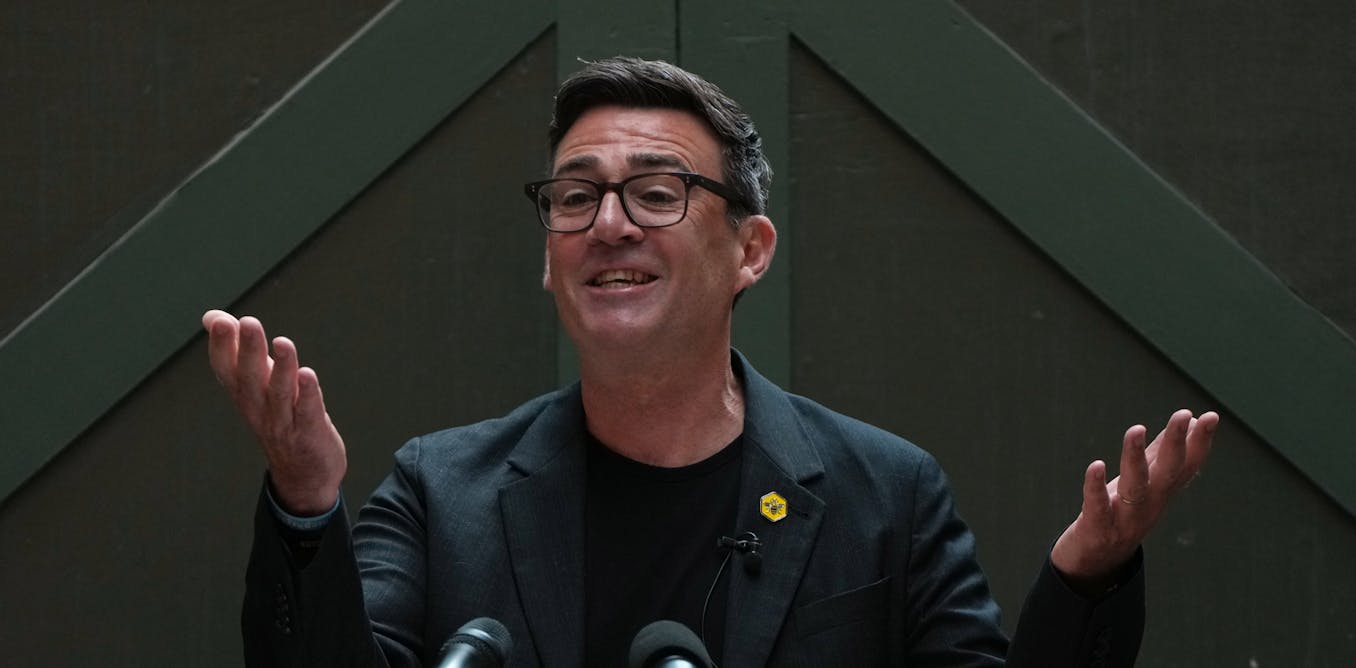
When Andy Burnham is handed the keys to 10 Downing Street on Monday, the United Kingdom will have its seventh prime minister in the ten years since it voted to leave the European Union. It begs the question: what is it about the UK that makes governing it so difficult at this point in time? At the risk of sounding like a broken record, a large part of the answer is Brexit. But Brexit only expressed and exacerbated some of the structural problems the UK still faces today: cynicism, pessimism and political polarisation; uncertain relations with the rest of the world; declining living standards for the poorest in society; a sense of social fragmentation; poorly maintained public services… and England knocked out of the World Cup in the semi-finals. The last point is not trivial, at least in as much as it draws attention to the structure of the UK. The political elephant in the room is England. Specifically, it is the politics of nationhood in England that Burnham needs to address if Labour is to retain office whenever the next election is called. England needs practical policies to address social and regional inequalities. Importantly, these policies must support a renewed national narrative that explains England’s place in the UK, and the UK’s place in Europe and the world. Lest this should be seen as a trivial endeavour, it’s worth remembering that Keir Starmer’s lack of a positive narrative meant his political honeymoon with the electorate was very short. Furthermore, national narratives need to have some grounding in reality. Boris Jonhson’s hyperbolic narratives served as an example of how excessive claims – in this case of restored greatness – can erode trust and increase a sense of distance between the audience and the author of such claims. Establishing a positive national narrative is no easy task. First, it will have to address some inherent contradictions. England is a diverse but singular entity. Through the UK, it has a relationship with the EU built on a newfound – and for many unwanted – sovereignty. It is a nation that values fairness but is increasingly unequal. And that’s before we get to the fact that the contemporary media environment favours, and at times actively supports, a sense of nationhood based on anger and grievance. Burnham has a partial answer to the English question: the devolution of decision-making powers to local communities. This is a variation on the “take back control” theme – this time from Westminster rather than the EU. Whereas Starmer was identified as being from southern England (despite being born in Yorkshire) because he supported Arsenal and had “Sir” in front of his name, Burnham wears his northern Englishness on his sleeve. His “Manchesterism” draws on the cooperative traditions of that part of England and inclines him towards greater state intervention in the economy – which will no doubt be resisted in some bastions of London’s financial district, and by tech giants. So when some people talk about Burnham as the “king of the North”, or when he says he will establish a “Number 10 North” to bring policy focus to places like his Greater Manchester constituency of Makerfield, the “north” we are talking about is not Scotland. It is implicitly the north of England. This is where the next election will be won and lost as Labour confronts the radical right insurgent party Reform UK. Read more: Andy Burnham is known as the ‘king of the north’. Could he become the UK’s next prime minister? As in Australia with support for One Nation, there is a deep well of pessimism, anger and anxiety that has been exacerbated by the post-pandemic pressure on living costs. In the UK, these pressures compounded existing hardships caused by the imposition of austerity measures and the slow, deflating effects of Brexit on the UK economy. But this politics of pessimism plays out in the UK’s peculiar structure. It’s worth remembering how unusual the UK is as a nation-state – if indeed we can use that term to describe it. It is comprised of (at least) four different nations. It is not a federation, but an asymmetrically devolved union that retains atypical levels of centralised governmental control. What used to be an electorate fairly evenly divided between the Conservatives and Labour has now become fragmented between seven different parties across its many devolved jurisdictions with different voting systems. In Scotland and Wales, notionally secessionist parties govern. The government of Northern Ireland is led by a party that claims it wants to reunite Ireland. In England, British nativism is mobilised by the radical and far-right. It is in this difficult context that Burnham needs to find a narrative for his government that links government policies with “Labour values” and speaks directly to England as a political community. Labour governments tend to be short, but with long-lasting impacts. This suggests a bold policy agenda rather than Starmer-like managerialism. Plans to re-nationalise failing privatised water utilities would be a good place to get some early runs on the board and signal that market-based solutions have their limitations. As English football fans know, it’s the hope that kills you. Hope among Labour supporters is again high, but it may be the UK’s structural problems run too deep for a change of manager to alter their course. This may make Burham’s main political task – defeating Reform with its transnational crypto currency financial support – harder. At least over the summer Burnham and Labour can enjoy the political farce of Nigel Farage scoring an own goal in a self-called byelection in his seaside constituency of Clacton. Farage resigned as MP for Clacton to defer parliamentary judgement on huge crypto donations from outside the UK. All other parties sensed the trap and declined to field candidates, leaving novelty candidate Count Binface as Farage’s sole challenger. A Binface victory would be a win for the ages. No one said the English don’t have a sense of humour.
Burnham’s Britain: what kind of country has the UK’s new prime minister inherited?
Full Article
📰 Original Source
Read full article at Theconversation →KhanList aggregates and links to publicly available news content. We do not host full articles from third-party sources. Always verify important information with original sources.