
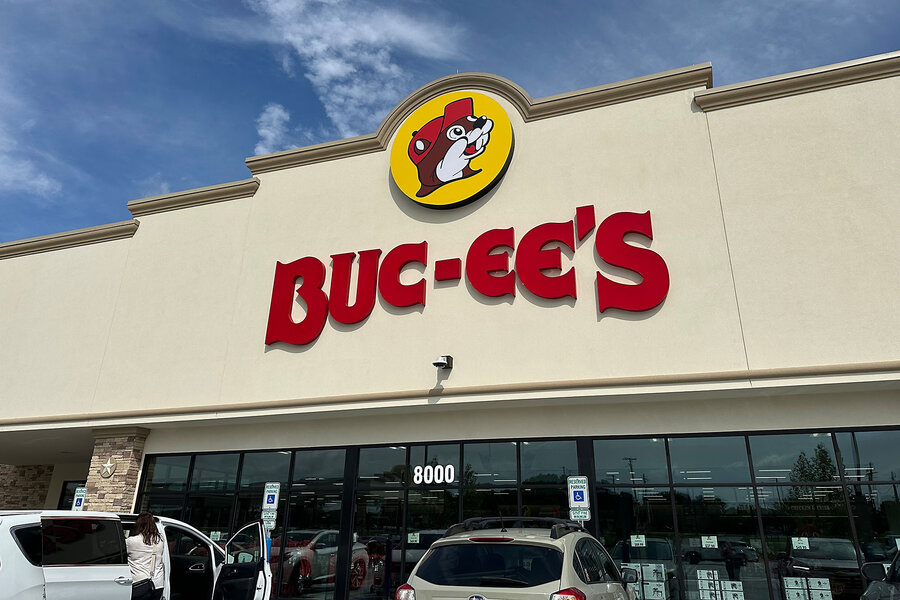
In just two decades, the gas-and-more travel stop called Buc-ee’s has gone from Texas phenomenon to national roadside empire and interstate institution.With its brisket tacos, “Beaver nuggets,” aisles of retail delight, and huge, pristine restrooms, the chain and its buck-toothed beaver logo promise weary drivers a Texas-size roadside experience. For many, the company’s cartoon mascot, plastered on billboards with slogans like “RISK IT FOR THE BRISKET,” has also helped fuel Buc-ee’s explosive post-pandemic growth and rap as a road-trip oasis, complete with cheaper-than-average gas.But that growth into 13 other states has also revealed a different side of Buc-ee’s. Alongside a taste of Texas, there’s a side to the beaver with less cuddle and sharper claws. Why We Wrote This The roadside oasis Buc-ee’s is known for brisket tacos and immaculate bathrooms. But the company’s lawsuits over its beaver logo fuel debate over the balance of power between national and local brands. The rest-stop company has filed more than a dozen trademark lawsuits, including four this year alone, arguing that other business logos – many of them on smaller regional shops and featuring alligators, bears, and moose – infringe on its branding.Trademark fights are nothing new, and piggybacking on popular design ideas is an entrepreneurial tradition spanning from Apple (a long-running music-versus-tech dispute) to Zara, the fashion brand that has faced numerous copyright or trademark claims. Customers at the Buc-ee's location in Huber Heights, Ohio, pose for photographs with the company's mascot on Aug. 14, 2026. But Buc-ee’s aggressive defense of its cartoon beaver logo represents an unusually bold effort to protect its brand identity. The chain’s enforcement efforts have drawn criticism from consumers as well as competitors.“A positive, lovable brand is of extraordinary value, and to compromise that over these lawsuits that are I think rightly characterized as pushing the little guy around is bad business,” says Cal Jillson, a political scientist at Southern Methodist University in Dallas.Lit like a Friday night football game, Buc-ee’s outlets have expanded with blazing speed, mostly across the South and Midwest. The chain gained global visibility during this summer’s World Cup, when fans marveled at its offerings. A standard store has nearly 60,000 square feet of retail space, giant restrooms staffed by a 24/7 cleanup crew, some 100 gas pumps, and oversize parking spaces to better accommodate the pickup trucks many Texans drive. Then there’s the food: the aforementioned Beaver Nuggets (the chain’s signature caramel-coated corn puffs), Texas brisket sandwiches, a wall of packaged beef jerky, and fresh-baked goods make it an obsession for many road-trippers, who might leave in new pajamas with a new pillow, game, or camping gear.With more than half of its stores in Texas (including its 75,000-square-foot Buc-ee’s Travel Center in Luling near San Antonio, the largest convenience store in the world), Buc-ee’s generally targets conservative-leaning areas that often have less red tape, lower taxes, and open policies toward big construction projects.But as it has expanded, Buc-ee’s has also faced pushback, at times due to the local impacts of its facilities, and at other times because of its legal campaigns.Where the Buc-ee’s stops?Earlier this year, after months of contentious meetings, legal challenges, and upheaval over lighting and conservation measures, Buc-ee’s modified abandoned plans to open a travel center in El Paso County, Colorado.After Buc-ee’s sued Beaver’s Mini Mart in Beavercreek, Ohio, this year, the Beavercreek City Council pushed back. It unanimously passed a resolution in August making the beaver an official part of its history, reclaiming its namesake. The local school mascot, Bucky the Beaver, made an appearance. A customer walks into Beaver's Mini Mart in Beavercreek, Ohio, Aug. 14, 2026. The convenience store's full-bodied beaver logo has drawn a lawsuit from Buc-ee's over what the Texas-based chain says is copyright infringement. Peter Wiley, co-founder of Ohio-based Hot Head Burritos, helped organize fundraisers for Beaver’s Mini Mart, where T-shirts with beaver logos were sold to help with the legal defense.“We relate to being the small guy,” says Mr. Wiley. “It is frivolous and frustrating from a small business standpoint: ‘Seriously, you’re going to come sue me when I have a mini-mart without a gas pump that says something related to a beaver?’ To see that [Buc-ee’s has] been doing that around the country, it tarnishes my opinion of the brand.”In an interview with a Dayton, Ohio, TV station, Buc-ee’s founder Arch “Beaver” Aplin III defended the lawsuit, calling it a necessary maneuver sparked by trademark actions by Beaver’s Mini Mart. (The local store, in fact, had filed state paperwork for tax purposes for a name that had been in effect since 2019.)And in north Georgia, the owners of a new business called “Teddy’s Market” fired back this summer after Buc-ee’s sued about its bear logo. They alleged that Buc-ee’s lifted its own image from a trademarked beaver featured in old Ipana toothpaste ads. Buc-ee’s, one Teddy’s filing said, is a “trademark bully.” (In its lawsuit, Buc-ee’s also contends that “Teddy’s” is too close to “Buc-ee’s.”)Buc-ee’s did not respond to a Monitor inquiry for this article.Alligator versus beaverBuc-ee’s aggressive tactics have worked before. In 2018, the company scored a home-state victory against another convenience store after convincing a Houston jury that a “friendly smiling cartoon animal similarly oriented within a circle and wearing a hat pointed to the right” infringed on Buc-ee’s trademark beaver – even though the animal in question was an alligator.“There are a lot of reasons that bullying is a productive strategy” for corporations, says Alexandra Roberts, a law professor at Northeastern University in Boston. “It kind of pays off.”But those strategies also have limits.Trademark law is based on a series of tests around the likelihood that a rival invention or logo can cause customer confusion. Successful brands such as Buc-ee’s, for example, can create customer familiarity that might spur copycats looking for shortcuts to gain market share.In the Beaver’s Mini Mart case, a central question is whether Buc-ee’s face of a beaver with buck teeth and a red baseball cap could be confused with the Ohio store’s mascot: a full beaver, unclothed, on a white background.“When trademark law is used well, it’s supposed to help consumers navigate the market,” says Mark McKenna, a professor at the University of California’s Institute of Technology, Law & Policy in Los Angeles. “But using [the law] to prevent uses that are not going to cause confusion and as a competitive weapon ... is contrary to its purposes. That’s what people are reacting to.”Professor Roberts agrees: “What’s happening now is people are highlighting for juries and others the extent of the bullying and the ridiculousness of saying, ‘We have a beaver, so you can’t have a moose.’”
Buc-ee’s gas stops are beloved. But has its beaver become a ‘trademark bully’?
Full Article
Original Source
Read the full article at Csmonitor →KhanList aggregates and links to publicly available news content. We do not host full articles from third-party sources. Always verify important information with original sources.