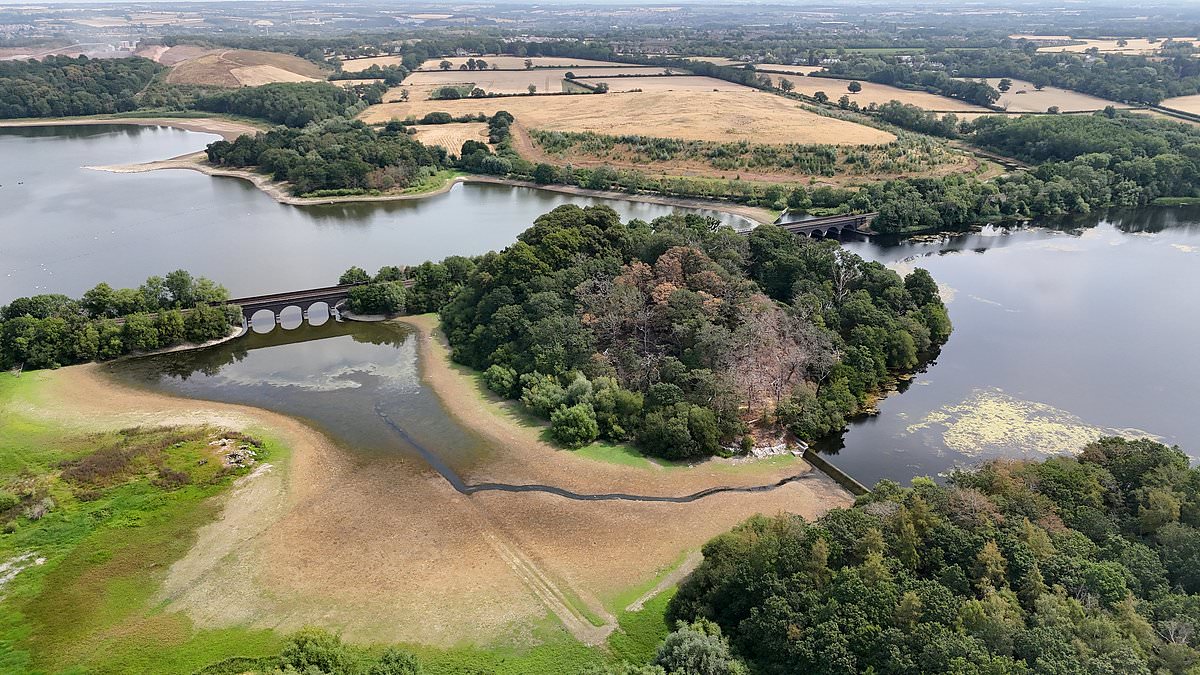
The next 10 days of weather are crucial in determining the impact of record-breaking dry and hot conditions on food supplies in Britain, farmers have warned. The South-East has seen the longest spell of no rainfall for more than 30 years, while England as a whole has had just 3 per cent of its long-term average July rainfall - and 23million people across the country are now under or facing hosepipe restrictions.Three heatwaves have brought the UK's hottest ever days in May and June, while the latest one earlier this month saw 12 consecutive days of temperatures above 30C.Now, the National Farmers Union (NFU) has warned that 'the next week to ten days could have an impact' on food supplies given some areas have not yet harvested.Cucumbers are also under threat after extreme heat in Spain and Morocco led to an overreliance on Dutch imports where suppliers are charging over £1 per vegetable. The National Drought Group has revealed this year's extreme conditions have had a 'severe impact on our environment and affecting water supplies and food production'.The organisation - which brings together the Met Office, government, regulators, water companies, farmers and conservation experts - said harvests have begun early and the heat was increasing the risk of fires breaking out in combine harvesters.The high temperatures are also said to be causing moisture issues for cereals while spring barley yields are set to be impacted by a lack of rain earlier in the season. Swithland Reservoir in Leicestershire yesterday, which Severn Trent says is at 44% capacity Parched fairways at Scraptoft Golf Club in Leicestershire yesterday as dry weather continues Visitors enjoy the hot weather at East Cliff beach in West Bay, Dorset, yesterday afternoon Scorched and parched grass at Cannizaro Park in Wimbledon, south-west London, yesterday People queue for ice cream at the Farnborough International Airshow in Hampshire yesterdaySome farmers in East Anglia, where it has been very dry, have had to stop abstracting water from local rivers because of the reduced flows caused by limited rainfall. An NFU spokesman told The Independent: 'Some areas haven't harvested yet so what happens over the next week to ten days could have an impact. We're asking the Environment Agency to be flexible when it comes to abstraction.'South-east England has now seen the longest unbroken spell of no recorded rainfall since 1995, with an average of zero rainfall measured across the organisation's weather stations in the region for 17 days in a row.London has now not had rain for 25 days since June 27 – while Wisley in Surrey holds the current record, having had 34 consecutive dry days.NFU deputy president Paul Tompkins said: 'Farmers and growers across the country are working around the clock to harvest crops which have come early, keep fruit and vegetables watered, and care for their livestock. Hosepipe bans across the UK this summer Anglian Water: Hosepipe ban for five million customers across eastern England in placeAffinity Water: Hosepipe ban across central area, covering Bedfordshire, Buckinghamshire, Essex, Berkshire, Hertfordshire, Surrey and parts of London in place. Company has a total of 3.9million customers.Cambridge Water: Hosepipe ban for its 350,000 customers in place.South East Water: Hosepipe ban for 850,000 people in Kent already in place. Extended to 2.4million people across Sussex, Surrey, Hampshire and Berkshire from Saturday. Southern Water: Hosepipe ban for one million people in Hampshire and the Isle of Wight in placeThames Water: Hosepipe ban for 10.1million customers across London, the Thames Valley and the home counties in place from today 'Parts of the country, particularly in the east and south, have seen exceptionally low rainfall this spring and summer, creating real challenges for farm businesses.'For many arable farmers, this could be another difficult and expensive harvest after extreme weather impacts in both 2024 and 2025 which saw both drought and flood.'To help farmers adapt, we must strengthen resilience to climate volatility. That means a more responsive abstraction licensing system, a consistent positive approach in planning to make building reservoirs easier, which will lead to investment in on-farm water storage.'Extreme heat across Europe and North Africa has caused a shortage of cucumbers in the UK, according to the Lea Valley Growers Association (LVGA).Its secretary Lee Stiles said: 'Reports of early aborted flowers in Spain and Morocco due to the heat has meant that Holland is the main cucumber market at the moment.'The Dutch are charging over £1 per cucumber at present and therefore the supermarkets can either pay the price or choose to have a lack of supply and empty shelves.'We have been here before many times due to climate change and global conflict and it once again highlights the importance of British food security.'The LVGA represents 75 per cent of the UK cucumber crop, but the country is just 20 per cent self-sufficient for the vegetable.The Met Office expects some parts of the North and West could start to see some rain from this weekend, although conditions will remain warm and dry in the South.Chief forecaster Steve Willington said: 'The high pressure has been a key feature of the UK's weather forecast over the last few weeks, bringing above-average temperatures and extremely dry conditions for many.'However, we will begin to see a modest change as a weak weather front pushes south across the UK on Saturday bringing some much-needed rain, albeit it light and mainly concentrated in the North and West.'Behind the front a showery air mass will bring potentially heavy showers some of which may be thundery.'Next week some Atlantic dominated weather fronts will push in from the West and bring some rain, but there will also be brighter spells bringing temperatures in the mid-20Cs.Met Office deputy chief forecaster Greg Wolverson added: 'Although there is a return to rain in the forecast, we have just come out of an exceptionally dry spell and the forecast rain is unlikely to be widespread or substantial.'Many areas are likely to continue experiencing prevailing dry conditions for the foreseeable future, especially in southern England.'It comes after the Environment Agency said 'prolonged dry weather' has now been declared in East Anglia, the West Midlands, Devon, Cornwall, Lincolnshire and Northamptonshire, Hertfordshire and London, Wessex, Thames, Solent and the South Downs.This means these eight areas are one stage away from official drought status, as dry and hot conditions continue for large parts of the country.Six reservoirs are also classed as having 'notably low' levels, the regulator said, including Wimbleball in Somerset, Grafham in Cambridgeshire and Hanningfield in Essex.Only 13 per cent of rivers are classed at normal levels for this time of year, with the Avon (Hampshire), Cam, Derwent (Yorkshire), Swale, Tone, Wye and Yare seeing exceptionally low levels.There have been 28 days in 2026, consecutive and non-consecutive, when 30C has been exceeded somewhere in the UK: seven in May, eight in June and 13 in July. The Thames Water hosepipe ban covers the 10.1million customers that the firm supplies across London, the Thames Valley and the home counties. These areas are marked in blueJoin the discussionIs Britain doing enough to protect our food supplies in the face of extreme weather and water shortages?What's your view?The record for the number of 30C-plus days in a calendar year is 34, which was set in 1995. It comes as Britain's biggest water company implemented a hosepipe ban for 10.1million customers.Thames Water said the restriction, also known as a temporary use ban (TUB), came into effect at 12.01am on Thursday.The ban applies to all customers that it supplies with drinking water across London, the Thames Valley and the Home Counties – but not to waste-only customers.It means hosepipes should not be used for watering gardens, cleaning cars or windows, or filling paddling pools, hot tubs or swimming pools.The company is the latest in a string of utilities to announce a temporary use ban in recent weeks.Officials say 23million people across England are now under or facing restrictions.On Monday, South East Water announced that a hosepipe ban in Kent will be extended to parts of Surrey, Sussex, Hampshire and Berkshire from Saturday.Bans are also in place for Southern Water customers across Hampshire and the Isle of Wight and South West Water customers in parts of Devon and Lyme Regis in Dorset.Customers of Cambridge Water, Affinity Water and Anglian Water, which supply areas in the East of England, have also introduced restrictions.
British farmers issue 10-day warning over food supplies as record-breaking dry weather continues and London hosepipe ban begins TODAY
Full Article
Original Source
Read the full article at Dailymail →KhanList aggregates and links to publicly available news content. We do not host full articles from third-party sources. Always verify important information with original sources.