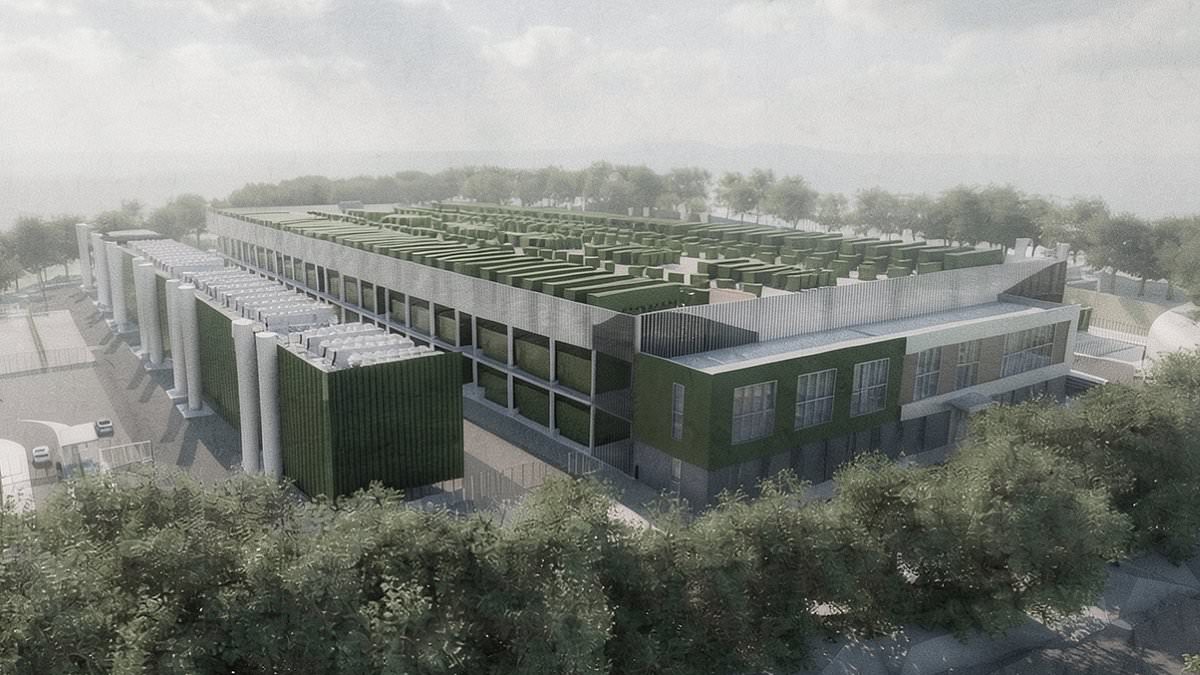
Poppies in full bloom - thousands of them - cover the field in a crimson carpet, bobbing and swaying in the summer breeze. A wide Norfolk sky looms overhead, dotted with cotton-wool clouds. It's a spectacular sight. But fast forward six years, and the scene has been transformed beyond recognition. The field has been stripped bare and levelled - transformed from a rural idyll into a barren expanse of sun-baked dirt. Located near the village of Keswick, just south of Norwich, the farmland is being repurposed to serve a new, more lucrative industry: artificial intelligence.Covering seven acres, the Norwich Apex Data Centre is set to become one of the UK's largest data centres, packed with high-tech equipment whirring around the clock to further the Government's vision of an advanced, AI-driven economy. But the plans face a significant roadblock in the form of 7,000 local residents who have signed a petition opposing the new site - among them BBC broadcaster Jake Humphrey. They say the data centre - which on architectural renderings resembles a cross between a warehouse and a multi-storey car park - will ruin the area's rural character, harm wildlife, and create intolerable noise and traffic. The site will use enough energy to power 10,000 homes and draw on local water supplies for cooling, although developers insist it will operate a 'closed-loop' water circulation system that, once full, will not consume any more water. Poppies growing in the field which is proposed to be the site of a new data centre at Keswick near Norwich The first photo was taken in 2020. This is what the site looks like today as it is prepared for development On architectural renderings, the site resembles a cross between a warehouse and a multi-storey car park Far from being a purely local issue, the dispute is the latest front in a wider war pitting AI proponents - led by the Labour Government - against a coalition of local people, councils and campaigners defending their vision for the British countryside. To American ears, this will all sound wearily familiar. Having birthed the tech giants that run the world's leading AI systems, the US is at least four years into a data centre building boom, with more than 1,500 data centres at various stages of development.This has sparked a major grassroots backlash, bringing together Americans across the political spectrum to call for a development freeze. Senior politicians, who are generally cheerleaders for AI, have been forced to take note, and the issue is expected to play a central role in the upcoming midterm elections. Data centres are far from rare in the UK, which by some measures has the third-highest number in operation after the US and Germany. But with the number of projects still lagging far behind America, data centres have yet to become the political flashpoint they are across the Atlantic. That may soon change. On top of the UK's estimated 477 existing data centres, another 100 are in the planning pipeline, and most are set to be built within the next five years - according to market intelligence firm Barbour ABI. Given their need for land and large amounts of energy - far more than some crowded urban electricity grids can provide - data centre developers favour rural locations. And so we return to the Norfolk village of Keswick, where proposals for the 150MW Norwich Apex Data Centre have encountered stiff opposition after being put to a public consultation. Villagers in Keswick say they want to protect the area's rural character An aerial view of the site, which has not yet been submitted for planning approval BBC presenter Jake Humphrey insisted he is not 'anti data centre' but the site is located in the wrong place Join the discussionShould the countryside be sacrificed for high-tech progress, or are we losing something too precious?What's your view?The development is close to Marston Marsh nature reserve, a 64-acre stretch of floodplain and grazing marsh teeming with water voles, wetland birds, dragonflies and otters. Residents also fear it will ruin the rural character of their area and lead to it being 'sucked' into urban Norwich. Jake Humphrey, the former CBBC presenter turned host of BBC Sport's coverage of Formula One, is the development's most prominent critic. He told the Daily Mail: 'This landscape is precious because it is one of the last places where Norwich still arrives gently. 'It is rural, it is quiet, and it has an unspoilt character that has been shaped over time. That is why a data centre feels so totally out of place here.'A huge, secure, power-hungry industrial facility does not belong beside marshes, river valleys, historic churches and rural homes. However it is dressed up in planning language, it would fundamentally change the feeling of this whole area.'It would bring scale, noise, light, fencing, substations, generators, traffic and a sense of permanent industrialisation to south Norwich that is currently defined by openness, nature and history. And once that is gone, it is gone forever.'A father of two, Mr Humphrey, 47, insisted he was not 'anti data centres' but simply trying to protect a beloved local landscape. 'You cannot tell future generations we protected Norfolk if we allow this. This is not an argument against technology.'It is an argument for putting things in the right place. A data centre may be necessary somewhere, but it is completely wrong here. This landscape is too rural, too historic, too sensitive and too precious to be sacrificed.'The centre is being proposed for a triangle of land beside the A140 between Ipswich and Norwich, opposite a large Tesco. The area was originally given planning consent by South Norfolk Council to become a business park, and had vegetation cleared away and preparatory groundwork started before it suddenly stopped several years ago. Developers say the centre will bring 'highly skilled jobs' and support 'the digital services people use every day'. They have also promised measures to reduce noise and hide the site using plants and trees. No planning application has been submitted yet, but many residents fear local opposition will be ignored and the project will be waived through by the Government.Such concerns are far from unwarranted. Last week, residents of Southfleet in Kent received letters through their doors informing them of plans to build Ebbsfleet AI Data Centre, which will sit on 145 acres of former farmland just outside the village. While many plan to object, they may find their calls unheeded after the project was deemed to be of 'national significance' - allowing developer Clearstone Energy to go straight to ministers for permission instead of seeking approval from the local council. The designation, previously reserved for critical infrastructure such as roads and railways, is intended to speed up the processing time for data centre applications by up to a year. Simon Rothwell, project manager for the Ebbsfleet AI Data Centre Campus, said local people would be consulted at every stage of the development and promised a 'community benefit package' to sweeten the deal.What developers cannot be accused of is seeking to do things on the cheap. A wall of cash from investment firms and tech giants like Google and Microsoft means these projects are well funded, with £3billion budgeted for the Southfleet site alone.Big figures are also being floated for the claimed benefits that data centres will bring to the wider economy. One company, Xlinks, claims a data centre and battery storage site it is planning in Devon will contribute £3.6billion to the national economy and create between 600 and 1200 jobs. Not that residents in the nearby town of Great Torrington are convinced. They claim these benefits are being exaggerated and will be vastly outweighed by the cost of losing an astonishing 850 acres of countryside. Xlinks - which was previously behind a stalled bid to bring renewable energy to the UK from Morocco via sub-sea cables - said the data campus buildings would cover only a third of the site.Matt Whittaker, who attended a public meeting, vowed to put up a fight. 'Everyone is up in arms, but we are doing it in an intelligent way,' he said. 'We are driven by emotion, but we are not distracted by our hearts. It won't just destroy the town, it's far bigger than that.' One site is planned for the former Truman Brewery in the heart of London's iconic Brick Lane The derelict brewery building where developers want to build a data centre to facilitate high-frequency trading Jamal Khalique, who was born in Brick Lane in 1970, urged housing secretary Steve Reed to reject the plansMost new data centres are clustered around London and the Home Counties. Although the biggest planned sites tend to be in the countryside, some are in cities.One such site is planned for the former Truman Brewery in the heart of London's iconic Brick Lane. Known for its curry houses and buzzing nightlife, the area could soon find itself sharing the streets with a less convivial neighbour - a 56,682-square-foot data centre processing high-frequency financial trades in the City. Documents suggest the centre will only have 15 full-time employees, prompting locals to insist it will 'bring nothing' to the area. Jonathan Moberly, a resident and member of the Save Brick Lane campaign group, said: 'This is right in the middle of a central London area where we have a social housing waiting list of 31,000 people.'With 15 people being employed, surrounded by stacks of computers, how on earth will this in any way benefit the local community? It simply will not.'The proposals show the datacentre's peak output would be 5.2MW, which campaigners say would be enough to provide energy to around 15,000 homes.Tower Hamlets Council rejected the £500million development. But housing secretary Steve Reed 'called in' the application, allowing him to have the final say. Jamal Khalique, who was born in Brick Lane in 1970, urged him to reject the plans. 'We are a very close-knit community here - nobody wants the extra noise and vibrations from this centre, he said. 'It will hardly have anybody working in it so there will be no benefit from footfall for local businesses.'The bustling streets of East London may seem to have little in common with the green fields of Norfolk, Kent or Devon, but the battle lines being drawn are strikingly similar.So will the AI advocates prevail? Or will local communities succeed in slowing the tide? Whatever the outcome, it will shape Britain's future for decades to come.
Britain's data centre hellscape beckons: Humming warehouses which dwarf the countryside use enough energy to power 10,000 homes and draw on water supplies...and one could be coming next door to you
Full Article
Original Source
Read the full article at Dailymail →KhanList aggregates and links to publicly available news content. We do not host full articles from third-party sources. Always verify important information with original sources.