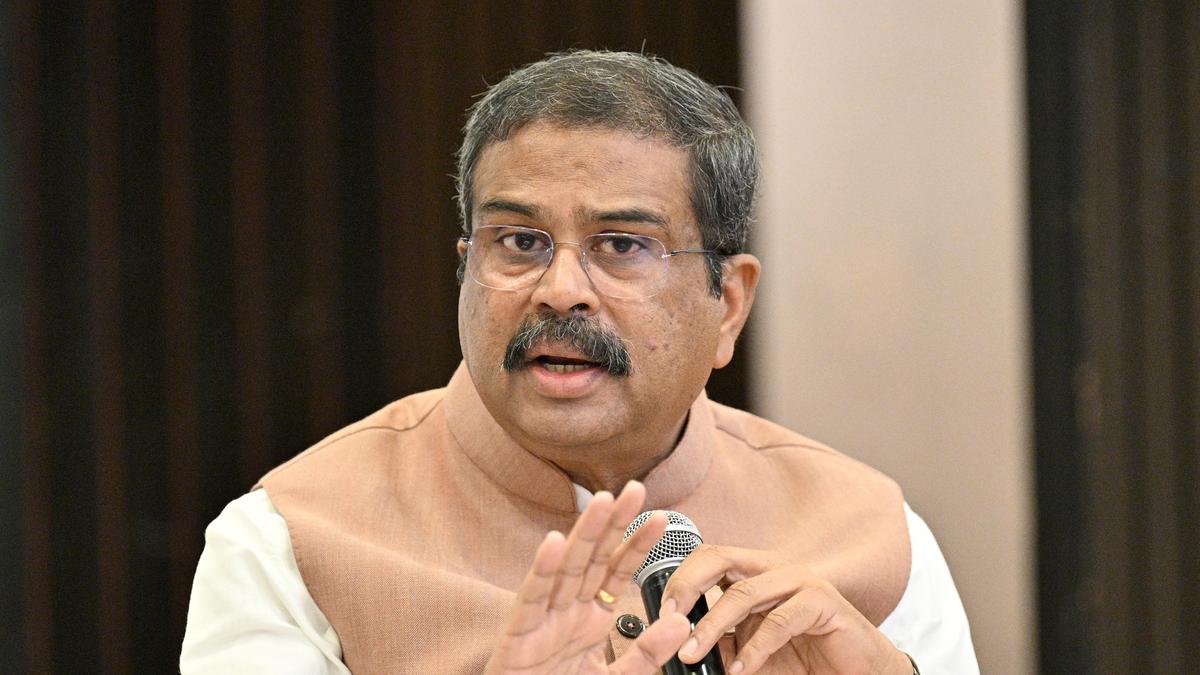
Former Education Minister Dharmendra Pradhan. File | Photo Credit: Shashi Shekhar Kashyap Dharmendra Pradhan’s exit as Education Minister has been under a cloud, but his five-year tenure was marked by a ramping up of efforts to implement the National Education Policy (NEP) 2020, which the Union Cabinet had accepted a year before he took charge. Earlier, at the Petroleum Ministry, he had made his mark on programme implementation by delivering eight crore LPG connections to poor households in three years against a four-year target.From the National Curriculum Framework (NCF), flexible learning and multidisciplinarity, and the Vikshit Bharat Shiksha Abhiyan (VBSA) replacing the UGC in higher education, to PM SHRI, the three-language formula and new teacher-training initiatives in school education, his Ministry was constantly in the news introducing “reforms”. Common threads ran through them: performance evaluation and accountability, skilling-education convergence, promotion of a certain vision of Indianness, ambition undercut by implementation challenges, and a push for uniformity that critics called centralisation and a disregard for diversity. Almost all remain works-in-progress that the new Education Minister will have to carry forward.Through Nipun Bharat, formally launched by Mr. Pradhan’s predecessor on the heels of pandemic-era learning losses, the government was finally acting on decades of evidence from surveys by voluntary organisations that India’s schoolchildren were lagging far behind in reading and mathematics despite formally graduating year after year. It seeks to ensure every child attains foundational literacy and numeracy by the end of Grade 3, by 2026-27. ASER 2024 showed a seven-percentage-point gain in numeracy since 2018, and PARAKH 2024 found Grade 3 students who benefited from the mission’s first three years outperforming Grades 6 and 9 in language and math. Yet fewer than a quarter of students nationally could read a Grade 2 text, and Grade 5 levels remained roughly where they were pre-pandemic — a sign of implementation gaps that may well necessitate a Nipun Bharat 2.0.The National Professional Standards for Teachers (NPST) is India’s first initiative to assess and classify teachers — as proficient, expert or advanced — against uniform national standards, with career progression tied to this ladder. The National Mentoring Mission (NMM), meant to identify mentor teachers to guide others up this ladder through nomination and volunteering, is being rolled out with online sessions, but awareness among the country’s one crore teachers remains low and impact assessments are yet to be formalised. The NPST itself has not been rolled out, leaving teachers little incentive to engage with the mentoring sessions.Some initiatives drew sharper controversy. The 2025 draft UGC regulations on appointing teachers, vice-chancellors and staff faced strong opposition — notably for giving Governors a decisive say in vice-chancellor appointments and for removing the cap on contractual professorships. Separately, the UGC’s new undergraduate and postgraduate degree rules, built around flexibility and multidisciplinarity to create a skilled workforce, have been formally in force since the 2025 academic year — but institutions across States are still barely grasping radical concepts such as a commerce student studying science, or transferring credits across colleges via the National Credit Framework.An example of education-skilling convergence is the Swayam Plus platform that offers over 500 industry-developed courses across 15 sectors, including emerging technologies. R. Sarathi, Dean (Planning), IIT Madras and Coordinator, Swayam Plus, says some 6.5 lakh students are registered and the “AI for All” initiative with courses such as AI for Physics, AI for Chemistry, AI in Accounting, AI for Educators, and AI/ML using Python have draw one lakh participants. Prof. Sarathi is seeing encouraging response from education institutions accepting industry credits that these courses bring.Mr. Pradhan also pushed to steamroll NEP adoption — particularly the three-language policy — by tying Central funding for primary education schemes to compliance. Tamil Nadu remains a holdout, though West Bengal’s new government has accepted it. In CBSE schools, Mr. Pradhan directly mandated the learning of two Bharatiya languages from Classes 6 to 12, prioritising Indian languages over English. Some relief has been granted to current students, but the government has held firm on this as the norm going forward — even though NEP, in the same breath as it champions Indian languages, also emphasises the learning of English and other foreign languages. Published - July 27, 2026 04:07 pm IST
Beyond Jantar Mantar: The Dharmendra Pradhan report card
Full Article
Original Source
Read the full article at Thehindu →KhanList aggregates and links to publicly available news content. We do not host full articles from third-party sources. Always verify important information with original sources.