
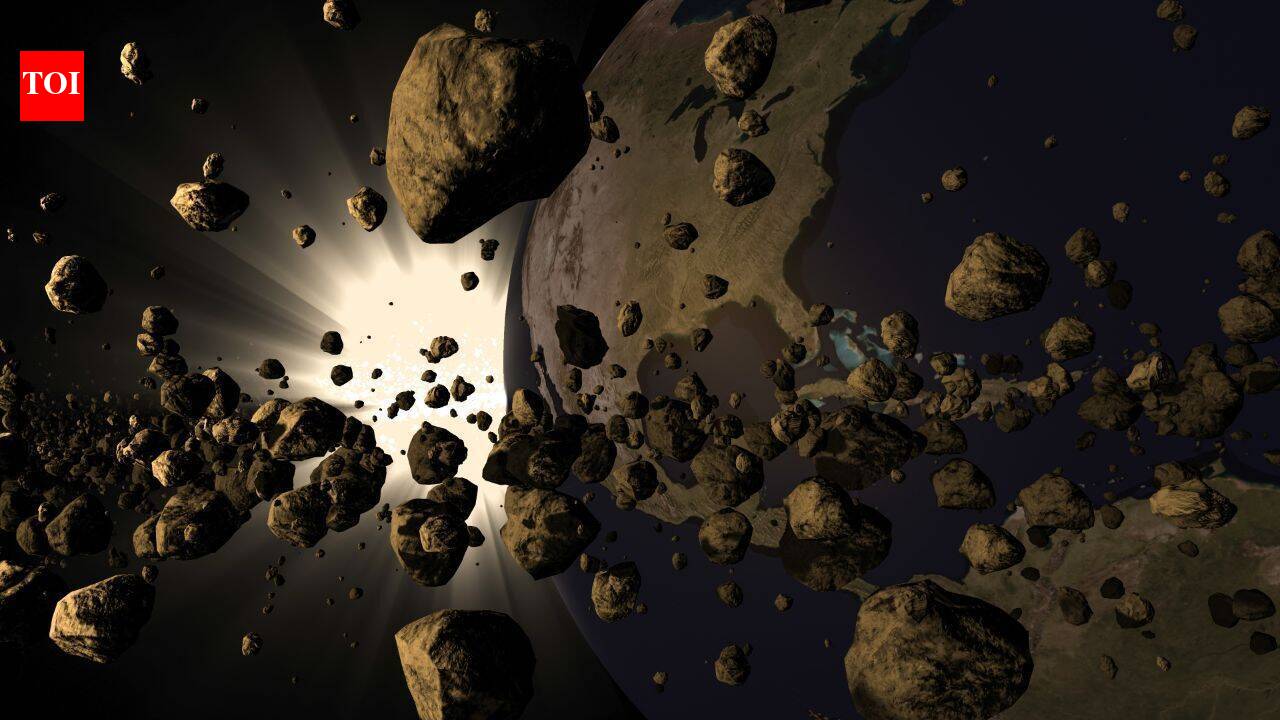
Space has a curious way of reminding us that our origins may be far more complicated than we imagine. Somewhere in the vast darkness between planets, tiny space rocks have been carrying clues about the early solar system for billions of years. Scientists have been searching for ways to source this cosmic material to form a repository of materials that appear at various spaces in our solar system.In Spetember 2023, NASA's OSIRIS-REx spacecraft returned pieces of asteroid Bennu to Earth. It was observed that the dust from the asteroid contained amino acids that belonged the early life of our solar system. Researchers also compared the samples from Bennu with a meteorite that fell to Earth in 1969. The differences in isotopic figerprints suggest that these materials may have formed in separate regions of the early solar system, under different chemical conditions.A space traveller called BennuBennu is a near-Earth asteroid, roughly 500 metres across, that has attracted considerable scientific attention. It is considered a primitive asteroid, meaning its material preserves clues from the earliest stages of the solar system, which formed around 4.6 billion years ago.NASA's OSIRIS-REx mission was launched in 2016 with the aim of travelling to Bennu, collecting a sample from its surface and bringing it back to Earth for detailed examination. The mission was successful as the spacecraft reached Bennu in 2018 and collected material in October 2020. Finally, on September 24, 2023, it delivered the materials to Earth for researchers to study. The mission was particularly significant as it allows scientists to study the material with sophisticated lab instruments that are difficult to send into space. The samples received contained crucial information including some water-bearing minerals, carbon-rich compounds and amino acids.The 1969 meteorite that became an unlikely comparisonOn September 28, 1969, fragments of a meteorite fell near the town of Murchison in Victoria, Australia, hence the name Murchison meteorite. After research, scientists found that it was rich in organic compounds and amino acids.The research team compared amino acids from Murchison with those collected from Bennu. An element known as beta-alanine, an amino acid-like molecule found in extraterrestrial samples is being used as the primary source of comparison.What exactly are atomic fingerprints?The differences in masses in atoms of the same element due to a different number of neutrons create isotopes of a chemical element.(Image Credit: Canva)For instance, carbon has different isotopes, including carbon-12 and carbon-13. Both are carbon, but carbon-13 is slightly heavier. By measuring the proportions of these isotopes, scientists can uncover clues about where a molecule came from and the chemical conditions under which it formed.The researchers used specialised instruments to examine the carbon and nitrogen isotopes in beta-alanine. More importantly, they developed a way to study the carbon isotopes at different positions within the same molecule rather than simply calculating an average.The results were strikingAlthough the average carbon isotope values appeared remarkably similar, looking at individual carbon positions revealed substantial differences. The nitrogen isotope measurements also differed between the two samples.The study found that despite showing broadly similar patterns of isotope distribution within beta-alanine, the Bennu and Murchison samples had different isotopic compositions. This suggests that although the chemical process involved in the development of these molecules may be related, differences in environments within the early solar system may be responsible for variations.In fact, the difference between the samples was so pronounced that researchers believe the atoms may have originated from distinct chemical reservoirs.The findings were published on September 24, 2026, in Communications Earth & Environment under the research paper 'Nitrogen and intramolecular carbon isotopic measurements of β-alanine in samples from asteroid Bennu and the Murchison meteorite.'A different neighbourhood, a different recipeA vast rotating disc of gas, dust and ice eventually settled to form the Sun of our solar system. Further, the materials kept rotating around sun and started separating based on differences in density and temperature which led to the formation of planets, moons, asteroids and other celestial bodies.However, this disc was not chemically uniform. Different regions experienced different temperatures, radiation levels and chemical conditions. Some were extremely cold, while others were warmer and had access to liquid water.The researchers' findings suggest that organic molecules such as beta-alanine could have formed in different parts of this evolving environment. Even when the same molecule emerged through a similar chemical pathway, the ingredients involved could have carried very different isotopic signatures.The findings are particularly important because meteorites have been considered a reliable source to understand the chemistry of early space. However, the chemistry of meteorites that fall to Earth can change due to exposure to moisture, microorganisms and other environmental influences. Asteroid Bennu, on the other hand has never left space, which makes the research much more authentic.
Bennu and 1969 meteorite samples point to different birthplaces for amino acids
Full Article
Original Source
Read the full article at Timesofindia →KhanList aggregates and links to publicly available news content. We do not host full articles from third-party sources. Always verify important information with original sources.