
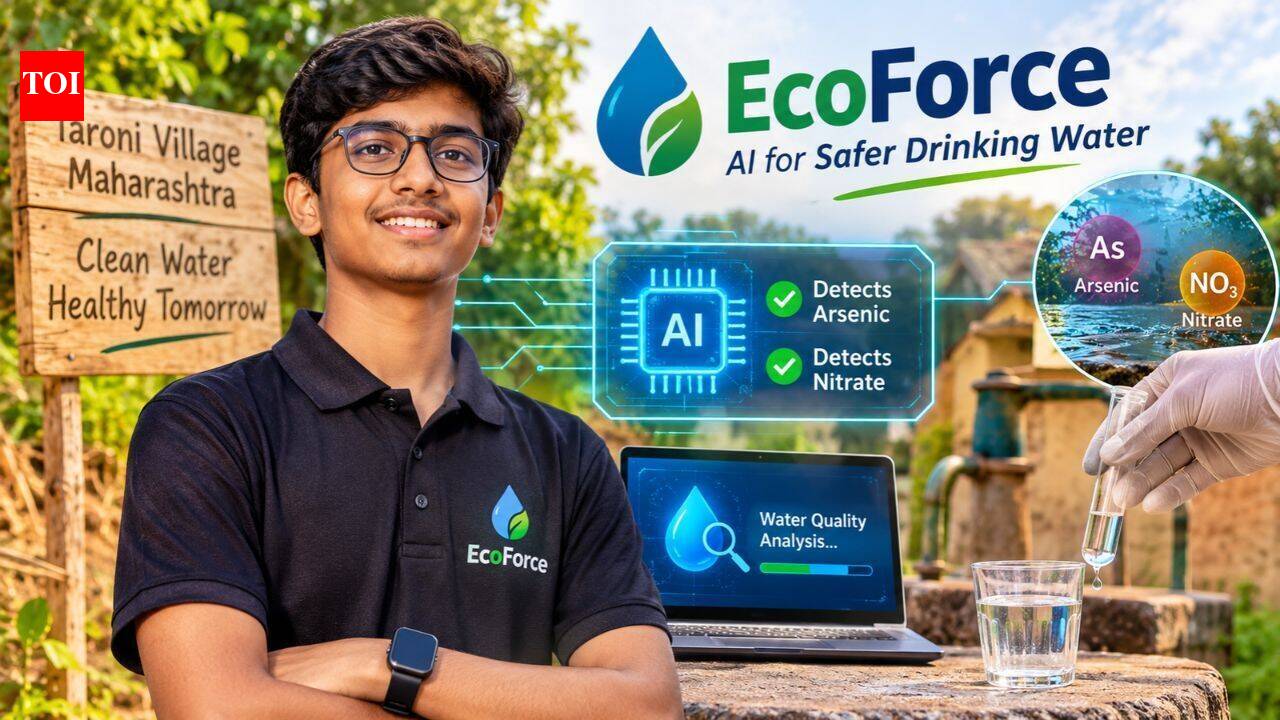
A village well can look clean and still contain contaminants that are difficult to identify without proper testing. For families who depend on groundwater for drinking and everyday needs, knowing what lies beneath the surface can make a significant difference.Seventeen-year-old Aditya Yadav, who grew up in Taroni village in Maharashtra, understands the importance of reliable water. Instead of treating water contamination as a problem that only scientists and government agencies could address, he began exploring how technology could make detection more accessible.His answer was EcoForce, an initiative built around an artificial intelligence-based system designed to identify contaminants such as arsenic and nitrate using limited real-world data. The technology has been tested on wells serving his village, bringing his research closer to the community that inspired it. Yadav's work earned him a place on the Diana Award's 2026 Roll of Honour, which recognises young people making a difference through social action. His project stands out for combining artificial intelligence with an environmental concern that directly affects rural communities.A village's water concerns inspire a technology-driven ideaGrowing up in Taroni, Yadav recognised how important safe and dependable water sources are to village life. Groundwater is a crucial resource for many rural households, but its quality cannot always be judged by appearance, taste or smell. Contaminants such as arsenic and nitrate may be present without obvious warning signs. Detecting them generally requires water samples to be tested using appropriate equipment and laboratory methods. For communities with limited access to testing facilities, identifying potential contamination can be difficult.Yadav began exploring whether artificial intelligence could help address this challenge. He founded EcoForce with the aim of developing a system that could work even when large quantities of water-quality data were unavailable. The idea was to make water contamination detection more affordable and practical, particularly in places where collecting extensive datasets can be challenging.How EcoForce uses AI to identify contaminantsOne of the biggest challenges in developing an AI-based water-quality system is the availability of reliable training data. Machine-learning models generally need large datasets to identify patterns and make useful predictions. However, such information may be limited in smaller villages. EcoForce addresses this problem through a combination of technical approaches. According to the Diana Award, Yadav's system uses physics-based data generation, Wasserstein generative adversarial networks (GANs) and fine-tuning.In simple terms, the system uses scientific principles to generate additional data and applies machine-learning techniques to improve its ability to recognise patterns associated with contaminants. This helps the model work with limited real-world information rather than depending entirely on large collections of previously tested samples.The system is designed to identify arsenic and nitrate, two contaminants that can pose risks when present in drinking water above permissible levels. Importantly, EcoForce is an AI-based detection approach, not a replacement for laboratory confirmation or a water purification system. Its purpose is to help identify potential contamination and support more accessible water-quality assessment.Why arsenic and nitrate detection mattersThe problem Yadav is addressing has wider relevance across India. Groundwater contamination remains an important public health and environmental concern, particularly in areas where households rely heavily on wells and other underground sources.A 2024 groundwater quality report prepared by the Central Ground Water Board and shared by the Ministry of Jal Shakti in Parliament examined samples from 15,259 monitoring locations across India. It found that 19.8 per cent of the samples had nitrate levels above the permissible limit, while arsenic exceeded the prescribed limit in 3.1 per cent of the samples.Maharashtra also faces groundwater quality concerns. In the report's 2023 state-wise data, 35.74 per cent of the 1,567 groundwater samples analysed for nitrate exceeded the specified threshold. For arsenic, 0.2 per cent of the 1,073 samples analysed were above the prescribed limit. These figures underline why affordable monitoring and reliable testing matter. However, they represent the samples analysed in the report and should not be interpreted as the proportion of all wells or households affected.From village testing to smarter water monitoringEcoForce has already moved beyond the idea stage. The technology has been tested on wells serving Taroni, allowing Yadav to explore its usefulness in the setting that motivated him to develop it. But he is looking beyond detection alone. According to the Diana Award, he is continuing research into plant-based water remediation, which explores how plants may help remove or reduce certain contaminants from polluted water.He is also working towards integrating Internet of Things (IoT) sensors into the project. Such sensors could support continuous water-quality monitoring, potentially helping communities track changes in their water sources instead of relying only on occasional checks. These developments are still part of his ongoing research, rather than a fully established village-wide monitoring network.For Yadav, EcoForce represents an effort to connect scientific research with a practical community need. His recognition through the Diana Award has brought wider attention to that work, but the larger goal remains rooted in Taroni. By combining AI, environmental research and local testing, the young innovator is exploring how technology can help rural communities understand the quality of the water they depend on every day.
Aditya builds AI tool to detect arsenic and nitrate in village wells using limited data
Full Article
Original Source
Read the full article at Timesofindia →KhanList aggregates and links to publicly available news content. We do not host full articles from third-party sources. Always verify important information with original sources.