
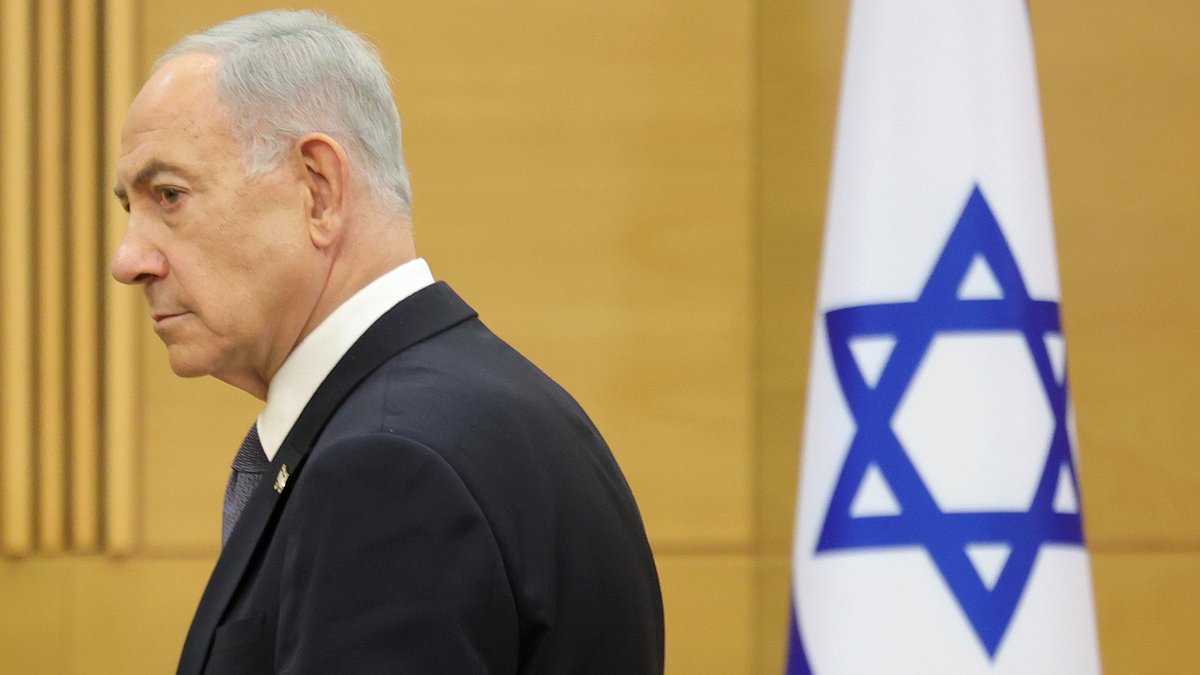
Israeli Prime Minister Benjamin Netanyahu has met with his rival for power sharing talks, after offering to step down in exchange for a role in the next government.Elections last month saw neither Mr Netanyahu, nor centrist party leader Gadi Eisenkot, win an overall majority.Mr Eisenkot, 66, was tasked with forming a government by President Isaac Herzog, and has since been trying to cobble together a coalition to oust Mr Netanyahu, 77, though has faced opposition to the idea of collaborating with Arab-majority parties.But yesterday, the outgoing leader tabled an offer: he would give up the reins in exchange for a position as 'rotating' alternative leader in a national unity government.This is an arrangement that allows two leaders from rival parties to take turns in the top job, rather than holding office at the same time.The pair were due to meet on Sunday morning at the headquarters of the Israeli Defence Force (IDF) to bash out the terms.Proposing the rotational alliance, Mr Netanyahu wrote: 'My responsibility as a leader requires me to set everything aside... and agree that Gadi Eisenkot will serve first as prime minister, while I will serve as alternate prime minister'.Mr Eisenkot said he was willing to hear the offer, responding with: 'If Likud [Mr Netanyahu's right-wing party] is ready for genuine unity, I am prepared to see how serious it is over the next 24 hours.' Benjamin Netanyahu has offered to step down if he is appointed as a rotational leader in the next government Gadi Eisenkot met with Mr Netanyahu on Sunday morning to listen to his proposalsThis came a day after Mr Eisenkot had vowed to announce the formation of a new government by the deadline of December 6, without using an option of a 14-day extension.Mr Netanyahu had previously insisted he was the 'natural' choice for the next term because he leads the largest party.However, he said he was prepared to set this aside 'given the magnitude of the existential threat and the possibility that a government incapable of confronting this threat will be formed'.Israel has previously formed three rotating prime minister agreements, though only two saw the scheduled handover of power.Shimon Peres of the Alignment party shared the top role with Yitzhak Shamir of Likud, with the former serving as prime minister between 1984 to 1986 before switching.Likud's Naftali Bennett served as prime minister from June 2021 for a year until handing over the reins to Yesh Atid's Yair Lapid until elections later in 2022.The deal that collapsed involved Netanyahu with Blue and White's Benny Gantz, in 2020, when their coalition came apart over a budget dispute.The talks come just two days after Mr Eisenkot accused Likud of stalling coalition talks in a bid to bring about new elections.'Likud... has been unwilling to compromise and, over two weeks, refused to put a single concrete proposal on the table,' he said.His wide-ranging camp has faced divisions over whether to forge alliances with the ultra-Orthodox parties, the Arab-majority lists, or form a unity government with Likud.Netanyahu opponents scoffed at his offer of a rotating premiership.Youssef Jabareen, leader of the Arab-majority Joint List, which is expected to support an Eisenkot-led government without joining it, wrote: 'The democratic majority has decided: this bloodstained, neglectful government must go.'It is time to fulfill the shared will of the entire public, Jews and Arabs alike, and remove Netanyahu this (upcoming) week.'Former premier Yair Lapid, co-chair of the centrist Beyachad party, said: 'Netanyahu's proposal is yet another transparent con by a serial fraudster who has deceived every partner and violated every agreement.'Eisenkot's Yashar party has so far agreed coalition deals with the left-leaning Democrats and the right-wing Israel Beiteinu party.Together, they have a combined total of 36 lawmakers - far short of the 61 needed for a majority in Israel's 120-seat parliament.Elsewhere, Israeli media reported Mansour Abbas, leader of the second Arab-Israeli party, Raam, is expected to recognise Hamas as a 'terror group' - a move that could pave the way for his party to join a possible Eisenkot-led coalition.Some of Eisenkot's allies have however voiced opposition to relying on the support of the Arab-majority lists, which made unprecedented gains in the election.
Benjamin Netanyahu meets rival for power-sharing talks after offering to stand down as Israel's prime minister to stay in government
Full Article
Original Source
Read the full article at Dailymail →KhanList aggregates and links to publicly available news content. We do not host full articles from third-party sources. Always verify important information with original sources.