
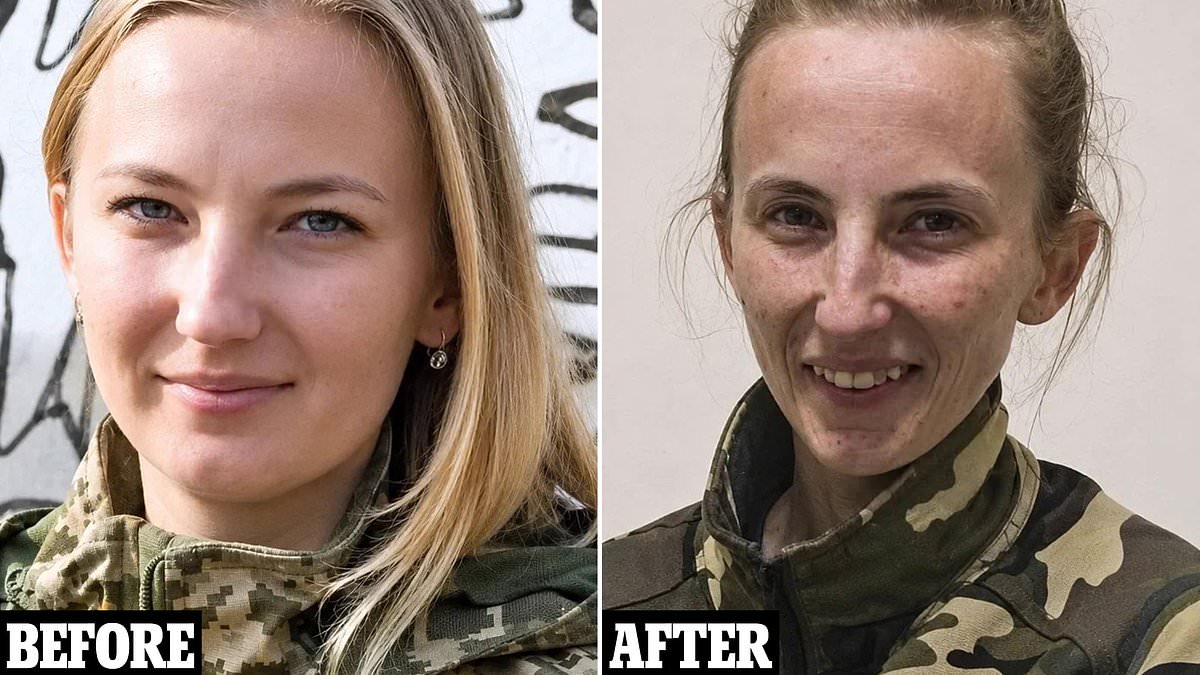
Nineteen months in Russian captivity left Ukrainian combat medic Halyna Hrytseniak, 31, with lasting damage to her physical and mental health. She was held for months in a freezing, dirty cell and fed maggot-filled porridge, while being forced to recite patriotic Russian songs.And the screams of fellow prisoners being tortured by Russian guards still give her nightmares, almost three years after her release.Speaking to the Daily Mail, Halyna, who has returned to serve her country despite the trauma she endured, recounted her harrowing ordeal as a prisoner of Putin's forces, whom she described as having no 'values or humanity.' Halyna was studying at a military university in 2014 during the start of the Russo-Ukrainian War, which saw the annexation of Crimea, an outbreak of war in eastern Ukraine and a domestic revolution inside the country.'Because of these events, I decided to become a military medic. Without a doubt, it was a pride and honour to serve my country,' she said.At the beginning of Russia's full-scale invasion in 2022, Halyna was part of the 36th Separate Marine Brigade's Marine Infantry Battalion, serving as a senior combat medic.She was stationed on the front line of defence in the field between the settlements of Vodiane and Pavlopil.She was later moved to Mariupol, where, as Russian forces encircled the city, she continued evacuating the wounded, including civilians. Halyna Hrytseniak pictured before (L) and after (R) her captivity. She lost 20kg (44lb) during her time as a prisoner Halyna returned to serve her country despite the trauma she endured as a POWDuring the 2022 Siege of Mariupol, Ukrainian soldiers and hundreds of civilians barricaded themselves inside the Azovstal steel plant's sprawling network of deep underground tunnels and concrete bunkers.She continued to treat injured soldiers even as medicine, disinfectants and food supplies dwindled.'There were many wounded. The fighting intensified significantly, and our positions came under heavy shelling. We had to withdraw to the outskirts of Mariupol.'The surrender and capture of Ukrainian defenders from Azovstal began on the night of May 16, 2022, following an order from Ukraine's military command to end combat operations and save the lives of the remaining troops.Halyna was one of those taken by Russian forces several days later and put on a bus heading towards the notorious POW gulag, Olenivka.'It was extremely unpleasant seeing the destroyed city, the Russian flag and their military personnel,' she said.'You are taken out of your own country, the country you were legally defending, and they arrive with war and turn you into a terrorist. This is our home. And we were forced to leave.'Upon arriving in Olenivka, Halyna was immediately subjected to brutal conditions. She was crammed into a cell with 29 other women despite it being built for only six, with so few beds available that many prisoners were forced to sleep on the floor. Meanwhile, the male soldiers who were taken captive were crammed up to 700 in a cell meant for 150.Fresh water was heavily rationed, with only a few bottles provided for the entire cell.'We economised as much as possible, but there were times when there was not enough water to drink, particularly when summer arrived.'According to Halyna, the food was so awful that calling it food would be generous. Prisoners were given maggot-filled porridge and watery soup with no meat, leading to severe malnutrition.Prisoners survived on meagre rations of bread, which was the only thing that kept them going, Halyna said. But with each passing month, they were given less and less.They were allowed to shower just once or twice a week, and rarely saw daylight, spending most of their time without even a glimpse of the sun. 'We were not taken outside at all for 17 days at one point,' she said.On one occasion, prisoners were forced to remain in their cells while the floor was covered in their own faeces due to the sewage system malfunctioning.When prisoners fell ill, they were treated by medics who were also imprisoned. All they had were whatever medications or items they managed to smuggle in from Azovstal. Halyna says she prayed every day to keep her sanity during those dark times Halyna bravely refused to speak Russian to her captors, even during interrogations when she was at the mercy of the guards After being transferred to a Russian prison in the autumn of 2022, Halyna saw the initially slightly improved conditions quickly deteriorate, replaced by severe physical and psychological torture unlike anything she had faced in Olenivka. 'I lost around 20 kilograms overall. In Russia, we were periodically weighed. After one of these weigh-ins, they increased my food portions.'Halyna was force-fed porridge while guards stood over her, but she says it was impossible to eat that much food.'My body simply could not accept such portions. Fortunately, this did not last very long.'The women had no proper hygiene products for their periods and were forced to use pieces of cloth.Prisoners in the camp were forced to comply with the guards' bizarre rules, like not being allowed to sit down in the cell and having to hold stress positions, including the splits.But by far the worst part of imprisonment was the interrogations. Halyna and others were subjected to physical, sexual and mental torture.'Women were sometimes tortured even more brutally than men,' she said, refusing to go into too much detail.Russian interrogators attempted to force Halyna to confess to crimes she had not committed, making her falsely admit that Ukrainian soldiers had tortured and murdered civilians in Mariupol.Halyna and her fellow prisoners were often kept up at night by the screams of others being tortured and beaten in nearby cells.Between interrogations, prisoners were forced to memorise Russian patriotic songs and poetry.'In Russia, there are no conventions, rules or even basic moral values of humanity,' she said.'What they do to our people there every day does not fit within any moral framework. It is difficult to accept for a civilised person who has never encountered such cruelty.'When asked how she kept her sanity during her time in Russia, Halyna said she and her fellow prisoners prayed every day.'We quietly sang our national anthem and Ukrainian songs,' she added, 'We dreamed a lot. And we knew that this would come to an end, that they would take us away from there and that we would return to our own country, while they would remain here in their own nedokraina (a derogatory Ukrainian term for Russia, meaning 'failed state').She bravely refused to speak Russian to her captors, even during interrogations when she was at the mercy of the guards.After one year, seven months and fourteen days in captivity, Halyna was finally released.On January 3, 2024, she was taken out of her cell and given back her clothing before being placed in a van.Halyna assumed she was being transferred to another detention facility. But she soon realised something was different when a female escort offered her water - a basic gesture of kindness she had not seen in almost two years.Moments after realising they had crossed into Ukraine, the POWs erupted in cries of 'Slava Ukraini!' ('Glory to Ukraine!') as Ukrainian flags were draped over their shoulders. Halyna was released on January 3, 2024 after spending one year, seven months and fourteen days in captivity Halyna has rebuilt her life, with her Instagram showing her vacationing in Spain, reading, painting and playing with a recently adopted puppy Halyna won't stop speaking about the horrors she endured in captivity'It is difficult to describe in words [how I felt.] It was happiness, shock, and so many questions, and adrenaline... It was incredibly pleasant to discover that everything [the Russians] had been telling us about the territory was a lie,' Halyna said.One of the most emotional moments of her release was hearing her mother's voice after so long.The exchange was the largest single prisoner swap of the war up to that point. Halyna was the last female Marine in captivity when she was returned.230 people, including 213 soldiers and sergeants, 11 officers, and six civilians, were returned home to their families. Meanwhile, 248 Russian captives were also returned.After her release, Halyna underwent several operations and rehabilitation as her health had suffered severely due to the imprisonment.'There are psychological consequences too, and I am dealing with those with the help of a psychiatrist,' she said.The 31-year-old returned to serve her country as a combat medic, and currently works as a police officer in a special-purpose battalion.Looking back on her time in captivity, she wants the world to understand that 'the value of human life and freedom' does not exist in Russia.'As much as I thought this could not be real, having experienced captivity has convinced me otherwise,' she said.UN human rights monitoring and international investigations have reported widespread and systematic torture and sexual violence against Ukrainian POWs, violating the Geneva Convention.A September 2026 report documented 1,004 cases of conflict-related sexual violence against civilians and POWs from the beginning of the invasion up until July 2026, attributing 89 per cent to Russian authorities and 11 per cent to Ukrainian authorities. It highlighted severe abuses including gang rape, genital mutilation, and electric shocks or beatings to the genitals.Although Halyna has rebuilt her life, with her Instagram showing her vacationing in Spain, reading, painting and playing with a recently adopted puppy, she won't stop speaking about the horrors she endured.'We must stop this and speak out so that the whole world knows what this country is and what kind of people they are,' Halyna said. 'What is happening is impossible to ignore.'
Sexual humiliation, kept awake by the screams of torture and force-fed maggot porridge: Horrific testimony of female Ukrainian soldier sent to Russian gulag
Full Article
Original Source
Read the full article at Dailymail →KhanList aggregates and links to publicly available news content. We do not host full articles from third-party sources. Always verify important information with original sources.