
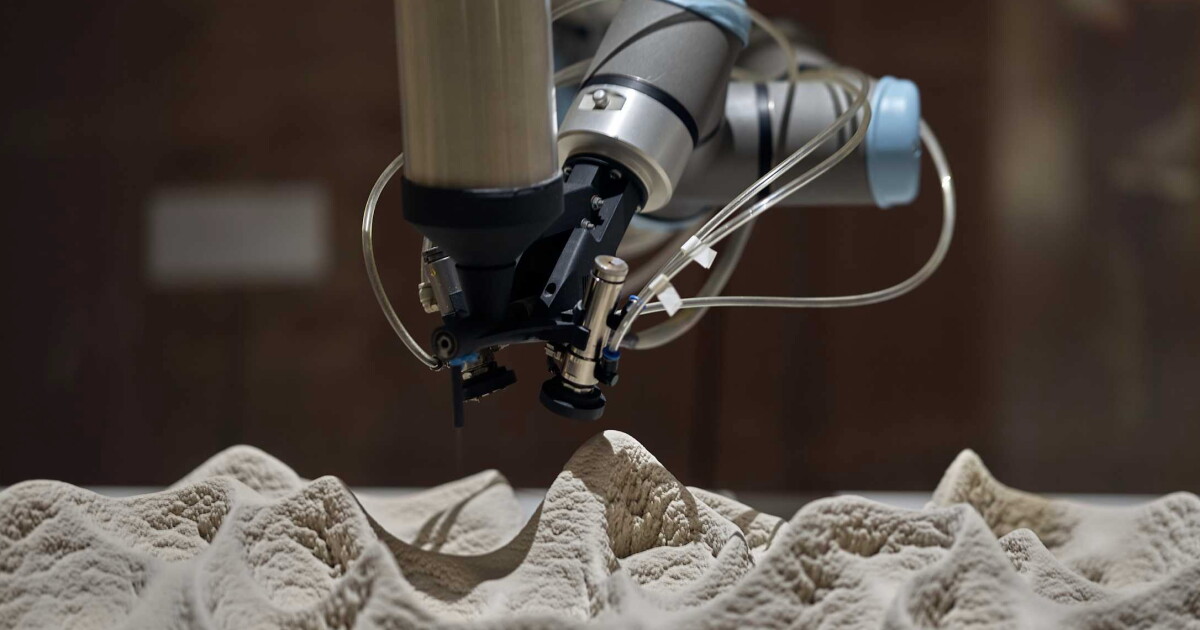
While sand is an important component in many construction materials, it’s not suitable for most building purposes all on its own. But if its grains could stick together, it could become a solid building material, offering an alternative to conventional cement. This is exactly what researchers at ETH Zurich have been working on.Why look for an alternative to cement in the first place? The problem is that its production requires very high temperatures and large amounts of energy, making it a major source of CO2 emissions. Finding a more sustainable alternative could make a real difference in the construction industry. To achieve this, Swiss researchers turn to a living bacteria called Sporosarcina pasteurii.Under the right conditions, it can grow between sand grains and bind them together by forming calcium carbonate, which is found in limestone, chalk, and mussel shells.This idea of using bacteria to bond sand – biocementation – isn’t new. We’ve previously seen it used to stabilize soil for growing crops and to help repair cracks in concrete. What’s different about the ETH Zurich project is the ultimate goal: the scientists are using biocementation not to just improve existing materials, but rather to turn sand into an architectural material on its own.Led by Karen Antorveza Paez, the research group found two ways to make this work. Design Strategies For Microbial Biocement Structures The first combines biocementation with 3D printing. Researchers essentially developed a special “bio-ink” that contains water, sand, living bacteria, and some chemicals. This material has a gel-like consistency and can be “printed” into a desired shape. After the object is formed, it’s immersed in a bath with urea and calcium chloride for three days. This is the key step, because this is where the bacteria get to work, triggering the formation of crystals and binding the sand grains together. After the bath, the object is dried at room temperature for two days, the bacteria is no longer active, and the result is a solid, durable structure. The whole process takes up to five days.Antorveza Paez compares this process to baking a cake: “You’ve got the dough, which is still very malleable and delicate. Only the oven can turn it into something solid.” In this case, bacteria act as an oven and hardens the material, but does it without any heat. A robotic arm builds up the structure layer by layerETH Zurich The second method uses a robotic arm to spray the mix of sand and bacteria onto the surface. The desired object is built gradually, layer by layer, as calcium carbonate gets formed. This sounds like a time-consuming method, but its main advantage is that it can be fully automated. This system ran continuously for six months, showing its ability to operate without constant human supervision.The two methods have different applications: 3D printing is more suitable for making complex architectural elements, while robotic spraying is designed for surfaces. A solid-sand facade element created as part of the studyKai-Hsun Yeh / ETH Zurich The new technology and the progress made so far are fairly promising, but there are still a few remaining limitations. One of the most concerning ones is ammonium, a by-product of the mineralization bath in the 3D printing method. It’s very toxic, so researchers need to find ways to neutralize it before scaling up the technology.Another important question is the strength of the final material. For now, it could replace mortar, which binds bricks together, but it’s still not quite as strong as concrete, which can support floors, columns, and foundations. The researchers are also trying to determine how sand grain size affects the properties of the final product, so there is still a lot of work to be done before “sandcastles” can become real architectural projects.Source: ETH Zurich
Bacteria binds sand into building-grade cement
Full Article
Original Source
Read the full article at Newatlas →KhanList aggregates and links to publicly available news content. We do not host full articles from third-party sources. Always verify important information with original sources.