
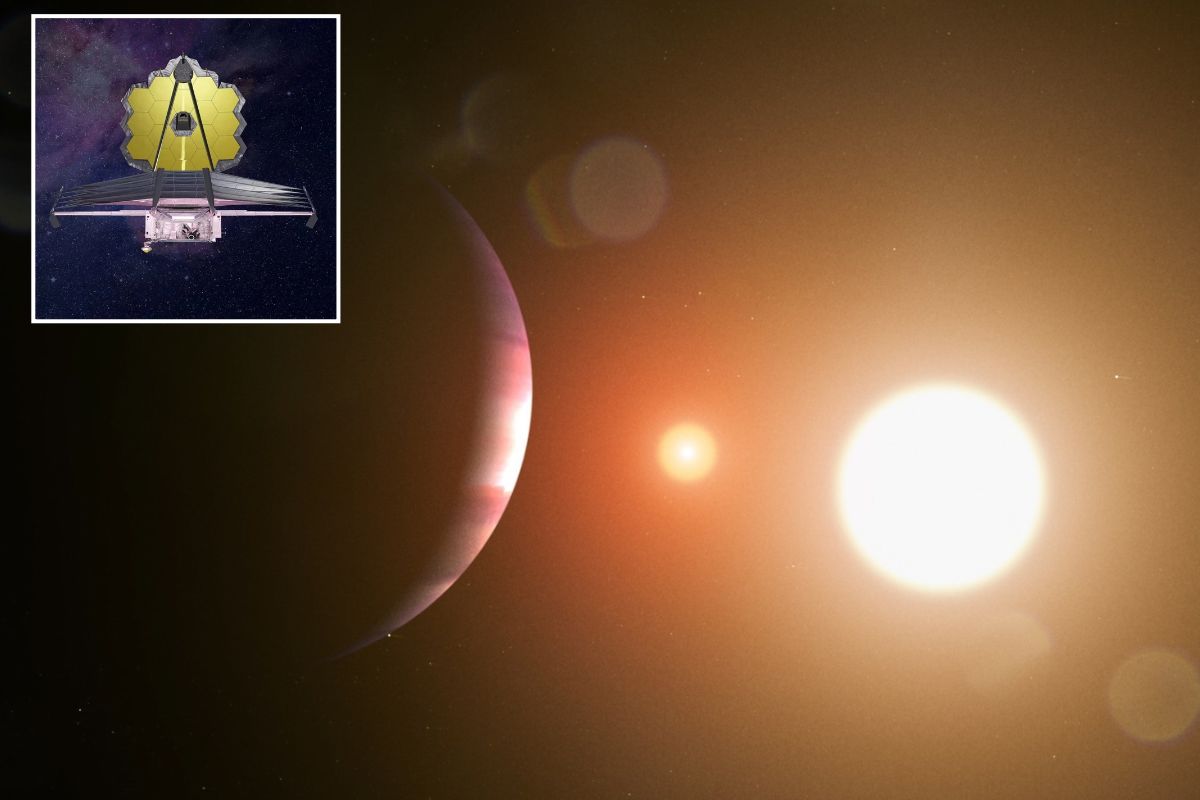
The idea of a planet orbiting two suns sounds like science fiction. More specifically, it’s an idea from Star Wars: the fictional planet Tatooine famously has two suns. But in real life? Scientists long thought that was impossible. However, in 2011, the first “circumbinary” planet, as it’s called, was discovered. In the following years, astronomers confirmed more and more. But scientists still didn’t understand much about this rare phenomenon. In 2019, a new planet with two suns was discovered by an unexpected scientist Wolf Cukier was just a high school junior when he began a summer internship at NASA’s Goddard Space Flight Center in 2019. Simply put, he was a data jockey. His job was to dig through extensive data on variations in star brightness captured by NASA’s TESS (Transiting Exoplanet Survey Satellite). On just his third day looking through the data, Cukier noticed something weird. All indications pointed to a stellar eclipse in a distant solar system called TOI 1338. A stellar eclipse is when one star passes in front of another in a binary system, or a system with two stars. “But the timing was wrong,” Cukier said, per NASA. Instead of an eclipse, he realized he was looking at a new planet. High school intern discovers planet TOI 1338 b The planet, clocked by then 17-year-old Cukier on just his third day on the job, became known as TOI 1338 b. Not the catchiest name, of course, which is why some informally call it “Wolftopia” after its discoverer. It lives about 1300 light-years away in the constellation Pictor. TOI 1338 b is a fascinating case. It orbits two stars: one noticeably larger than Earth’s Sun and the other slightly smaller. The stars orbit each other while the planet, about 6.9 times Earth’s size, orbits both. For its part, Wolftopia is extremely large but has an extremely low mass. Its density qualifies it as a “super-puff” exoplanet. Circumbinary planets like TOI 1338 b are difficult to detect. Scientists agree they are relatively common, even though we’ve confirmed only about 18 so far. But their unusual light patterns make them tricky for algorithms to identify. Luckily, the eager and very human eyes of Cukier were on the case. A paper published in The Astronomical Journal featured TOI 1338 b, and Cukier was even listed as a co-author. That makes him one of the youngest co-authors ever on a NASA-related scientific discovery. (He remains ever so slightly edged out by 16-year-old Pritvik Sinhadc, who co-authored Astrobiology Primer 3.0 in 2020.) 7 years later, Cukier and TOI 1338 b have a bright future Cukier’s story was a media hit when it first occurred about seven years ago. But the tale doesn’t end there. TOI 1338 b remains of great interest to scientists. In September 2026, the world’s most powerful telescope—the James Webb Space Telescope—set its sights on the planet to analyze its atmosphere. Though astronomers have discovered over a dozen circumbinary planets, we still don’t know much about them. The light, heat, radiation, and gravitational pull of two suns undoubtedly create weather patterns and surface conditions unlike anything scientists have seen. Once the analysis is finished and released, it can tell us more about how planets form and help us identify even more Tatooine-like circumbinary planets in the future. As for Cukier, he’s still shooting for the stars as an Astronomy and Astrophysics PhD student at the University of Chicago, no doubt motivated by the fact that a discovery on his third day on the job continues to pay dividends in the scientific community.
A 3rd day NASA intern found a planet with 2 suns. 7 years later, it’s still fascinating scientists.
Full Article
Original Source
Read the full article at Upworthy →KhanList aggregates and links to publicly available news content. We do not host full articles from third-party sources. Always verify important information with original sources.