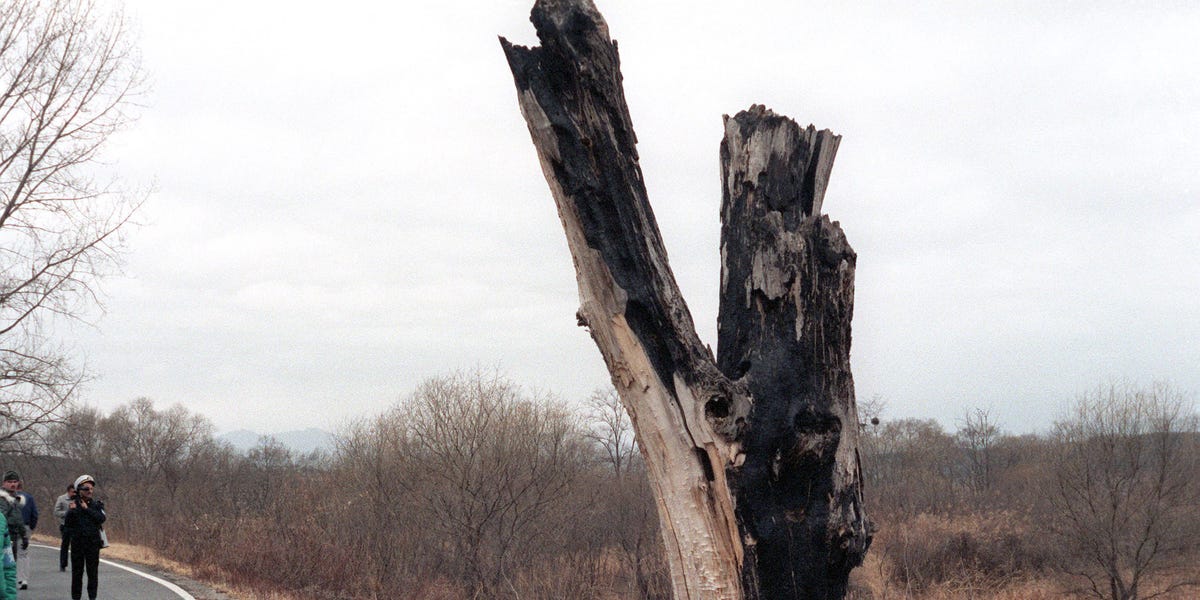
7 min readIn August 1976, a routine tree-trimming operation near the Korean DMZ escalated into a deadly confrontation.North Korean soldiers attacked U.S. military personnel, killing two American officers in what became known as the Panmunjom Axe Murder Incident.President Gerald Ford was forced to authorize a heavily militarized response operation, and declassified documents later revealed that he narrowly avoided authorizing bombing strikes on North Korea.The signing of the Korean Armistice Agreement in 1953 effectively ended the Korean War. The terms of that agreement, however, turned the village of Panmunjom into a veritable political powder keg, with the nearby Korean Demilitarized Zone (DMZ) and its Joint Security Area (JSA) an ever-burning stove. If a single spark from that stove ever strayed too close to the keg, it could ignite an explosion that would consume the region—if not the whole world—in a costly and deadly conflict.In the more than seventy years since the agreement was signed, that scenario has come scarily close to happening a number of times. One of those times, the inciting incident was the most innocuous of circumstances: the trimming of an inconvenient tree.Heading into the morning of August 18, 1976, President Gerald Ford’s administration may have been confident in the future of America’s diplomatic relations in East Asia. The day before, at the Conference of Non-Aligned Nations in Sri Lanka, Pham Van Dong (the Prime Minister of Vietnam) signaled a desire for his country to “develop economic ties with capitalist countries and normal diplomatic relations with the United States.” Ford’s predecessor, Richard Nixon, had ended the U.S.’s involvement in Vietnam in 1973 (and the war as a whole ended in 1975), so things were looking promising for the prospect of peace and a return to normalcy.That prospect of peace was very important to Ford’s political career, and August 18 was the day that the Republican Convention would vote to decide if Ford got a chance to run for re-election. There was no guarantee that he would get the nomination, despite his incumbency—though he had won more delegates in primaries than his challenger, actor-turned-governor Ronald Reagan, it wasn’t enough to secure the nomination, and delegates on the convention floor could be persuaded on the day to vote either way. Ford needed to show that he was equal to the moment.Consolidated News Pictures//Getty ImagesSupporters of Republican challenger Ronald Reagan take the floor of the 1976 Republican National Convention.Pham Van Dong’s comments were a good sign, but at this same August 17 conference, North Korea offered what appeared to be their usual bluster. They demanded that the United States withdraw their forces from South Korea, claiming that there were 400,000 American troops lying in wait in the region (the real number was roughly 42,000). But that might have been just chest-puffing, possibly in response to the joint U.S.-South Korean discovery of North Korean infiltration tunnels into South Korea (one tunnel was discovered in 1974, another in 1975, and two more would later be found in 1978 and 1990).Ford merely needed to maintain the detente in the DMZ, and that shouldn’t have been too hard. All that was on the docket for the day was to supervise the trimming of a single tree—a poplar that was obstructing the line of sight between the United Nations Command checkpoint and a nearby observation tower—near the Joint Security Area’s so-called Bridge of No Return.“Kill the Bastards!”HUM Images//Getty ImagesOn the morning of August 18, 1976, Captain Arthur Bonifas and First Lieutenant Mark Barrett escorted a group of five Korean Service Corps members and eleven enlisted personnel to trim the offending tree. At first, there appeared to be no tension with the North Korean side, but after a time, Senior Lieutenant Pak Cheol advanced towards the tree-trimming group with 15 North Korean (KPA) soldiers in tow. Pak instructed the tree trimmers to halt their activity, but Bonifas knew Pak lacked the authority to do so. He reportedly turned his back on the blustering Senior Lieutenant and instructed the trimmers to keep working.Pak was incensed, and sent a call for reinforcements back across the Bridge of No Return. Soon, a truck loaded with twenty more North Korean troops armed with melee weapons arrived. Pak instructed Bonifas once more to halt the trimming. Bonifas once more declined, and instructed his team to keep working. That’s when Pak reportedly gave the order: “Kill the bastards!”HUM Images//Getty ImagesA photograph of the tree pruning that quickly escalated into the Panmunjom Axe Murder IncidentThe North Korean forces then attacked, taking the trimmers’ axes and incorporating them into their cadre of bludgeoning weapons. Both Bonifas and Barrett were killed in the fray, which would be dubbed the “Panmunjom Axe Murder Incident.”Back in the U.S., at a meeting of the Washington Special Action Group (WASG), a briefing described the attack as “a deliberate provocation.” Their assessment was that the assault “was primarily intended to agitate American public opinion over the issue of our troops in Korea in the context of the US election campaign.” In their assessment, North Korea hoped that American casualties would sway public opinion against America’s continued involvement in the region, and that an embattled Ford (already facing opposition from Democrats and within his own party) would cave to public pressure and withdraw. Ford asked the WSAG to present him with options on the following day.Dirck Halstead//Getty ImagesPresident Ford watches the 1976 Republican National Convention coverage from his hotel room while he eats. Facing serious opposition within his own party to his seeking re-election, Ford’s WSAG had informed him that the North Koreans may have deliberately attacked American soldiers in the DMZ to sway the American election.At 7 p.m. that night, at the Kemper Arena (now the Hy-Vee Arena) in Kansas City, delegates began casting their votes for the Republican nominee for President. It wasn’t until 12:29 a.m. the following day that West Virginia cast 20 of their 28 electoral votes and pushed Gerald Ford over the top to become the Republican nominee.On August 19, 1976, from 8 a.m. to 9 a.m., the President Ford Committee held their staff meeting ahead of that day’s Republican National Convention in Kansas City. The same day (from 8:12 a.m. to 9:15 a.m.) WSAG participants—including Secretary Henry Kissinger and CIA Director George Bush—gathered in the White House Situation Room to determine a course of action for Ford. Per the Meeting Minutes from the papers of Deputy Secretary of Defense William P. Clements Jr., the options were as follows:1. Seek Presidential approval of a military action to cut down the tree and try to do it in such a way as to avoid confrontation.2. Seek Presidential approval to start the B-52 exercise. The first such B-52 run should be timed to coincide with the tree cutting.3. To start moving the Naval Task Force south into either the Sea of Japan or the Yellow Sea.4. To start moving 18 F-111s from Mountain Home, Idaho.5. To develop a contingency plan for hitting the North Korean barracks near the JSA.Presented with these options, and after great consultation, Ford entrusted the planning of what would be called “Operation Paul Bunyan” to General Richard G. Stilwell. Regarding the necessity of a show of force in response to the unprovoked attack on UNC forces, General Stilwell would remark, “Although it is only a damn tree, it involves a major principle. We cannot accept the premise that measures to protect our forces must be concurred in by the KPA.” The task would require a show of force that wouldn’t automatically provoke an escalation, and to prepare for any outcome, readiness levels for troops in South Korea were increased to DEFCON 3.That night, Ford took the podium at the Republican National Convention and delivered his acceptance speech. “Two years ago America was mired in withdrawal from Southeast Asia,” he recalled. Then, he continued: “Look at the record since August, 2 years ago. Today America is at peace and seeks peace for all nations. Not a single American is at war anywhere on the face of this Earth tonight.”Ford had to hope that his words would still be true in the coming days.Operation Paul BunyanWikimedia CommonsSouth Korean soldiers ultimately trim the tree, using chainsaws, on August 21, 1976. This is very likely the most heavily-armed act of arboriculture in history.At 7:00 a.m. on August 21, 1976, Operation Paul Bunyan was launched. With no advance warning to the North Koreans, two eight-person teams of engineers from the 2nd Engineer Battalion, 2nd Infantry Division arrived, armed with chainsaws, inside the JSA as part of a convoy of 23 U.S. and South Korean military vehicles.That convoy didn’t enter the JSA alone. According to Reed R. Probst’s 1977 U.S. Army War College paper, “Negotiating with the North Koreans: The U.S. Experience at Panmunjom,” the convoy moved “under cover of circling helicopter gunships, F-4s, F-11s, and B-52 bombers, plus a quick-reaction force of 300 US and Korean combat troops on the ground.” The engineers reached the tree and successfully trimmed it down to an 8-foot stump.The massive show of force did, in some sense, provoke a small act of retaliation. According to Probst’s report, “One observation helicopter carrying a US general officer was struck by communist small arms fire when it strayed over the Military Demarcation Line that morning.” But it also provoked something entirely unexpected: a quasi-mea culpa from no less than North Korean President Kim Il-Sung.Hours after the operation, a message was conveyed to UNC officials from President Kim, in which the North Korean leader called the incident at Panmunjom “regretful.” While far from a full admission of responsibility from the leader, and surrounded in the full statement by more of the usual verbiage insisting that North Korea’s policy was solely motivated by self-defense, the UNC viewed Kim’s expression of regret as a “positive step.” An escalation of tension had been avoided. Just as Ford had hoped, there was still “not a single American is at war anywhere on the face of this Earth.”JUNG YEON-JE//Getty ImagesIn 2022, a U.S. soldier stands at the former site of the poplar tree, which is now a memorial for the two officers killed in the Panmunjom Axe Murder Incident.Ford would ultimately lose the 1976 election to Jimmy Carter, who would in turn lose four years later to Ford’s primary opponent, Ronald Reagan. Towards the end of Reagan’s second term in 1987, the 8-foot stump of the Panmunjom Axe Murder poplar was removed and replaced with a stone monument bearing a brass plaque honoring Captain Arthur Bonifas and First Lieutenant Mark Barrett.It wasn’t until 1996, 20 years after the incident, that the memos from the WSAG meetings were declassified, and the world understood how close the situation came to escalation. Those memos showed that both William Clements and Henry Kissinger advocated strongly for Option 5 (the bombing of North Korean barracks), but that Ford ultimately opted against it. The reason Kissinger gave for Ford’s decision suggests that perhaps things might have gone differently had the incident simply occurred on any other day. “But the real problem,” Kissinger told the assembled WSAG members, was that “the President's speech on Thursday night saying that there were no Americans in combat anywhere in the world.”Michale Natale is a News Editor for the Hearst Enthusiast Group. As a writer and researcher, he has produced written and audio-visual content for more than fifteen years, spanning historical periods from the dawn of early man to the Golden Age of Hollywood. His stories for the Enthusiast Group have involved coordinating with organizations like the National Parks Service and the Secret Service, and travelling to notable historical sites and archaeological digs, from excavations of America’ earliest colonies to the former homes of Edgar Allan Poe.
Axe Murders Inspired a Strange Military Plan to Chainsaw a Tree—and Nearly Started WWIII
Full Article
Original Source
Read the full article at Popularmechanics →KhanList aggregates and links to publicly available news content. We do not host full articles from third-party sources. Always verify important information with original sources.