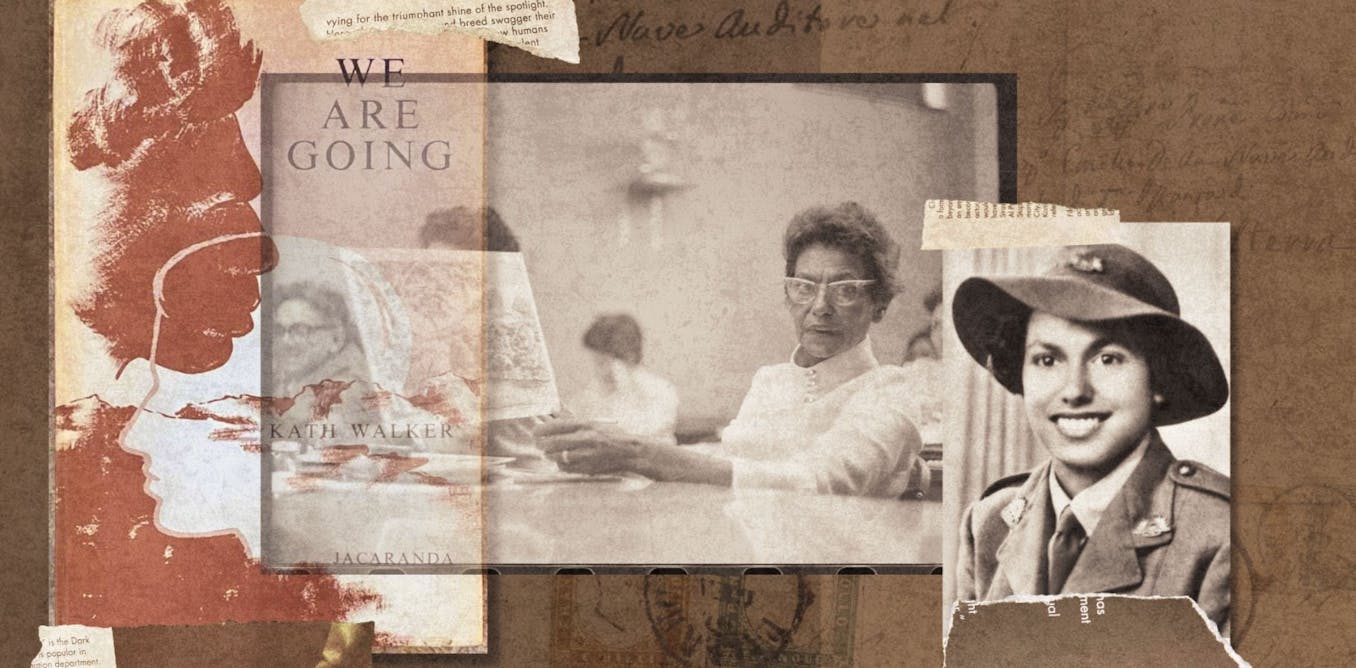
Aboriginal and Torres Strait Islander readers are advised this article contains names and images of deceased people. In our new series, we explore influential Australian poems. We can sometimes underestimate the challenges of others, especially when none have come before them to begin something – something that creates a legacy they probably never imagined. Aboriginal and Torres Strait Islander history is littered with such people. One of these was the late Oodgeroo Noonuccal (1920–1993). Oodgeroo (Kath Walker) was born in the Brisbane suburb of Bulimba to an Aboriginal man of Noonuccal descent from Minjerribah (Stradbroke Island) and an Aboriginal and Scottish mother. She lived on the island as a child. When she left school at 13, she moved to Brisbane to become a domestic servant. Oodgeroo had limited education, but she could read and enjoyed writing. During World War II, she worked as a signaller for the army and performed administrative duties, becoming a Lance Corporal in 1943. The same year, she married Bruce Walker, an Aboriginal man from the Logan and Albert rivers region. Kath Walker (Oodgeroo Noonuccal) in uniform (1942). Australian War Memorial, via Wikimedia Commons, CC BY Later, as a single parent to her son, Oodgeroo became an office worker, then undertook household duties for prominent Brisbane doctors Raphael and Phyllis Cilento. Here, she was encouraged to write. The 1940s was a time when the White Australia policy was in full flight. The only political party that did not support this policy was the Communist Party of Australia. Oodgeroo felt a strong connection to the communists’ lack of racially discriminatory beliefs. She flourished through the association, writing speeches and public speaking. But it was after leaving the party Oodgeroo really began to delve into writing. She joined the Brisbane Realist Writers Group, a collective of left-wing authors founded in 1944. The poet Judith Wright recommended Oodgeroo’s work and her debut collection We Are Going appeared in 1964. It was the first ever book of poetry published by an Aboriginal person. Tenacity, passion and hope We must place this achievement in the context of the times. Where none had gone before, Oodgeroo stood, and it was only the beginning. What tenacity, passion and hope does that take? To push through where no one looks, speaks, behaves like you? Where previously you had to expect closed doors, Oodgeroo used writing and a strong desire for change to break open those doors. That act has allowed others to follow. Aside from this courage, it takes a great creative mind to write such powerful poetry and win such acclaim. Oodgeroo had a strong connection to the natural world and she found solace in forming words to match her feelings. We Are Going remains one of the most significant books in First Nations literature. There were critics who likened her poems to “nursery rhymes” in their sound and structure, but they missed the true meanings instilled in them. Oodgeroo’s verses are full of anger, sadness and resilience as they look to the future. Take, for example, A Song of Hope, the final poem in We Are Going, which begins: Look up, my people, The dawn is breaking, The world is waking, To a new bright day, When none defame us, Nor colour shame us, Nor sneer dismay. Now brood no more On the years behind you, The hope assigned you Shall the past replace, When juster justice Grown wise and stronger Points the bone no longer At a darker race. Managing the delicate balance of deficit and positivity, the poem traverses space and time, from “our father’s fathers” to “our children’s children”, in a way that brings us back to the desire to push for more, for better. It envisions a “new Dream Time”, when “all doors open / That long were closed”. Oodgeroo was proud of being a protest poet and she broke new ground in Australia, using poetry for political protest at a time when it was meant to be for art’s sake. Oodgeroo had many attacks levelled against her by critics of the day. But her first book sold 10,000 copies, making her the bestselling Australian poet since C.J. Dennis, and she used her public recognition and her identity as a protest poet to campaign for the 1967 constitutional referendum to enfranchise Indigenous Australians. Oodgeroo spoke of discrimination in a way that did not alienate; she mentioned “justice” in a manner accepted for the times. Her remembrance of past traumas allowed the dawning of hope for what the poem calls a “glad tomorrow”. In today’s context, “hope” is often seen as almost too gentle a word when considering Indigenous rights. There are many First Nations people who use anger, frustration and rage to propel themselves in their activism for better rights within Australia. That frustration and rage can assist in times when one is tired, but envisioning a different way can also empower one to rest, regroup, and then continue. These two approaches are not mutually exclusive. They can coexist within the writing of poetry and prose in a contemporary era. Art as activism, activism as art We live in an era of division, when some express a desire to go backwards to a time of “monoculture”. But we are also witnessing a celebration of First Nations literature, art, science and education previously hidden. The literary arena is now fortunate to have many First Nations writers all over Australia, as well as publication houses and awards specifically for these creatives to flourish. We would not have writers of the ilk of Alexis Wright, Tony Birch, Evelyn Araluen and Alison Whittaker if not for Oodgeroo and many others who came before. Araluen’s connection to Oodgeroo’s work exists in her discussions of political clarity, reclamation of land and the re-inscribing of the concept of Country. Both poets seek to do away with a mythologised pastoral history and establish sovereignty within their words. Whittaker’s poem Many Girls White Linen has similarities with Oodgeroo’s We Are Going and No More Boomerang in its critique of colonial surveillance and Australia’s fascination with the policing of Aboriginal bodies. Birch’s work is not predominately in poetry, yet it is grounded in a political resistance that asserts Country as identity and protector, rather than pastoral ownership. Wright’s novel Plains of Promise takes its title from a line in A Song of Hope. Oodgeroo was the first Indigenous woman in Australia to use poetry as a political tool. She emboldened (considering the context of the time) seemingly small yet important acts of writing as resistance – something we see in the Aboriginal and Torres Strait Islander literature of today. She used the fame her writing gave her to advocate for Indigenous rights, organising petitions, giving speeches and directly lobbying politicians. She was the national campaign coordinator of the Federal Council for the Advancement of Aborigines and Torres Strait Islanders and co-founded the National Tribal Council. She is regarded as a principal architect of the 1967 referendum. She was also the first Aboriginal Australian to run (unsuccessfully) for a seat in the Queensland state parliament. This is just a small list of her significant acts. Oodgeroo was awarded a Member of the Order of the British Empire (MBE) in 1970, which she returned to the Governor General as Australia prepared to celebrate the 1988 Bicentenary to bring attention to systemic injustice and the struggle for Aboriginal land rights. It was around this time she ceased using the name Kath Walker, in favour of her Indigenous name. Oodgeroo Noonuccal at a meeting of Sydney’s Foundation for Aboriginal Affairs in 1970. State Library of New South Wales, via Wikimedia Commons, CC BY Nothing Oodgeroo did was small. First Nations’ people in Australia see her activism as part of her art, as her art was part of her activism. As Aboriginal women in academia with a love of writing, we imagine Oodgeroo’s position as a groundbreaking poet to be similar to Aboriginal academics who began their university careers when nothing was there for them. No supports translating knowledge, no comfortable spaces with like-minded and familiar-looking faces, and no great institutional desire for them to be there. It not only takes immense talent to push through these invisible barriers to create a space; it also takes great courage. Oodgeroo knew how valuable education was, and now her words are heard throughout these institutions in Australia. The legacy she has left is at the core of our belief we teach, give knowledge and, if we are lucky enough, wisdom for others to grow from. Writing poetry and prose is a deeply personal act; it holds an intimacy of something deep inside that needs to be spoken of and needs to be heard. Not all poetry needs to be pretty, hopeful, raging or perfect. But it does need to be in a voice that demands to be witnessed. Now, more than ever, we need both the frustration and passion to nourish our movement, along with the hope things may be better for Aboriginal and Torres Strait Islander people. We want more Oodgeroos, more Araluens, more Whittakers into the future, more writers and poets who can propel the language, culture and poetry that has sustained us throughout history. Oodgeroo’s life and work created a legacy that will continue to be built upon by First Nations’ writers and creatives. “So long we waited / Bound and frustrated,” she wrote in A Song of Hope, with her eyes looking to the future: See plain the promise, Dark freedom-lover! Night’s nearly over, And though long the climb, New rights will greet us, New mateship meet us, And joy complete us.
Australian poetry classics: Oodgeroo Noonuccal’s A Song of Hope created a legacy to build on
Full Article
Original Source
Read the full article at Theconversation →KhanList aggregates and links to publicly available news content. We do not host full articles from third-party sources. Always verify important information with original sources.