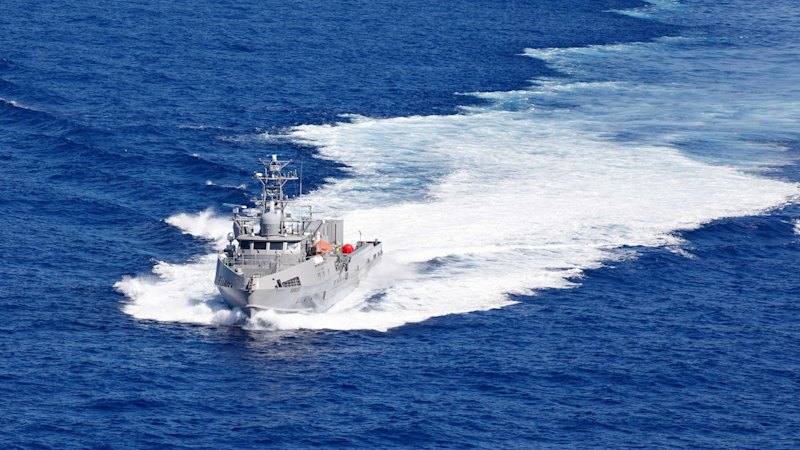
Australia could scrap plans to develop a fleet of large “drone ships” with the United States and instead seek to partner with Britain on the navy’s first foray into cutting-edge autonomous surface vessels.The government announced two years ago, following a review into the nation’s surface fleet, that the navy would acquire six large optionally crewed surface vessels “through formal engagement with the United States Navy program as a fast follower”.A US naval vessel, USV Ranger, on the Pacific Ocean during a training exercise in 2023. But, as this masthead reported this week, the US Navy has killed off its plan to develop large vessels of this kind, throwing Australia’s plan into doubt.The opposition is calling for the government to reconsider its requirement that the ships be able to operate with sailors on board and examine options for a fleet of fully uncrewed vessels.Defence Industry Minister Pat Conroy said the government was “absolutely not” abandoning the program and had time to see how the technology developed before making a final decision.“Obviously, the US have changed their investment priorities, but it would be incorrect to say that they’re moving away from autonomy,” Conroy said in response to a question from this masthead during a visit to Washington.“Their program focuses on a medium-sized unmanned surface vessel that would have the ability to carry missiles, and I’m aware of at least four or five companies that were awarded contracts for prototyping.“So, our program still exists, it’s being funded. We’ve got time to look at what the rest of the world is doing.”Conroy said the government was eager to partner with another nation on the project rather than pioneer an Australian design, as it had with technologies such as the Ghost Shark underwater vehicle.“This is an area where it’s probably in our interest to be a fast follower rather than to lead the world,” he said.“It could be the United States, it could be UK, it could be a third country. But autonomy is going to become an increasingly prominent feature in naval warfare, and just because one program has changed doesn’t mean our commitment has changed.”Conroy said the government remained committed to building the vessels at the Henderson shipyards in Perth, the same place where landing crafts for the army and Mogami-class general purpose frigates for the navy are poised to be made.The ships are not expected to be built until the mid-2030s at the earliest.Former naval officer Jennifer Parker said Australia was likely to examine acquiring Britain’s planned Type 91 missile barge, a key part of its recently unveiled push to develop a “hybrid navy” with a mix of crewed and uncrewed ships.British publication Navy Lookout reported the Type 91 is expected to “carry a large concentration of missile launch cells” and is “expected to operate with minimal or no permanent crew as part of a distributed combat system”.Parker, an expert associate at the Australian National University’s National Security College, said she feared the British concept was “unlikely to work”.“We have to ask ourselves why the Americans abandoned their plan for large uncrewed vessels in the first place,” she said.“I think we will end up with a smaller, uncrewed capability which is required to be at sea for a shorter time.”Richard Dunley, an expert in maritime security at UNSW, said the British plan for a hybrid navy, including the Type 91 missile barge, was “still very much a concept without a lot of detail behind it”.When announcing the navy overhaul in 2024, Defence Minister Richard Marles said the six large optionally crewed vessels would be “exactly based on what has been developed in the United States” and described the American prototype as a “known quantity”.“They have the capacity to operate in an uncrewed fashion, but it is the intention of the Royal Australian Navy to crew these vessels,” he said.Opposition defence spokesman James Paterson said: “I hope the Albanese government is carefully considering its optionally crewed vessels in light of decisions by our two closest military allies”.“Uncrewed surface vessels must play a critical role for the ADF going forward, but building a ship capable of sustaining a crew and operating without one is much more complex than a focused alternative.”Senior US navy leaders have said their preference was to keep sailors off the next generation of unmanned vessels that they are developing.“When you introduce that capability to operate with people on board, it creates a lot of other requirements and cost and complications,” Captain Matt Lewis, the US navy’s program manager for unmanned maritime systems, said last year at a US Naval Institute event.Cut through the noise of federal politics with news, views and expert analysis. Subscribers can sign up to our weekly Inside Politics newsletter.From our partners
Australia doesn’t need to lead world on ‘drone ships’, government says
Full Article
Original Source
Read the full article at Smh →KhanList aggregates and links to publicly available news content. We do not host full articles from third-party sources. Always verify important information with original sources.