
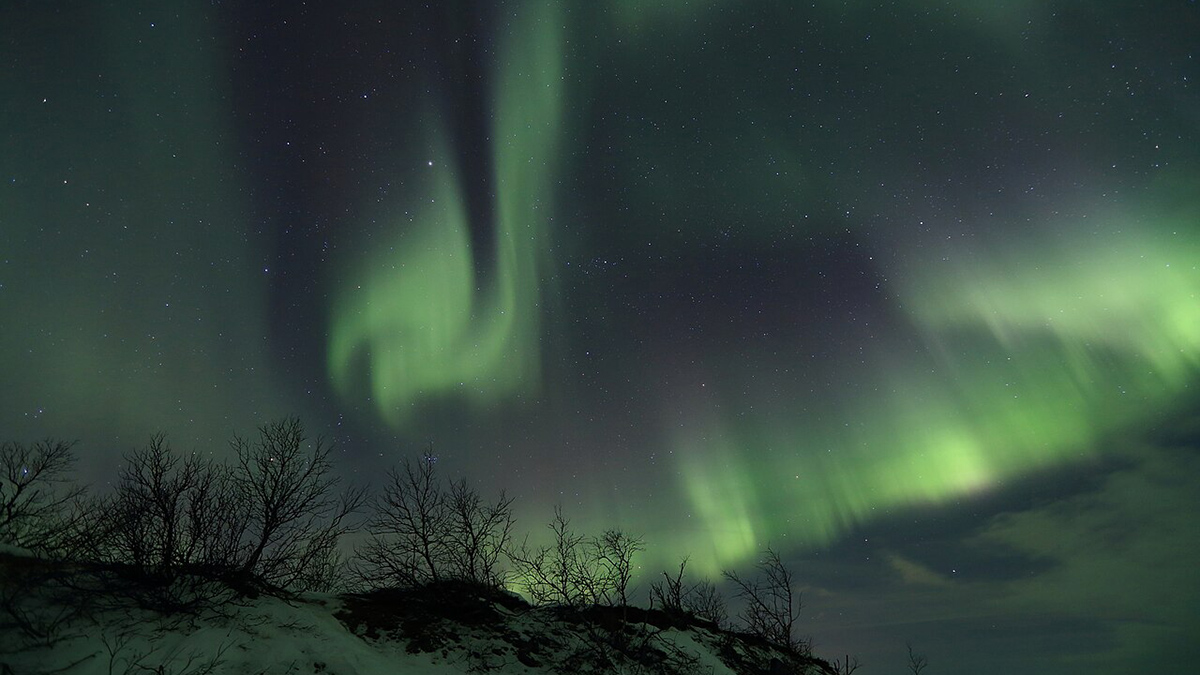
The aurora borealis as seen near Lake Torneträsk in Sweden. Credit: Pavel.shyshkouski/Wikimedia Commons, CC BY-SA 4.0 Source: Journal of Geophysical Research: Space Physics The aurora is among nature’s most visually striking phenomena. It occurs when charged particles from the Sun are funneled by Earth’s magnetic field into the upper atmosphere, where they collide with atoms and molecules and produce distinctly colored curtain-like patterns of light. Despite a good understanding of the physics driving the aurora, some small-scale features have proven more challenging to make sense of. Using high-resolution optical data and a simple mathematical model, Brindley and Whiter showed certain fine auroral structures could result from electrons “bouncing” off low-frequency plasma waves (Alfvén waves) above the ionosphere. The aurora offers both challenges and opportunities for studying plasmas and electromagnetic fields. Any plasma is complex, as the electrically charged particles that compose it produce their own fields and are steered by external fields. However, the motion of the aurora provides a way to estimate electric fields. Earth-orbiting satellites have mapped U-shaped electric potentials above auroral arcs, but these observations are limited in part because most spacecraft are above a region of interest for only brief periods. To understand small-scale fluctuations, the authors used oxygen and nitrogen emissions in the optical and near-infrared part of the spectrum, measured by the ground-based Auroral Structure and Kinetics (ASK) instrument when it was deployed in Svalbard, Norway. The instrument provided both spatial and temporal data on how electric fields evolve over a 25-second time period. That span was long enough to catch behavior typically missed by satellite-based studies. The researchers used two different approaches to map the electric fields, with one assuming the presence of a U-shaped potential. The two results were mostly consistent, and the researchers suggested that discrepancies between the two could be explained by electrons accelerated by bouncing off Alfvén waves above the ionosphere. The optical-only observation method with high spatial and temporal resolution provides a way forward for understanding the aurora at small scales, as well as other space weather phenomena, the authors suggest. (Journal of Geophysical Research: Space Physics, https://doi.org/10.1029/2026JA035658, 2026) —Matthew R. Francis (@BowlerHatScience.org), Science Writer Citation: Francis, M. R. (2026), Auroral structure could be caused by bouncing electrons, Eos, 107, https://doi.org/10.1029/2026EO260334. Published on 19 October 2026. Text © 2026. AGU. CC BY-NC-ND 3.0Except where otherwise noted, images are subject to copyright. Any reuse without express permission from the copyright owner is prohibited.
Auroral Structure Could Be Caused by Bouncing Electrons
Full Article
Original Source
Read the full article at Eos →KhanList aggregates and links to publicly available news content. We do not host full articles from third-party sources. Always verify important information with original sources.