
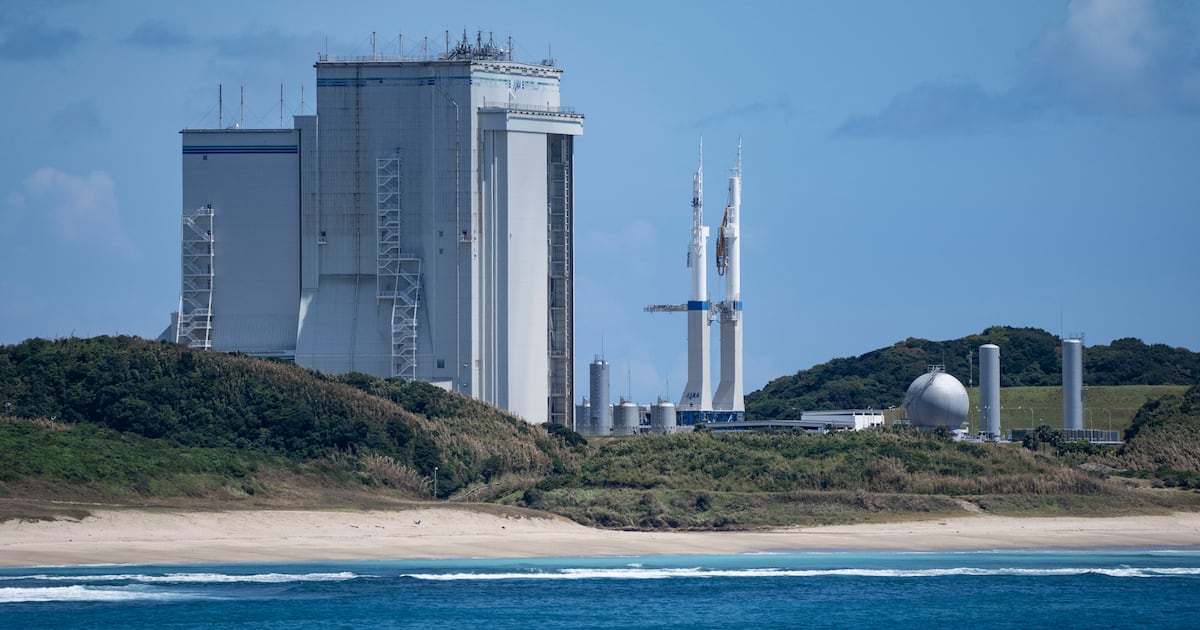
Japan is preparing to launch the first return trip to Mars’ orbit, aiming to retrieve physical samples from the moon Phobos and search for further possible signs of life.An H3 rocket is set to blast off from Tanegashima Space Center on Tuesday carrying a spacecraft that will make a five-year voyage that promises to reveal vital data on the red planet’s secrets and the feasibility of human travel there.The so-called MMX expedition, a collaboration with US and European space agencies, has risen in importance after Nasa cancelled its own Mars sample return programme due to cost overruns and science budget cuts. The MMX module will drop a wheeled exploration rover named Idefix, after the dog who features in the Astérix comic books and is known to English-language readers as Dogmatix. “We’ve been to Mars a lot of times, but we’ve never come back, so it’s a huge milestone for space exploration,” said Sanjeev Gupta, a planetary scientist at Imperial College London.READ MOREThe origin of Phobos and its fellow moon Deimos is “one of the big unsolved questions in planetary science” with potential implications for the possibility of life on Mars and elsewhere, he added. “If Phobos is an asteroid, it’s likely to belong to the fleet of asteroids thought to have brought significant amounts of the water and volatile chemicals needed for life from the outer to the inner solar system early in its history,” Gupta said.The meteor-gouged moons are named for the twin sons of the gods Aphrodite and Ares, the Greek counterpart of Roman war deity Mars. Scientists hope to search material from Phobos, the larger of the duo, to settle the long-running mystery of how it and Deimos came to be.While it is possible the pair are asteroids captured long ago in Mars’ orbit, they could alternatively be debris from a giant collision between the red planet and another celestial body.If the moons are the product of such a cosmic crash, they may contain Martian matter that includes clues on whether the planet was able to support life. “Material returned from Phobos could serve as a time capsule of ancient Mars,” said Yasuhiro Kawakatsu, the MMX expedition’s project manager. “Or [it could be] a record of the building blocks delivered to the young terrestrial planets that may have contributed to the emergence of habitability.”The Japan Aerospace Exploration Agency has carved out a niche in returning samples to Earth. It was the first nation to recover asteroid materials, via its Hayabusa – meaning Falcon – expeditions.Modules making up the Martian Moons eXploration (MMX) spacecraft at the Tanegashima Space Centre in Minamitane, Kagoshima. Photograph: Yuichi Yamazaki/AFP/Getty Images An image taken from the ESA's Mars Express shows the surface of the moon Phobos. Photograph: Nasa/ESA via Getty Images Kazuto Suzuki, a University of Tokyo professor, said Japan was “consciously taking decisions to do sample returns as something the US cannot or has not done”. China is more focused on prestige space missions that appeal to the public, Suzuki added.The MMX mission will take roughly a year each way to travel to and from Phobos, with three years of data collection in between. The voyage will face multiple technical challenges, starting with the pressure to launch on time. The best window for travelling to Mars comes around only once every 26 months, when the planet and Earth are aligned to allow the most energy-efficient trip. The H3 launch rocket has failed twice in nine previous attempts, while landing on Phobos is hard because of weak gravity and uncertain surface conditions.The expedition features advanced technologies including to lighten the craft’s load for the journey home, said Araki Ono, lead engineer at Mitsubishi Electric, prime contractor for the 4,480kg probe.“What is groundbreaking about this mission is that we will go to the Martian system and then return,” he said. [ Starship rocket reaches orbit, with SpaceX saying it will pave way for Mars missionsOpens in new window ]The voyage will have a bittersweet quality for planetary scientists as a reminder of an elusive even greater prize. This is the material held uncollected at Mars’ surface, aboard the Perseverance rover dropped there in 2021 as part of the abortive Nasa sample return mission. While the MMX expedition would be “not a replacement” for the Perseverance trove, it could help build on “tantalising evidence” transmitted back to Earth of potential ancient Martian microbial activity, said planetary scientist Briony Horgan.“MMX will be a critical step in our understanding of small bodies in the solar system, and may be able to provide some insight into Mars itself as well,” said Horgan, director of the Research Institute for Space Exploration at Purdue University in Indiana. “This could be very helpful for understanding sources of materials needed to support microbial life on Mars.”MMX promises further crucial insights into possible future crewed visits to Mars, a long-standing dream of some space agencies and billionaires, notably Elon Musk.A successful voyage would “tell us a lot” about the logistics of a human Martian mission including how to enter and leave the planet’s orbit, said Bruce Jakosky, a planetary scientist at the University of Colorado Boulder. “It won’t tell us about landing on the surface of Mars and then ascending to orbit again, or the full details of planetary protection required for samples,” Jakosky said. “But the more we can do some of these ‘firsts’ before we send people, the fewer we need to do later – and therefore the lower the risk.” – Copyright The Financial Times Limited 2026
Japan leads mission to make first return trip to Mars
Full Article
Original Source
Read the full article at Irishtimes →KhanList aggregates and links to publicly available news content. We do not host full articles from third-party sources. Always verify important information with original sources.