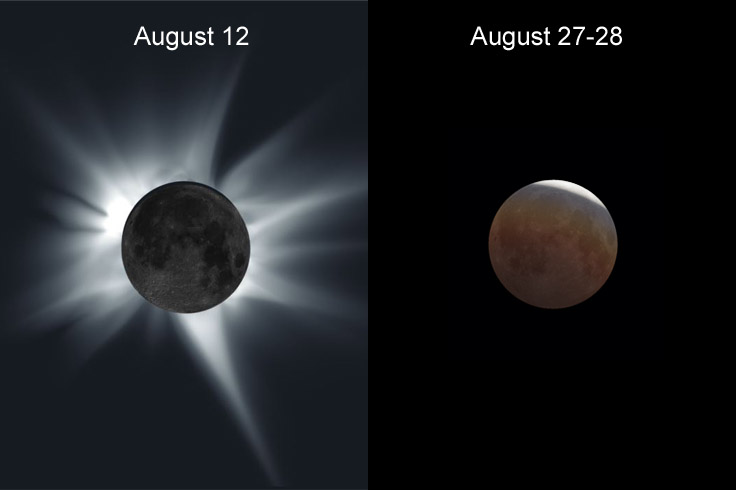
This month we’ve got three big celestial events to cover: eclipses of the Sun and Moon, and especially good prospects for the Perseid meteor shower. Plus we’ll track down a few planets, and gaze at the center of our galaxy. So load up on the bug juice, and come along on this month’s Sky Tour. Check out the illustrated version of this podcast on Sky & Telescope’s YouTube channel! It’s well known that solar eclipses occur at new Moon, and lunar eclipses occur during full Moon. Well, this month you’ll get to put both of those tidbits of astronomical knowledge to good use — because well-placed skywatchers will be treated to both a total solar eclipse and a nearly total lunar eclipse! On August 12th, the shadow of the Moon will race across our planet along a path that starts in the Arctic and stretches down into the Atlantic Ocean, clipping Greenland and Iceland before passing right across Spain. Only along this path, no wider than about 180 miles, can someone witness the complete disappearance of the Sun behind the lunar disk. But a much wider swath of Earth’s surface will experience a partial solar eclipse that day. Will you get a chance to see any of it? Listen to this month’s Sky Tour podcast to find out! Then, two weeks later, August 12th’s new Moon will be followed by a full Moon — and on the night of August 27-28 there’ll be a nearly total lunar eclipse. This one will be observable in its entirety from a much bigger part of Earth. But will you get to see this eclipse? Once again, check out this month’s Sky Tour podcast to find out! During August, skygazers will be treated to two glorious cover-ups: a total solar eclipse and a nearly total lunar eclipse. Both of these images simulate what the eye might see at each mid-eclipse.Left: Predictive Science; right: Stellarium The third boffo night-sky event involves the Perseid meteor shower, which this year will be pretty much as good as it gets. The Perseids have a fairly sharp peak, which is forecast for the night of August 12th, the same night as the solar eclipse (and thus new Moon). So that guarantees that you won’t be bothered by moonlight as you watch for these meteoric bits of rock flashing across the sky! Planet-wise, it’s possible to see the “Big Five” — Mercury, Venus, Mars, Jupiter, and Saturn — but they're scattered across the evening and predawn sky. The Sky Tour podcast tells you when and where to look for them. There’s much more to see in July’s evening skies — including guidance on how to locate the center of our Milky Way galaxy. So check out this month’s podcast to get a personally guided tour of the beautiful stars of summer. Thanks for listening! Read the full podcast transcript.
August Podcast: Three Big Events!
Full Article
Original Source
Read the full article at Skyandtelescope →KhanList aggregates and links to publicly available news content. We do not host full articles from third-party sources. Always verify important information with original sources.