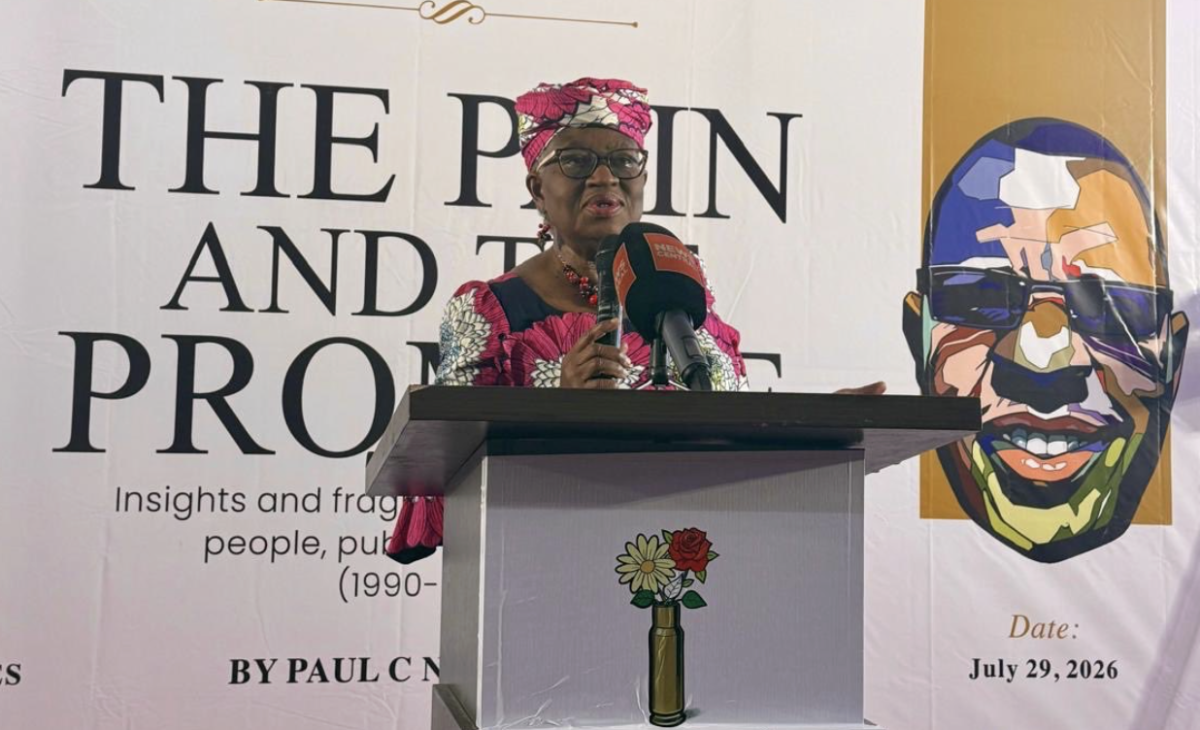
• Says communication critical in reforms drive, declares it’s about persuading people, explaining trade-offs, building trust not just writing new laws •Chidoka, Adeniyi, others hail author’s intellectual legacy James Emejo in Abuja Director General, World Trade Organisation (WTO), Dr. Ngozi Okonjo-Iweala, has vowed “never give up hope” on Nigeria despite the country’s recurring setbacks, adding that lasting prosperity will only come when Nigerians build a broad national consensus that rises above ethnic, religious and regional divisions to pursue shared development goals. She spoke at the public presentation of at the public presentation ofmThe Pain and the Promise: Insights and Fragments on Nigeria and People, Public and Personal (1990–2026) by public policy analyst and member of THISDAY Baord, Mr. Paul C. Nwabuikwu in Abuja. The former Minister of Finance and Coordinating Minister for the Economy, stressed that while Nigeria had repeatedly lost momentum through policy reversals, its abundant talent and resilience give her confidence that the nation can still achieve enduring prosperity. She said, “Until Nigerians can overcome the ethnic, religious and regional divides embedded in our society to forge a social compact that agrees key directions for the nation… Nigeria will find it difficult to move forward at the pace required to create enduring prosperity for our people.” She added, “I’ll never give up hope… I believe in talent from every corner of Nigeria. There’s no place in Nigeria that doesn’t have talented people.” However, Okonjo-Iweala, who led Nigeria’s landmark economic reform programme in the mid-2000s, said Nwabuikwu’s collection of essays accurately chronicled the country’s long journey through military rule, democratic transition, economic reforms, anti-corruption efforts and technological transformation, while preserving faith in a better future. She said, “This is a book I recommend heartily… to better understand our wonderful, complicated, often frustrating, but always exciting country,” she said, stressing that the nation’s “pain” should become “a spur to deliver on Nigeria’s boundless promise.” She said the nation’s ability to convert decades of recurring disappointments into enduring prosperity would ultimately depend on forging a national consensus that rises above ethnic, religious and regional divisions. The former minister said the country’s greatest obstacle was no longer a lack of talent but the inability to agree on common national priorities that survive successive governments. Despite describing Nigeria as “the most interesting, if the most chaotic country in the world,” she insisted she remained unwavering in her belief that the country would eventually realise its immense potential. “I’ll never give up hope,” she declared. According to her, while Nigeria has repeatedly experienced policy reversals that set back progress, the country possesses abundant talent across every region and only needs a shared national purpose to unlock lasting development. Drawing extensively from Nwabuikwu’s essays, Okonjo-Iweala noted that his reflections offered more than historical commentary; providing a roadmap for understanding why the nation’s development journey had often stalled and what must change. She particularly endorsed the author’s argument that the absence of broad agreement on national priorities had slowed economic transformation, adding that infrastructure, poverty reduction and productive investment should become national rather than sectional objectives. Okonjo-Iweala said, “Until Nigerians can overcome the ethnic, religious and regional divides embedded in our society to forge a social compact that agrees key directions for the nation — directions that remain steady no matter who is in government — Nigeria will find it difficult to move forward at the pace required to create enduring prosperity for our people.” The WTO chief said the book captured Nigeria’s long transition through military rule, democratic governance, anti-corruption efforts, technological change and economic reforms while never losing faith that the country’s future could be better than its past. She described the 300-page collection as “a portrait of a generation” and recommended it especially to younger Nigerians seeking to understand the country’s complex history. She said, “This is a book I recommend heartily to everyone and to anyone seeking to better understand our wonderful, complicated, often frustrating, but always exciting country.” Okonjo-Iweala also reflected on her years leading Nigeria’s economic reform programme, recalling how she recruited Nwabuikwu into the Federal Ministry of Finance after recognising that difficult reforms required equally effective public communication. She said policy reforms could not succeed merely through legislation and technical design but depended on winning public understanding and trust. She added that the country’s successful negotiation of about $30 billion in Paris Club debt relief was made possible not only by difficult economic reforms but also by a deliberate effort to explain those policies to Nigerians in clear, simple language. According to her, “Reform is not just about writing new laws and enforcing new policies. It is about persuading people, explaining trade-offs and building enough trust that governments can keep pushing through obstacles.” “I had been brought in from the World Bank to help straighten up and strengthen Nigeria’s weak finances, including getting rid of the $30 billion of the country’s debt owed to the Paris Club. To do this work, I knew Nigeria would have to undertake serious economic reforms of the type that would demand understanding and sacrifices from Nigerians,” she said. Okonjo-Iweala said effective communication had to become a central part of the reform programme, adding that government policies, especially difficult economic decisions, needed to be presented in language that ordinary Nigerians could easily understand rather than technical terms that excluded the public. She credited Nwabuikwu with providing that strategic communications leadership during the reform era. She said, “I can say without fear of contradiction that we wouldn’t have had as much success with the reform programme if we had not had a masterful steering of communications from Paul.” Describing him as “one of the best parts” of the economic team, she praised his rare ability to combine intellectual depth with accessibility. “He had the ability to be intellectual whilst being accessible. His writing was fearless and fair. While never shying away from what was going wrong, his writing never lost sight of the possibility that things would get better, she added. Okonjo-Iweala said one of the book’s greatest strengths was that it challenged readers not merely to celebrate reforms but to ask whether institutions were genuinely delivering development. She cited Nwabuikwu’s reflections on Nigeria’s banking consolidation, saying he asked the more important questions beyond financial stability. “Are banks financing real production? Are they supporting long-term investments? Are they helping entrepreneurs create jobs?” she said, noting that such questions remained central to Nigeria’s economic future. She also praised the author’s assessment of the economic reform team she led, saying his observation that government should become more accessible, accountable and results-oriented accurately reflected the philosophy that guided the administration. Beyond economics, Okonjo-Iweala said the book’s humanity stood out through its attention to ordinary Nigerians struggling to build lives in difficult circumstances. She commended Nwabuikwu for blending public policy with deeply personal reflections, making complex national issues understandable without sacrificing intellectual rigour. “What made me happy is that you reminded readers of the hard work done by our economic team on debt relief, transparency, infrastructure, entrepreneurship, institutional building and structural reforms. It was the work of a team, and I’m proud you were part of it,” she said. She also expressed optimism that Nigeria would ultimately fulfil the promise embedded in the book’s title. Okonjo-Iweala said, “Let us hope that Nigeria ultimately lives up to the challenge implicit in your book, that the country’s pain is acknowledged and remembered, but it becomes a spur to deliver on Nigeria’s boundless promise.” Earlier, former Minister of Aviation and Chairman of the Athena Centre, Osita Chidoka, described Nwabuikwu as one of Nigeria’s finest public intellectuals, praising his combination of “analytical profundity with humanity and a gift for language.” According to Chidoka, the author has consistently enriched national conversations through thoughtful interventions that transcend partisan debates and remain relevant across generations. Specifically, he described Nwabuikwu as “one of my favourite columnists at The Guardian.” He added that the author distinguishes himself through “analytical profundity with humanity and a gift for language,” qualities that have made his interventions on national issues consistently insightful and compelling over several decades. Reviewing the book, Vice Chancellor of Baze University, Prof. Abiodun Adeniyi, described the collection as “an archive of conscience” and “an alternative history of modern Nigeria”, and “an archive of conscience” assembled by “one of the country’s most thoughtful journalists.” He argued that the collection rises above the level of a compilation of newspaper essays to become a documentary record of a nation “in perpetual conversation with itself,” preserving not only the evolution of the author but also the anxieties, contradictions, triumphs and aspirations of modern Nigeria. He said the essays document not only the country’s defining political and economic events but also the shifting emotions, aspirations and contradictions that have shaped Nigeria over the past three decades. Adeniyi said Nwabuikwu’s enduring strength lies in his ability to separate “noise from substance,” demonstrating that journalism practised with intellectual seriousness and literary elegance can outlive the daily news cycle to become lasting literature. Drawing from his years as Nwabuikwu’s colleague at The Guardian, Adeniyi recalled the author as a journalist distinguished by “the quieter virtues of scholarship, reflection and measured judgment,” with “an enviable ability to separate noise from substance.” He said the essays demonstrate that journalism practised with “intellectual seriousness and literary grace” can transcend the news cycle to assume the permanence of literature. According to the media scholar, the book’s central theme captures Nigeria’s enduring paradox by acknowledging the country’s deep wounds without surrendering faith in renewal. Spanning the years 1990 to 2025, he said, the essays constitute “an alternative history of modern Nigeria,” documenting not only major national events but also the subtle shifts in public consciousness through the discerning eyes of a thoughtful writer who consistently balanced critical judgement with empathy.
At Nwabuikwu’s Book Launch, Okonjo-Iweala Vows Never to Give Up Hope on Nigeria
Full Article
Original Source
Read the full article at Thisdaylive →KhanList aggregates and links to publicly available news content. We do not host full articles from third-party sources. Always verify important information with original sources.