
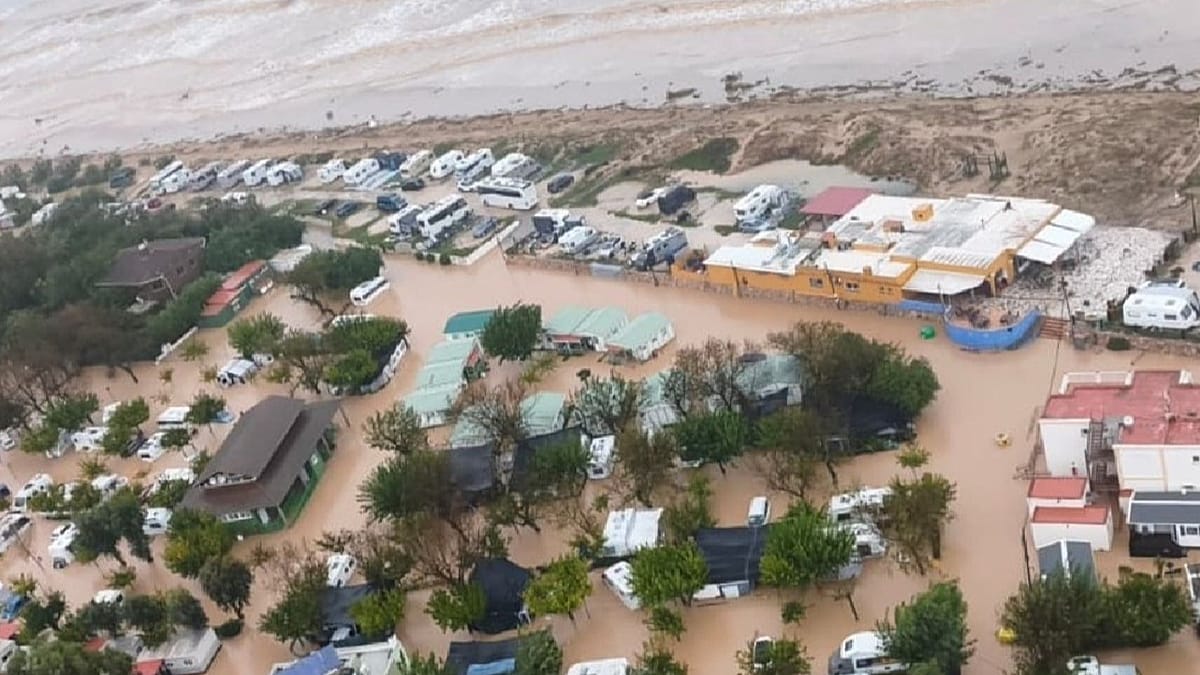
The DANA weather system Storm Adam began to ease on Tuesday after leaving at least five people dead and causing severe flooding in eastern Spain. In the Valencia region, the Civil Guard evacuated more than 2,100 people and rescued almost 500 since the start of the storm, according to the latest update released by the force. ADVERTISEMENT ADVERTISEMENT Spain's Prime Minister Pedro Sánchez will visit Valencia on Tuesday to see the impact of the storm. The visit is scheduled for around 12:30, after which the premier is expected to speak to the media. The Valencian town of Oliva is among the worst affected, with rainfall of 600 litres per square metre in 24 hours. Around 600 people received assistance at the municipal centre and 400 spent the night there from Monday into Tuesday. Emergency operations have deployed more than 1,300 Civil Guard officers, with helicopters, boats and specialised units for water and mountain rescues. Although the rain has lost intensity in the Valencia region and stay-at-home orders have been lifted, the State Meteorological Agency (Aemet) is keeping warnings in place in nine provinces on Tuesday, with particular attention to the rainfall forecast in Catalonia and the Balearic Islands. Historic rainfall of more than 700 litres per square metre Aemet has described the rainfall as exceptional in the Valencian counties of La Safor and Marina Alta, where some of the largest rain accumulations in recent decades have been recorded. In L'Atzúvia in Alicante province, 713 litres per square metre fell during the episode, while Pego registered 632 litres in 36 hours, 430 of them in just six hours. The intensity of the rain caused the rivers Girona and Vernisa and the Beniopa ravine to overflow, as well as flooding in numerous municipalities. According to RTVE, the episode ranks among the most intense ever recorded in Spain, behind the historic rainfall in Oliva in 1987, when 817 litres per square metre fell in 24 hours, and the rains from the 2024 DANA, with 772 litres in Turís. In Oliva, the streets were left completely under water and many residents had to take refuge on the upper floors of their homes or climb onto rooftops as they waited for rescue teams to arrive. The severe flooding forced the Generalitat Valenciana to temporarily lock down 145 municipalities in Valencia and Alicante on Monday. Authorities urged people to avoid travelling and seek shelter on upper floors because of the risk of further surges. The restrictions were gradually lifted in the afternoon. The storm also caused road closures, transport disruption and the suspension of classes for more than 100,000 pupils. Balearic Islands and Catalonia also suffered The storm has also hit the Balearic Islands, particularly Ibiza and Formentera, where the rain has caused torrents to burst their banks, flooding and numerous road closures. In Ibiza, more than 130 incidents have been recorded, including fallen trees and problems accessing the airport, where standing water forced some operations to be suspended. In Formentera, up to 203 litres per square metre were recorded in 24 hours. The UME has also been deployed on the islands to help with emergency work and remove the accumulated water. The Balearic government suspended classes in Mallorca, Ibiza and Formentera on Monday, a precautionary measure affecting around 160,000 students. In Catalonia, the heaviest rain shifted towards the provinces of Barcelona, Girona and Tarragona on Monday afternoon, after Aemet issued warnings for heavy and persistent rainfall. Mobile phone alerts, key to the response to the storm The Generalitat Valenciana has used the ES-Alert system to send warnings directly to the mobile phones of citizens in areas threatened by the rain. The first messages were sent over the weekend, before the storm reached maximum intensity, and were repeated on Monday as the flood risk increased. The alerts urged people to avoid travelling, stay away from rivers and ravines and seek shelter on higher ground or on the upper floors of buildings. The rollout of these warnings marks a difference from the handling of the October 2024 DANA, when delays in emergency communications were the subject of fierce criticism.
At least five killed and thousands evacuated as Storm Adam batters eastern Spain
Full Article
Original Source
Read the full article at Euronews →KhanList aggregates and links to publicly available news content. We do not host full articles from third-party sources. Always verify important information with original sources.