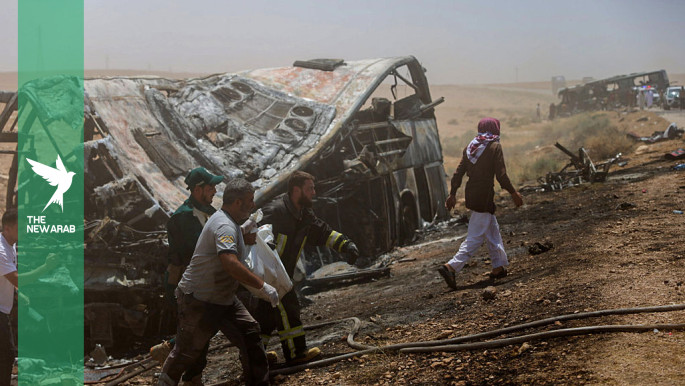
The crash took place on the desert highway near al-Sukhna, a route widely regarded as one of Syria’s most dangerous highways, underscoring road safety concerns Teams conduct an investigation and continue their work at the scene of the accident where two passenger buses collided near al-Sukhna [GETTY] At least 35 people were killed and 30 others injured on Saturday when a bus belonging to Syria's internal security forces collided with a civilian bus on the road linking Damascus to Deir Ezzor, in one of the deadliest traffic accidents on the route in recent months. The crash also sparked a fire at the scene near the town of al-Sukhna in the eastern Homs countryside, prompting the defence ministry to deploy helicopters to evacuate the wounded to Homs Military Hospital. A medical source, who asked not to be named because they were not authorised to speak publicly, told The New Arab that the collision caused the fire, with some of the injured taken to Palmyra Hospital for treatment as rescue and transfer operations continued. Several local outlets warn that the casualty figures are still preliminary and could change as recovery continues. The Syrian Civil Defence said its teams were dispatched from Palmyra centre to the site, with reinforcements requested from its centres in Deir Ezzor province to speed up the response, save the wounded and deal with the fire that broke out after the crash. Syrian Interior Ministry officials are continuing to examine the circumstances of the incident and finalise response measures for the injured. Foreign Minister Asaad Hassan al-Shibani said he was following the crash’s aftermath "with great sorrow and grief", offering his "sincere condolences and heartfelt sympathy" to the families of the victims. Medical response gaps and wider road safety concerns The al-Sukhna crash has revived debate over road safety and basic services along Syria’s long desert routes amid a shortage of ambulance and medical facilities along the way. That shortage, officials and residents say, makes rapid response difficult and increases the likelihood of higher casualties in such disasters. In comments to The New Arab, Mustafa Abdul Razzaq, a resident of al-Sukhna, said the crash underlined the urgent need to establish a full hospital, first-aid points and a large civil defence centre in the area because of the repeated accidents on the international road between the capital and Deir Ezzor. He said al-Sukhna’s strategic position on the desert highway – approximately 130 kilometres east of Deir Ezzor, 250 kilometres west of Homs and roughly 70 kilometres from Palmyra – makes it a key transit point for travellers, trucks and military vehicles, increasing the need for advanced medical and emergency services. The Syrian Civil Defence said that just one day earlier it had responded to 19 road accidents across Syria, which left three people dead and seven civilians injured. It again urged drivers to follow traffic safety measures, including reducing speed, checking vehicle readiness – especially brakes and windscreen wipers – and avoiding the use of phones or any other item that could distract the driver’s attention while driving. Syria has seen a number of deadly road accidents in recent months, highlighting the risks on major highways. On 16 April, several Syrian security personnel were injured in a crash involving a security force bus near the town of Maarrat Misrin in the country’s Idlib countryside. Likewise in September 2025, a horrific collision between a passenger bus and an oil tanker killed a dozen people, in what became one of the deadliest accidents last year. Related Articles
At least 35 dead, dozens more injured in Syria bus crash
Full Article
Original Source
Read the full article at Newarab →KhanList aggregates and links to publicly available news content. We do not host full articles from third-party sources. Always verify important information with original sources.