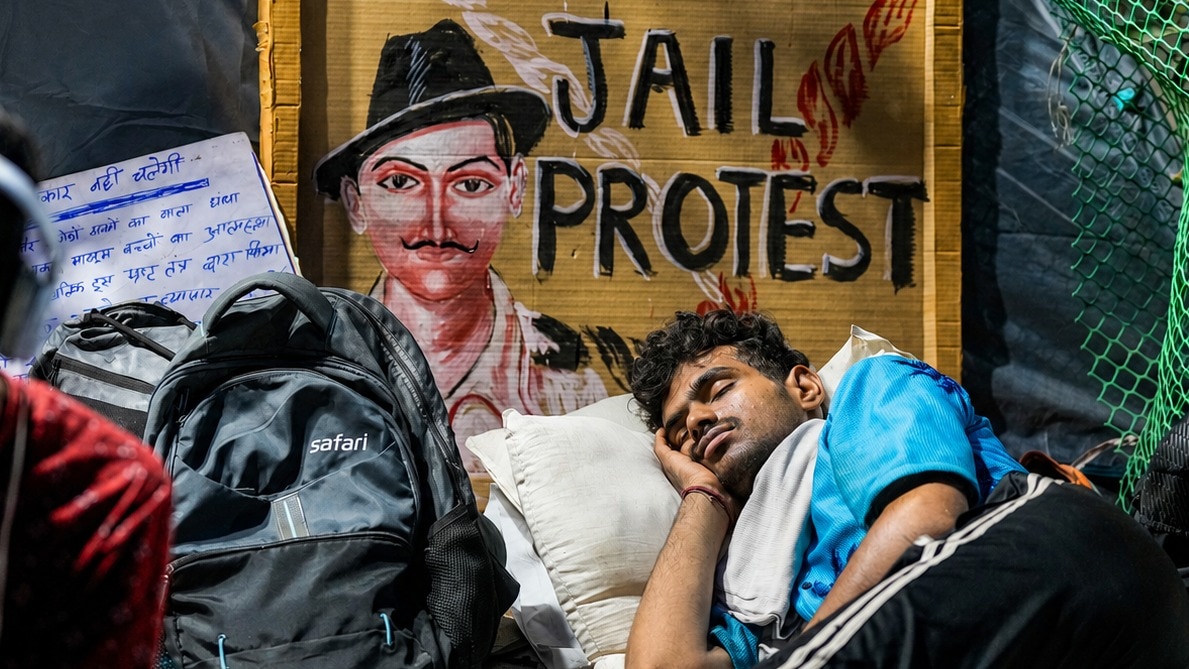
Viral videos captured the laughter, meme-oriented placards and Gen Z humour at New Delhi's Jantar Mantar. But beyond the memes were stories of aching bodies sleeping on the pavements of Jantar Mantar, volunteers who worked tirelessly without expecting anything in return, strangers who became family, and young people who chose discomfort over silence. Away from the social media reels was another Jantar Mantar, one that smelled of sweat, damp bedsheets and public toilets, where survival itself became part of the protest.The protest site in New Delhi that became synonymous with satire, memes and Gen Z rebellion demanded something far less glamorous than online virality. It demanded endurance.For nearly a month, the Cockroach Janta Party (CJP), founded by Abhijeet Dipke in Boston, transformed New Delhi's designated protest site into a temporary township. Thousands of students, elderly and young volunteers occupied the stretch of Jantar Mantar, demanding Union Education Minister Dharmendra Pradhan's resignation over the NEET-UG 2026 paper leak and other alleged irregularities in the education system. Their days revolved around speeches and slogans. Their nights revolved around finding enough space on the pavement to sleep.The government that prided itself on its ministers not resigning gave in on Saturday. Dharmendra Pradhan resigned on Saturday (July 25). Before that, for more than a month, life at the protest was stripped to its bare essentials. Protesters washed themselves using public taps, stood in long queues outside filthy public toilets, lived out of backpacks and endured Delhi's unforgiving July heat, followed by sticky monsoon nights.For women, the unhygienic washrooms brought an added anxiety. The condition of the washrooms put them at risk of urinary tract infection (UTI). Yet, every morning, they lined up again. Not many of those moments became viral.The internet mainly embraced another side of Jantar Mantar. Humorous placards, playful slogans, satirical performances and spontaneous dancing turned the protest into one of the most distinctive youth movements in recent memory. The memes helped the movement travel far beyond Delhi, attracting thousands who first encountered the protest on their phone screens before deciding to board trains and buses to join it.But after spending days at the protest site, one thing that couldn't be ignored was that the memes may have amplified the movement, but they did not sustain it.What kept Jantar Mantar alive were the ordinary people who never occupied the centre of the stage. Volunteers who spent entire days arranging drinking water, bedding and meals instead of delivering speeches. Students who slept on concrete footpaths after travelling hundreds of kilometres because they believed their presence mattered. Hunger-strikers who entered the protest as strangers and, through weeks of shared uncertainty and physical suffering, became companions.It was these lesser-addressed acts of care and sacrifice that gave the protest its staying power. The memes brought attention. The masti went viral. But it was the sweat, exhaustion and quiet resilience of hundreds of ordinary youths that carried the movement through nearly a month and culminated in Pradhan's resignation.NIGHTS SPENT ON ROADS, STRUGGLE FOR CLEAN WASHROOMSAs darkness settled over Jantar Mantar, protesters would quietly begin claiming small patches of pavement. Some spread thin bedsheets, others slept directly on flattened cardboard boxes. Bags were tucked under heads to keep valuables safe. The pavements of Jantar Mantar became a dormitory for hundreds of protesters.There were no fans except those located near the main stage. A slight breeze was considered a luxury. Amid all this, the morning brought another challenge.The public toilets, already struggling to serve the crowd, became one of the most difficult parts of life at the protest.For women protesters, the problem was even greater. Many avoided using the washrooms unless necessary because of poor hygiene. Doctors often warn that delaying urination or repeatedly using unhygienic public toilets increases the risk of UTI, making an already difficult protest physically more taxing for women.Yet every morning, they would line up again and start raising slogans against the government. Such moments are difficult to capture on camera. It is a struggle that is witnessed through one's eyes, not through the camera lens.I spent an entire night at Jantar Mantar, eating and sleeping like the protesters. You can read my experience here — I spent a night as a cockroach at CJP's Jantar Mantar protest. This is what I saw.THE INVISIBLE VOLUNTEERS WHO FUELLED THE PROTESTEvery protest has speeches, slogans, and its own agenda. Fewer people notice the ones who make those speeches possible. Hasan Ali, 21, from Uttar Pradesh, was one of them.Within minutes of entering Jantar Mantar, it became impossible not to notice him. Someone wanted drinking water. Another elderly visitor needed a chair. A newcomer was searching for a place to sleep. Another protester wanted directions to the stage. Every few steps, somebody called his name. Ali answered everyone with the same smile before rushing to the next task.When I asked where I could stay overnight at the protest site, he looked at the essential things that I carried for the night stay and smiled."We would have arranged bedsheets for you if you hadn't brought them," he said. Ali had been volunteering since the CJP protest began on June 28. His responsibility was to find sleeping space for newcomers. In reality, it meant ensuring that every protester arriving from another state found a place to spend the night.His work would never trend online. Nobody clapped for allocating sleeping spots. Neither did he gain followers on Instagram. But protests survive because someone remembers who needs water, who has nowhere to sleep, and who forgot to eat.NOT EVERYONE WAS AT THE PROTEST SITE FOR REELS, BUT FOR REALThe CJP protest at Jantar Mantar gained momentum when social activist Sonam Wangchuk joined the agitation and announced an indefinite hunger strike on June 28. His fast became the movement's centre of gravity. People gathered in solidarity with Wangchuk, but the turnout remained modest. Then came the CJP's 'Chalo Sansad' march to Parliament on July 20.The march turned violent after some protesters pelted stones at security personnel, prompting the Delhi Police and the Rapid Action Force (RAF) to respond with lathi-charge, tear gas and pellet guns.The police action achieved what weeks of sit-ins and Wangchuk's hunger strike could not. It transformed a relatively small protest into one where counting the number of protesters became nearly impossible.Among those who arrived after the crackdown was 28-year-old Ashwini Verma from Uttar Pradesh's Azamgarh. A Provincial Civil Service (PCS) aspirant, Verma had been following the movement from afar. Like thousands of students, competitive examinations shaped both his present and his future.A man from his neighbouring village had earlier travelled to Delhi with just Rs 20 to protest against the education system. That story stayed with him. Then came the police action."That was the trigger," Verma told India Today Digital. "I realised it was time to come to Delhi."Throughout the protest, Verma kept his face covered with a mask, not to hide from fellow protesters, but because he feared photographs or videos could later be used to implicate him."My being here is important because I am also a student suffering from this education system," he said.A PROTEST THAT TURNED STRANGERS TO FAMILY WITH HUNGER STRIKEUntil July 18, the spotlight remained fixed on the main stage, where Sonam Wangchuk continued his fast. But a short distance away stood another tent, far from the cameras and public attention. Inside the canopy, Bahadhur Singh from Uttar Pradesh's Aligarh sat cross-legged on a thin mattress.He was observing a hunger strike alongside Wangchuk, not on the main stage, but quietly in the smaller tent."I came here for the nation," Singh told India Today Digital. "I won't return home until I achieve my purpose," he said firmly.Beside him sat Deepak Yadav from Lucknow, who had also spent days without food. Nearby were others who had joined the fast later, inspired by the movement.Just weeks earlier, none of them knew one another. They came from different districts, different backgrounds and different lives. Yet days of sharing the same tent, uncertainty and physical hardship had forged an unexpected bond. They reminded each other to drink water, discussed health updates, shared medicines and kept a close watch on one another's condition.It was a relationship difficult to explain. It was not a friendship born out of shared interests or common backgrounds, but one built through shared sacrifice. Inside that tent, strangers had slowly become companions.GENUINE ACTS DIDN'T GO VIRAL ON THE INTERNETThe CJP protests became an internet phenomenon. There were memes, satirical slogans, funny placards. There were also young protesters dancing on the roads. Social media captured the energy of a generation that refused to protest in conventional ways.But it failed to recognise the exhaustion. The internet did not record volunteers delaying their meals because they were busy helping others. It also did not recognise someone choosing a dirty public toilet over returning home.That is because sacrifice is harder to package than humour. The memes made Jantar Mantar famous. But they did not keep it alive.That responsibility belonged to hundreds of ordinary young people whose names never trended, whose faces often remained behind masks, and whose days were spent performing invisible acts of care.Beyond the masti was labour. Beyond the slogans was discomfort. And finally, beyond the viral videos was a protest held together not just by anger, but by quiet acts of endurance that rarely made it to anyone's Instagram feed.- EndsPublished By: Avinash KateelPublished On: Jul 26, 2026 14:30 IST
At Jantar Mantar, survival was the protest. A story beyond the memes
Full Article
Original Source
Read the full article at Indiatoday →KhanList aggregates and links to publicly available news content. We do not host full articles from third-party sources. Always verify important information with original sources.