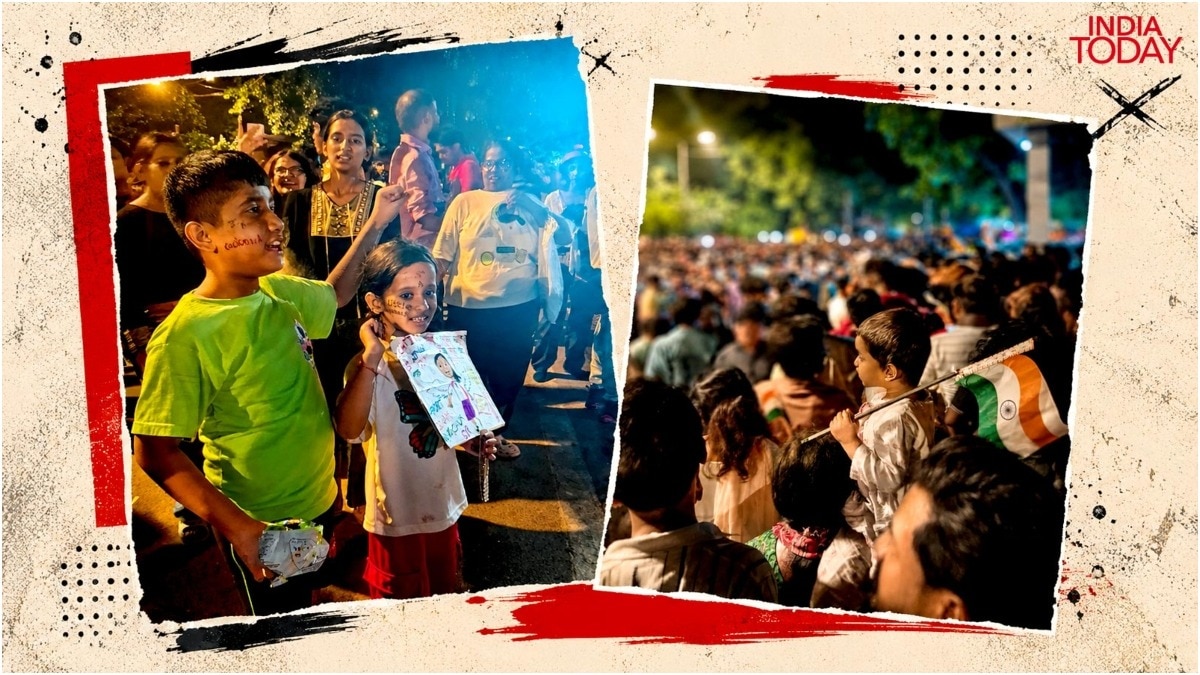
The smallest placard I saw at Jantar Mantar was also the heaviest.It wasn't held by a college student preparing for an entrance exam. It wasn't raised by a parent anxious about their child's future either. It was clutched by a little boy who looked no older than six. The cardboard was almost as big as he was. On it were just three words: ‘Secure our future’.Around him, thousands of adults shouted slogans demanding accountability. He didn't shout much. He simply stood there, occasionally looking up at the people around him, his tiny fingers wrapped tightly around the sign.It made me wonder: At what age does a protest become your inheritance? Children aren't supposed to remember protests. They're supposed to remember ice creams, balloons and the long walks that tire them out before sunset. A child holding a placard with a simple demand. (Photo: Akash Chatterjee) Yet, at Delhi's Jantar Mantar, I kept running into children carrying placards that read "Secure Our Future." One was four. Another was six. One quietly sat beside his parents for hours. Another confidently spoke into a camera about why paper leaks could create ‘fake doctors’. Somewhere between the chants and the barricades, childhood had found itself in the middle of a movement.WHEN THE FUTURE BEGINS TO HOLD A PLACARDAt the Cockroach Janta Party (CJP) protest, however, something felt different. The children weren't merely accompanying adults. Many had become part of the visual language of the movement itself.One little girl stood patiently beside her family, gripping a handmade placard covered in colourful doodles. Beside her was another child with an equally uneven, unmistakably childish drawing demanding the resignation of Education Minister, Dharmendra Pradhan. Their signs were drawn with sketch pens and childlike scribbles, but the demand was anything but childish. (Photo: Author) The letters were wobbly and the sketches looked as though they had been coloured between homework and bedtime. Yet they carried the same message being shouted from the makeshift stage a few metres away.There was something quietly disarming about those signs. They weren't professionally printed. They weren't designed for television cameras. They looked exactly like what they were; messages imagined through the hands of children.THE BOYS WHO WATCHED MORE THAN THEY SPOKEA little further away, I noticed two boys sitting cross-legged on the ground beside an older family member. Unlike the students around them, they weren't chanting slogans or raising fists. They mostly watched.Every few minutes they turned their heads as chants echoed through the crowd. They looked towards the stage, then towards the police barricades, before looking back at the adults beside them, almost as if trying to understand why thousands of strangers had gathered under the unforgiving Delhi heat.For them, the protest seemed less like a political event and more like an enormous classroom without walls.A VIEW FROM THE TALLEST SHOULDERSElsewhere in the crowd, another child sat high above everyone else on a parent's shoulders, clutching a small Indian tricolour.From his vantage point, he had the best view of the sea of flags, placards and people stretching across Jantar Mantar. Every now and then he waved his flag with infectious enthusiasm, oblivious to the weight of the conversations unfolding below. Hope, held in tiny hands. (Photo: Ajay Singh) Then there was the mother whose video stayed with me long after I had left the protest site.Her child rested comfortably in her arms as she stood amid the crowd with a battery-operated fan, water and everything needed to shield the little one from Delhi's relentless heat.When asked why she had brought her child to the protest, her answer wasn't about creating memories or making a statement.She said she wanted her daughter to learn the difference between right and wrong. She wanted her to grow up knowing that speaking up against injustice matters. More than anything else, she said, she was standing there to secure her child's future.It is easy to dismiss children at demonstrations as passive participants. But watching them at Jantar Mantar, I wondered whether adults sometimes underestimate what children absorb simply by being present.Long before they understand policies or politics, they recognise emotion.They notice when their parents refuse to leave despite exhaustion. They hear strangers applaud acts of courage. They watch people share food with one another. They see disagreement unfold without ever reading a newspaper editorial.Perhaps that is how civic memory begins, not in textbooks, but in moments. Years from now, these children may not remember every slogan that echoed through Jantar Mantar. A little boy sat with a CJP placard observing the protest. (Photo: Author) They may forget the speeches, the banners and even the reason thousands had assembled there. But they might remember standing beneath a blazing July sky, holding a placard almost their own size, watching adults insist that the future was worth showing up for.And perhaps that is the quiet legacy of this protest.A SIX-YEAR-OLD’S WORDSSix-year-old Devdas Singh, a Class 1 student from Lucknow, stood at Jantar Mantar holding a placard he'd made himself. When asked why he'd braved the heat to be there, he said, "Because if we can do something for our country, we should. We have to. If we don't raise our voice now, thousands of children will suffer”.He was just as clear on the exam paper leaks that brought him there: "If papers leak, someone who hasn't studied can become a doctor. The children who studied so hard for years... what happens to all their hard work?" And when asked what could go wrong if such a person became a doctor, the six-year-old didn't hesitate: "They could give the wrong injections." It's this plainspoken, almost matter-of-fact logic, delivered without a trace of coaching, that has turned clips of the boy’s interview into one of the more widely shared moments from the protest.A MOVEMENT STILL UNFOLDINGWhat began as a gathering of students demanding accountability over the NEET-UG 2026 paper leak has, over the past few weeks, evolved into one of the country's most closely watched youth-led movements. From Delhi's Jantar Mantar, where the Cockroach Janta Party (CJP) first called for a march to Parliament, the protests gradually spread to cities including Mumbai, Patna and Kolkata, each producing moments that resonated far beyond the protest sites themselves.Late on Wednesday night, as demonstrations continued across the country, Prime Minister Narendra Modi shared a video message on social media, assuring students and their families that those responsible for the alleged paper leak would face the "strictest possible action" and that the integrity of competitive examinations would be protected.The Delhi High Court had also ordered the constitution of a fast-track court to exclusively hear cases related to the alleged NEET-UG paper leak, signalling that the matter would receive expedited judicial attention.But for me, the lasting image of this movement will not be the speeches, the barricades or even the slogans.It will be the smallest placard at Jantar Mantar, held by hands far too young to be worrying about examinations, asking the adults around them to protect a future they have only just begun to dream about.- EndsPublished By: Srimoyee ChowdhuryPublished On: Jul 25, 2026 13:16 IST
At Delhi's Jantar Mantar, the youngest protesters carried the biggest questions
Full Article
Original Source
Read the full article at Indiatoday →KhanList aggregates and links to publicly available news content. We do not host full articles from third-party sources. Always verify important information with original sources.