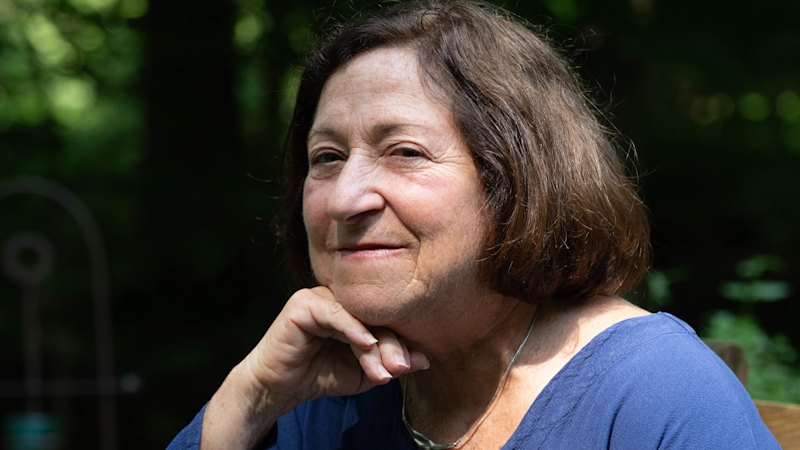
Washington: Donna Sorkin received her cochlear implant from Australian company Cochlear in 1992. “I was a very early adopter,” she says from her home in McLean, Virginia, just outside the US capital.At the time, the Cochlear Nucleus 22 was the only such device approved by America’s Food and Drug Administration. Sorkin, who had measurable hearing loss as a child, was referred to a clinic at Johns Hopkins University in October of that year, and went under the knife in December.Donna Sorkin, photographed at her home in McLean, Virginia, received a cochlear implant from Australia in 1992.Chuck FazioThe implant changed her life. Her father, who also developed profound hearing loss as an adult, was not so lucky. He had to retire on a medical disability at 52, no longer able to perform key aspects of his job.Sorkin’s surgeon, the late John Niparko, later helped create the American Cochlear Impact Alliance, where Sorkin served as the founding executive director – a role she only recently left after 14 years.It was in that capacity that she addressed American trade officials earlier this month, imploring them to spare cochlear implants from imminent new tariffs on 60 countries, including Australia.The proposed 12.5 per cent tariffs – notionally to punish countries for allowing the importation of products derived from forced labour – are set to be formalised as soon as this week.Cochlear’s manufacturing operations in Macquarie Park, Sydney. It supplies a majority of the implants used in the US.Steven SiewertThey are designed to replace the so-called “reciprocal tariffs” announced by US President Donald Trump in April last year, which were ultimately ruled unlawful by the Supreme Court.A temporary measure following that court ruling, which imposed worldwide tariffs of 10 per cent, will expire on Friday (US time).A report by the US trade office accused Australia and 53 other countries of failing to impose a legal prohibition on the importation of goods produced with forced labour. Six other countries failed to enforce such a ban, the report alleged.The Australian government made a written submission to the trade office inquiry, signed by acting trade counsellor at the embassy in Washington, Erin Kelly, arguing that Australia does have robust protections against modern slavery, albeit using a different model to the US.Donald Trump has already imposed an array of new tariffs this month, with more to come.AP Photo/Julia Demaree Nikhinson“There is no evidence … to support the conclusion that a US-style prohibition on the importation of goods produced with forced labour is more effective than Australia’s measures,” Kelly wrote.“Any action taken against Australia as a result of this Section 301 investigation is unwarranted and unsupported by the record.”The submission also pointed out that the US State Department consistently awarded Australia top-tier status in its Trafficking in Persons Report, which assesses countries’ effectiveness in eliminating human trafficking, including forced labour.Several Australian companies made submissions seeking an exemption for their products, including cochlear and baby formula maker Bubs Australia. The Business Council of Australia also submitted that the tariffs would impose disproportionate costs on US manufacturers, businesses and consumers without making a difference to forced labour.Lisa Aubert, president of Cochlear North America, flew to Washington for a public hearing on the proposed new tariffs.Chet StrangeLisa Aubert, president of Cochlear North America, flew from Colorado to Washington to testify at a public hearing. Most cochlear implants in the US are manufactured at Cochlear’s Australian plants – or they come from MED-EL in Austria. “Tariffs would risk serious supply disruption where there is no practical domestic substitute,” Aubert told the trade office.A long-standing international agreement called the Nairobi Protocol provides for duty-free imports of items used by people with disabilities. Donna Sorkin says it’s a no-brainer that cochlear implants should be exempt.“For our device, it would just really destroy access,” she says. “The forced labour arguments just don’t apply to this device at all.“The reality is the companies that make implants, that’s what they do, that’s all they do. If the [US] government decided we’re going to try to stimulate manufacturing for cochlear implants in the US, it would still take eight to 10 years.”Donna Sorkin fears more American children will miss out on cochlear implants if the tariffs are imposed.Chuck FazioAccording to both Cochlear and Sorkin, about half the children who are assessed as eligible for a cochlear implant in the US end up receiving one – lower than in Europe, and much lower than in Australia, where the figure exceeds 90 per cent.About half the American children who receive implants have the procedure funded wholly or partly by Medicaid, Sorkin says. The money paid to healthcare providers through Medicaid varies state by state, and she is worried hospitals will opt out if their costs increase.“Some states really underpay them,” she says. “There will be providers that drop out of providing Medicaid, and it’s going to hit children the hardest. They already lose a lot on Medicaid – so if we make it even worse by adding 14 per cent or whatever they’re talking about, it’s just going to get passed along.”The Albanese government recently announced a raft of changes to strengthen its legal framework against modern slavery, though it did not explicitly tie this to Trump’s proposed tariffs.The White House did not respond to a request for comment about the forthcoming forced labour tariffs and whether Australia’s new measures would change the administration’s plans.US trade ambassador Jamieson Greer told CNBC this week that an announcement was imminent, while the Financial Times reported that Trump was poised to pick from a range of tariff options offered by US officials as soon as this week.He has already announced new 50 per cent tariffs on certain Canadian products, including hockey sticks, wine and cement, and 25 per cent tariffs on machinery, sugar and ethanol from Brazil. The administration said the levies were in response to unfair trade practices by those countries.Meanwhile, a new 100 per cent US tariff on imports of patented pharmaceuticals is due to begin on July 31 for major manufacturers – and Trump said earlier this week that he had no plans to change that schedule.He also announced that generic drugs would remain tariff-free for two years, but would receive a 100 per cent tariff starting in August 2028, increasing to 200 per cent a year later.Get a note directly from our foreign correspondents on what’s making headlines around the world. Sign up for our weekly What in the World newsletter.From our partners
As Trump’s new tariffs loom, Australian exporters clamour for carveouts
Full Article
Original Source
Read the full article at Smh →KhanList aggregates and links to publicly available news content. We do not host full articles from third-party sources. Always verify important information with original sources.