
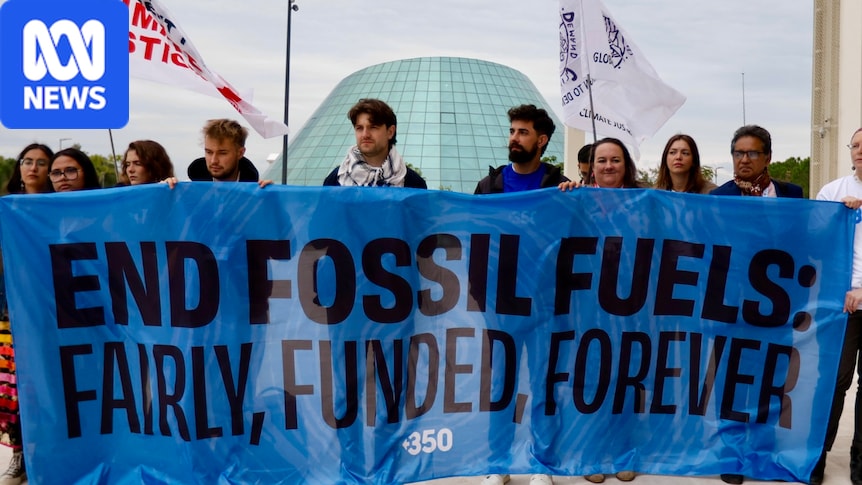
Estimates vary, but the organisers of this year's UN climate talks in Türkiye said earlier this week that there were 94,866 people in Antalya for the two-week COP 31conference.That includes all the official delegations, observers and media, not all the other groups who come along for the climate jamboree.Given that climate change seems to be so far down the list of world leaders' priorities these days, the numbers — which include 34,000 delegates of the various nations attending — seem even more staggering.The United States, at least at a national level, isn't here since Donald Trump withdrew from the Paris Agreement for a second time after regaining office.Neither are a lot of other world leaders.China's President Xi Jinping is missing; Vice-President Han Zheng has come instead.There's no sign of India's Narendra Modi, Canada's Mark Carney or Japan's Sanae Takaichi.British Prime Minister Andy Burnham turned up very briefly.Despite this, those who keep the faith on climate change say coming to the COP meetings each year and seeing such huge numbers of people in attendance, gives them hope."At least it shows that the rest of us are sticking together," one attendee said.But pragmatists concede that the process of annual international talks feels like it is, at best, treading water for now.This week's meeting was the first time it had been conceded that the 1.5°C target had been blown. (Reuters: Wolfgang Rattay)A '35 by 35' planWe are a long way from the grand (and failed) ambition of Copenhagen in 2009, when an attempt to set up an entire world regulatory and pricing structure for carbon seemed (briefly) possible.We are also a long way from Paris in 2015, where a legally binding international agreement was signed by nearly 200 countries to hold the global average temperature increase to "well below 2 degrees Celsius" above pre-industrial levels, while pursuing efforts to limit the increase to 1.5°C.This week's meeting was the first time it had been conceded that the 1.5°C target had been blown.The forecast of a 2.6°C increase in warming has also now snuck up to 2.7°C..In that context, the central plank of this year's talks seems not only starkly unambitious but more rubbery and accommodating of differences.The trajectory of what can be achieved keeps falling, even as the number of climate-related disasters around the world keeps growing.Turkiye and Australia — as co-presidents of this year's conference — have proposed the world adopt a "35 by 35" plan.That is, a plan for electricity's share of final energy consumption to increase to around 35 per cent by 2035.While there is talk of this being a "pledge", the language of the proposal speaks of "advancing the shared ambition" of increasing electricity's share "while recognising different national circumstances and development priorities, and encouraging broader participation and implementation through national action, international partnerships and investment".In other words, the "pledge" is not only not binding, but it also puts no strictures on just what sort of energy is used to generate this electricity.In the language of international diplomacy, 35 by 35 "aims to mobilise political support, investment and international cooperation to accelerate electrification in line with national circumstances".Australia and Turkiye, by happenstance, are among the countries currently most reliant on fossil fuels to generate electricity.(Also by happenstance, Turkiye announced on the day the climate talks opened that new oil discoveries would help lift daily production to over 100,000 barrels a day in the second half of next year.)Climate and Energy Minister Chris Bowen, who is chairing the negotiations, says the 35 by 35 target would require countries to quadruple the current pace at which they are electrifying. (Reuters: Murad Sezer)Not an ambitious targetSome countries, notably France, say the pledge is not worth anything if it is made on the back of fossil-fuel sourced electricity.Critics say it may lock in fossil fuel use for longer.Advocates argue that the plummeting cost of renewable energy means the only rational decision to reach when considering future electricity supplies is clean energy.But it is not always that simple. The complications of individual countries energy systems, the structure and age of electricity grids and infrastructure, let alone the cost, can also limit a country's capacity to switch.No-one seems entirely sure how this proposal will end up after two weeks of negotiations: will it be an "ambition" or some form of binding pledge?Electricity currently accounts for about 23 per cent of energy consumption.It is forecast to rise to 30 per cent on the basis of technology changes already underway.The international think tank the Energy Transitions Commission has estimated that if the whole 35 by 35 pledge was powered by clean energy it would only cut global warming by about 0.3°C.With the 1.5°C target already blown, that doesn't sound particularly ambitious.Climate and energy minister Chris Bowen, who is chairing the negotiations between 190 countries, rejects that, saying the target would require countries to quadruple the current pace at which they are electrifying their energy systems.That means four times faster take up of electric cars, renewable energy like wind and solar, greener buildings and transport systems.In a world where global political will on climate adaptation feels like it is on life support, focusing on electrification offers the political advantage that it can be sold as directly addressing household energy costs at a time when a world energy crisis has made that a rather important issue.Matt Kean, who chair's Australia's Climate Change Authority, was briefly in Antalya at the conference. The Authority's brief relates only to Australia's climate tasks, but he reflected both the reasons why focusing on electrification might make sense in policy terms, but also the political ones in global terms."For Australia to hit it's ambitious emissions reduction targets, there are three things that we need to do: decarbonise the grid [that is move away from fossil-fuel based electricity]; electrify as much as we can; and use our landmass to sequester as much carbon as possible," he says."Doing those three things largely gets us to 62 to 70 per cent [emissions reduction]. Then we need to invest in research and development, to try and solve the problems of steel and cement, that is, the very-hard-to-abate parts of the economy."But let's focus on the things where the technologies are available to us now."If you were to electrify, not only is it going to be good for our emissions, but it will also be good for families and businesses through lower bills."Every time you drive past the bowser at the moment, you're reminded about the need to get off energy supplies coming from very volatile parts of the world."The plight of Palestinians in Gaza has been raised this week in environmental terms as well as human terms, and not just by activists like Greta Thunberg. (ABC News: Ian Cutmore)The calamities of the world are convergingMeetings like the one in Antalya run on compromise and meetings with eye-glazing titles like the "High Level Event on Matters Related to the Global Implementation Accelerator".For those who want such meetings to completely shift the dial on the climate discussion, they seem like what Greta Thunberg described in 2021 as just a lot of "blah, blah blah".There is outrage here that the agenda doesn't even mention cutting fossil fuels directly — a deliberate decision by Turkiye and Australia because talks in so many previous years have foundered on setting any targets or plans to do it.If you put this year's climate talks in the prism of broader world events, rather than just arguing the questions of what should be done about the climate, they are happening in a world without US leadership, where the international order has been crumbling, and where there seems to be an inverse relationship between the need to solve conflicts and the ambitions or capacity to do so.It's somehow appropriate that the plight of Palestinians in Gaza or conflicts in Lebanon, Ukraine and Africa have been raised this week in environmental terms as well as human terms. And not just by activists like Thunberg, but by Turkish President Recep Tayyip Erdoğan in his opening address as host of the conference."What has taken place in Gaza is not only a genocide; it is also an ecocide," he said."Centuries-old olive trees have been cut down in Gaza. The soil and water have been polluted in Gaza. And cities in Gaza have been turned into enormous piles of rubble."All the calamities of the world seem to be converging.Laura Tingle is the ABC's Global Affairs Editor.
As the world's calamities converge climate talks tread water
Full Article
Original Source
Read the full article at Abc →KhanList aggregates and links to publicly available news content. We do not host full articles from third-party sources. Always verify important information with original sources.