
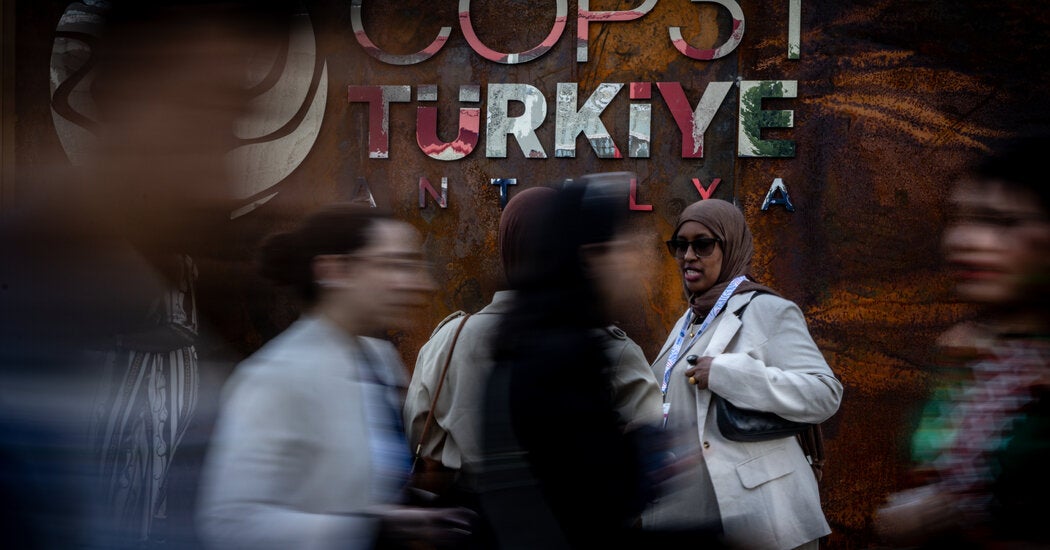
AdvertisementSKIP ADVERTISEMENTSeveral countries that rely heavily on fossil fuels want to delay the next round of scientific assessments that governments use to inform their climate policies.Outside the United Nations climate summit in Antalya, Turkey, on Friday.Credit...Chris McGrath/Getty ImagesNov. 13, 2026, 12:59 p.m. ETA squabble over the publication timetable for several climate reports has turned into one of the burning issues of this year’s United Nations climate conference, as some warn that fossil fuel interests might be interfering with the world’s pre-eminent climate science organization.The U.N.-backed Intergovernmental Panel on Climate Change produces landmark reports that generally come out every five to seven years. The next round of reports would take on topics like physical changes to the earth and greenhouse gas emissions.Timing is critical because in 2028 nations are supposed to assess their progress and then ramp up their efforts to do more, based on the best science. That process, known as a stocktake and occurring every five years, is the engine of the Paris Agreement.Saudi Arabia, India and Russia are among those pushing to delay the reports so that at least two of them come out after 2028.The fact that those nations rank among the largest fossil fuel exporters or importers has led to accusations that coal, oil and gas interests might be interfering with science.“Saudi Arabia is trying to destroy the I.P.C.C. in order to prevent the next global stocktake from using the accurate scientific data on fossil fuels,” said former Vice President Al Gore, who is in Turkey for the talks.At COP31, the United Nations climate talks being held this year in Antalya, Turkey, a handful of world leaders warned that the United Nations’ climate science body is being undermined.“I am deeply troubled” by the impasse, said Prime Minister Feleti Teo, of Tuvalu, whose island nation lies barely six feet above sea level. “Our survival demands collective actions to be guided by science and not by politics.”Many small developing nations, as well as the European Union, want all three I.P.C.C. reports to come before this next assessment period so the science can inform new policies. The United Nations secretary general, António Guterres, said on Friday that he, too, was in favor of that timetable.ImageFormer Vice President Al Gore giving a presentation at the conference on Friday.Credit...Chris McGrath/Getty ImagesBut that group is facing big pushback.The nations that have sought a delay, which also include China and Kenya, have said they want to ease pressure on government reviewers, according to meeting accounts from the International Institute for Sustainable Development, an independent research organization. Smaller countries without resources have a harder time managing this workload, they say, and faster turnaround time could compromise scientific rigor.Representatives from Russia, Saudi Arabia, India, China and Iran did not respond to a request for comment.Patricia Nying’uro, a meteorologist who is Kenya’s lead representative to the Intergovernmental Panel on Climate Change, said that Kenya’s position “comes down to capacity, not politics.”In 2023, countries agreed to transition away from coal, oil and gas. It was the only time a United Nations climate agreement has explicitly referenced fossil fuels.This year, the Trump administration announced it was withdrawing from the Intergovernmental Panel on Climate Change and dozens of other international organizations and treaties, calling them “contrary to the interests” of the United States.One I.P.C.C. negotiator, who requested anonymity because he was not authorized to speak publicly, said that in previous years the United States had been a “mediating influence” in talks, one that hasn’t been replaced. In 2013, for instance, Saudi Arabia contested the key findings of a panel’s report but then backed off.The impasse has complicated the talks in Antalya, which began on Monday.Diana Acconcia, a senior European Commission climate official, said Friday that if the I.P.C.C. issue were not resolved, it might not be possible for the representatives from 190 countries that have gathered in Turkey to agree on other matters.“It is not separable from the COP discussions here,” Ms. Acconcia said, adding, “Europe stands on the side of science.”The climate talks are scheduled to run until Nov. 20.The Intergovernmental Panel on Climate Change, established in 1988, assesses available climate science but does not conduct its own research. It depends on scientists who volunteer to scrutinize existing studies, synthesize findings and draft reports that often span more than 1,000 pages. As part of the timeline fight, its upcoming budget has also been left in limbo.“Our authors deserve clarity and certainty,” said Jim Skea, a British scientist who chairs the I.P.C.C. “I encourage member governments to spare no effort to find consensus and reach a decision.”Chico Harlan is a global climate correspondent for The Times.Lisa Friedman is a business correspondent covering energy for The New York Times.Related ContentAdvertisementSKIP ADVERTISEMENT
Timing of Climate Science Reports Ignites a Hot Fight at U.N. Talks
Full Article
Original Source
Read the full article at Nytimes →KhanList aggregates and links to publicly available news content. We do not host full articles from third-party sources. Always verify important information with original sources.