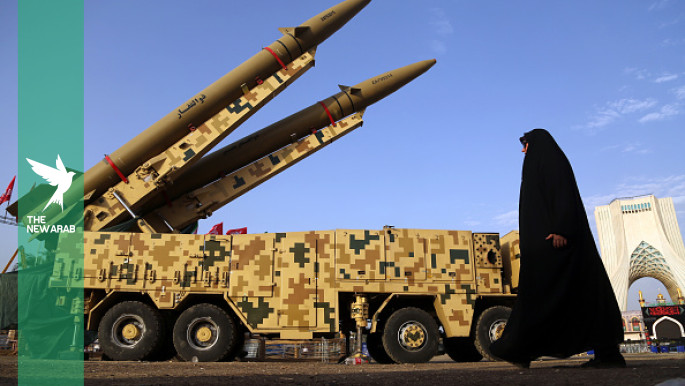
Iran's missile capabilities have become more accurate during the US-Israel war against the country [Getty]Questions are mounting over the extent to which Russia and China are assisting Iran's retaliatory strikes against the US and its regional allies, following reports that Tehran's increasingly accurate missile strikes have been aided by Chinese satellite imagery and tactics adapted from Russia's war in Ukraine. A report by The Guardian said Iran's recent attacks reflected a "real transformation" in its ballistic missile capabilities, citing analysts who pointed to improved intelligence, missile navigation, manoeuvrability and coordinated attack planning. The report followed an Iranian missile strike last week on the Muwaffaq Salti airbase in Jordan, where three US soldiers were killed despite the base being protected by a Terminal High Altitude Area Defence (THAAD) system. Satellite imagery later published by Iranian media appeared to show several buildings had been destroyed. While the Pentagon is investigating why the air defence system failed, analysts say the attack has highlighted Iran's ability to strike targets with increasing precision despite repeated US assertions that its military capabilities had been severely degraded. What evidence is there of Chinese support? Reports have suggested that Chinese satellite imagery has been used by Iran to identify US military installations and critical infrastructure across the Gulf. In May, the US imposed sanctions on three Chinese companies accused of providing satellite imagery to Iran. Among them was Mizar Vision, which Washington alleged had exposed the locations of US military aircraft as well as Patriot and THAAD air defence systems at bases in Saudi Arabia, Bahrain and Jordan. Beyond satellite imagery, Iran's missile programme is also understood to rely heavily on Chinese-made electronics and ammonium perchlorate, a key component in solid rocket fuel, while its navigation systems are capable of using GPS alongside China's BeiDou and Russia's GLONASS satellite networks. According to The Guardian, some of Iran's ballistic missiles now employ steerable warheads capable of adjusting their course during descent, while optical and heat-seeking guidance during the terminal phase reduces their vulnerability to electronic jamming. However, the extent of Chinese involvement remains disputed. Sidharth Kaushal, a senior research fellow at the Royal United Services Institute (RUSI), questioned whether Beijing had provided intelligence directly to Tehran, arguing that Iran had largely targeted fixed military installations whose locations are already visible through commercially available satellite imagery. "I haven't seen anything where Iran has struck a target so dynamic that I've looked at this and gone 'this has got to be foreign aid,'" he told the newspaper. Has Russia helped improve Iran's military capabilities? Russia's role is similarly difficult to assess. Iran and Russia have significantly expanded defence cooperation since Moscow's full-scale invasion of Ukraine, with Tehran supplying drones that have been widely used by Russian forces. Analysts say the relationship has allowed both countries to exchange operational experience, particularly in missile and drone warfare. It has been reported that Iran has adopted tactics similar to those employed by Russia in Ukraine, including using drones to distract air defences before launching ballistic missile attacks. Kaushal argued this was better understood as "a convergent evolution" between two militaries facing similar battlefield challenges rather than clear evidence that Moscow had directly transferred tactics to Tehran. The report also noted that a series of accurate Iranian strikes on CIA facilities in the Gulf prompted some US analysts to question whether Russia had shared intelligence with Tehran, although it stressed that the hypothesis remained tentative. Where does the evidence leave the bigger picture? US Defence Secretary Pete Hegseth this week told Congress that both Russia and China were helping Iran "to some extent". However, President Donald Trump appeared to play down those concerns on Friday, saying Chinese President Xi Jinping and Russian President Vladimir Putin had personally assured him they would not supply weapons to Tehran. Despite growing cooperation between Iran, Russia, China and North Korea, analysts caution against viewing the four countries as a formal military alliance. Matthew Savill, director of military sciences at RUSI, told The Guardian there was "a kind of collaboration there", but said it did not generate "the kind of massive net benefits that Nato produces". While evidence points to expanding technological, economic and strategic cooperation between Tehran, Moscow and Beijing, whether that amounts to active military participation in Iran's campaign remains the subject of debate.
Are Russia and China helping Iran's military campaign?
Full Article
Original Source
Read the full article at Newarab →KhanList aggregates and links to publicly available news content. We do not host full articles from third-party sources. Always verify important information with original sources.