
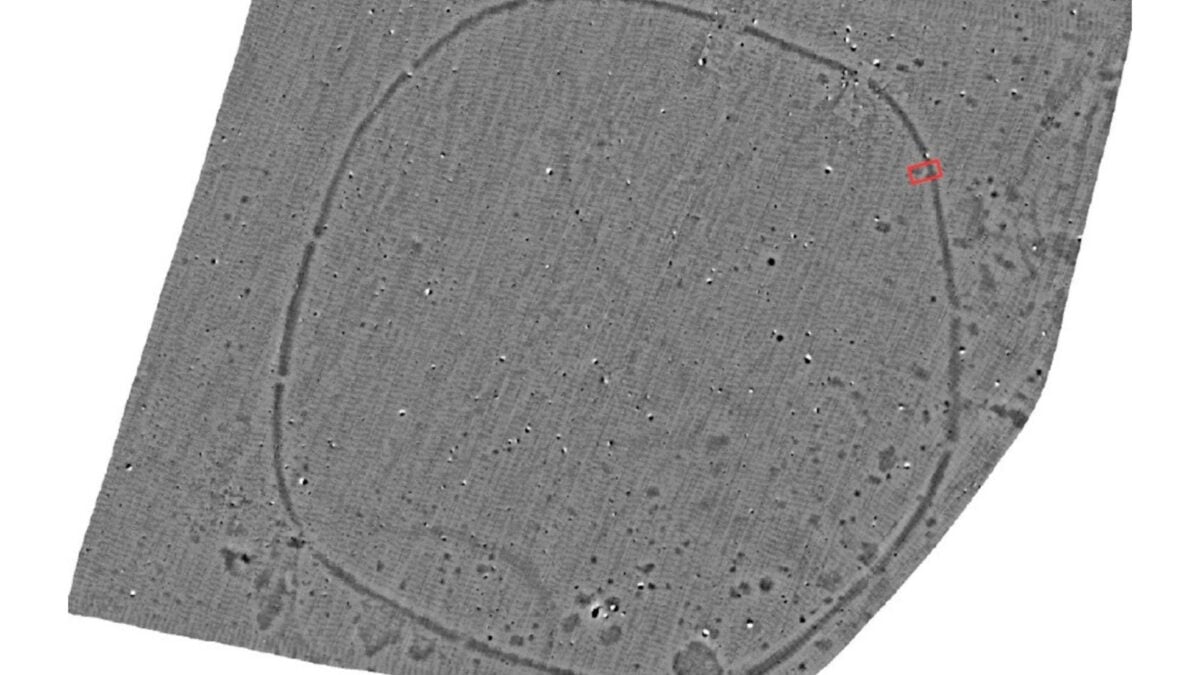
Hidden in a flat plateau of farm country about 25 miles (41 kilometers) east of Prague, archaeologists have uncovered the remains of a prehistoric structure estimated to be 1,000 years older than Stonehenge. At 755 feet (230 meters) in diameter, this mysterious enclosure covers more surface area than the reflecting pool in Washington, D.C. The best clues to its intended use are 12 non-symmetrical entrances along its nearly circular outer rim. Researchers in the Czech Republic now believe those entryways have revealed this 6,500-year-old site’s true purpose: a ritual center built, like Stonehenge, to interact with the movements of the Sun and Moon. One of the site’s astronomically positioned openings appears to have been constructed to honor the lunar standstill, a recurring moment in the Moon’s 18.6-year cycle in which the north-to-south transit of its rising and setting proceeds at an extreme. The ritual center, located near the small village of Chleby, also has entryways that appear to connect the sunrise of the summer solstice to the sunset of the winter solstice—a feature it shares with Stonehenge in England. But, according to landscape archaeologist Petr Krištuf at the University of West Bohemia, it was the structure’s shape that first really caught his attention. Czech researchers are excavating ritual artifacts from ditches uncovered near a circular enclosure that’s roughly 755 feet (230 meters) in diameter and predates Stonehenge by a millenia. Credit: University of West Bohemia “Circular enclosures are completely unknown in our region for this period, which already makes the site exceptional,” Krištuf noted in a press statement. A very old farmer’s almanac Krištuf’s colleague, archaeologist Jan Turek at Charles University, said their excavation work at the Chleby site has only reinforced the hypothesis that this large flat structure had once been a site of religious significance during the Neolithic period or New Stone Age. The researchers have thus far discovered the skulls and horns of bulls near the circle’s entrances, indicative of ritual use. “We assume that they may originally have decorated monumental gateways leading into the enclosure,” Turek explained in a statement. “The cult of the bull was an important religious symbol among the first farming communities and is known from many parts of prehistoric Europe.” Some of this organic material, Krištuf added, provided the raw material needed to date the site in relation to Stonehenge. “For prehistoric farming communities, the connection between sunrise and the summer solstice symbolized a beginning, while sunset and the winter solstice represented an ending,” according to Krištuf, the team’s lead researcher. “The same principle can be seen along Stonehenge’s main axis.” A drone’s eye view of one of the site’s two-tiered excavations, showing a Neolithic ditch and an Iron Age hut from a later, more recent settlement. Credit: University of West Bohemia Bronze Age gravesite A few mysteries remain about this apparently ancient center for ritual worship, including a ditch the team unearthed that’s measured to be over 8 feet (2.5 meters) deep. But, arguably, one of the bigger unanswered questions is why the site’s significance changed from a Stone Age site of worship into a Bronze Age grave. The archaeologists identified human bones located near the site’s entryways, not unlike where they found the bull horns and skulls. These remains echoed previous excavations at the site dated to the time of the Únětice culture of Central Europe’s Bronze Age, between 2300 and 1600 BCE, which uncovered the remains of 18 people buried at the Chleby site over the course of many years. The researchers hope chemical traces found in the site’s soil might one day help explain this cultural shift. “While Stonehenge experienced repeated periods of renewed use and is still associated, for example, with Celtic druids, the first results from Chleby suggest the opposite development,” Krištuf noted. “By the Iron Age, the monument appears to have definitively lost its original significance. The ditch was gradually filled in, and an ordinary settlement was established on the site of the former sanctuary.”
Archaeologists Uncover a Circular Sanctuary That Tracked the Sun and Moon 1,000 Years Before Stonehenge
Full Article
Original Source
Read the full article at Gizmodo →KhanList aggregates and links to publicly available news content. We do not host full articles from third-party sources. Always verify important information with original sources.