
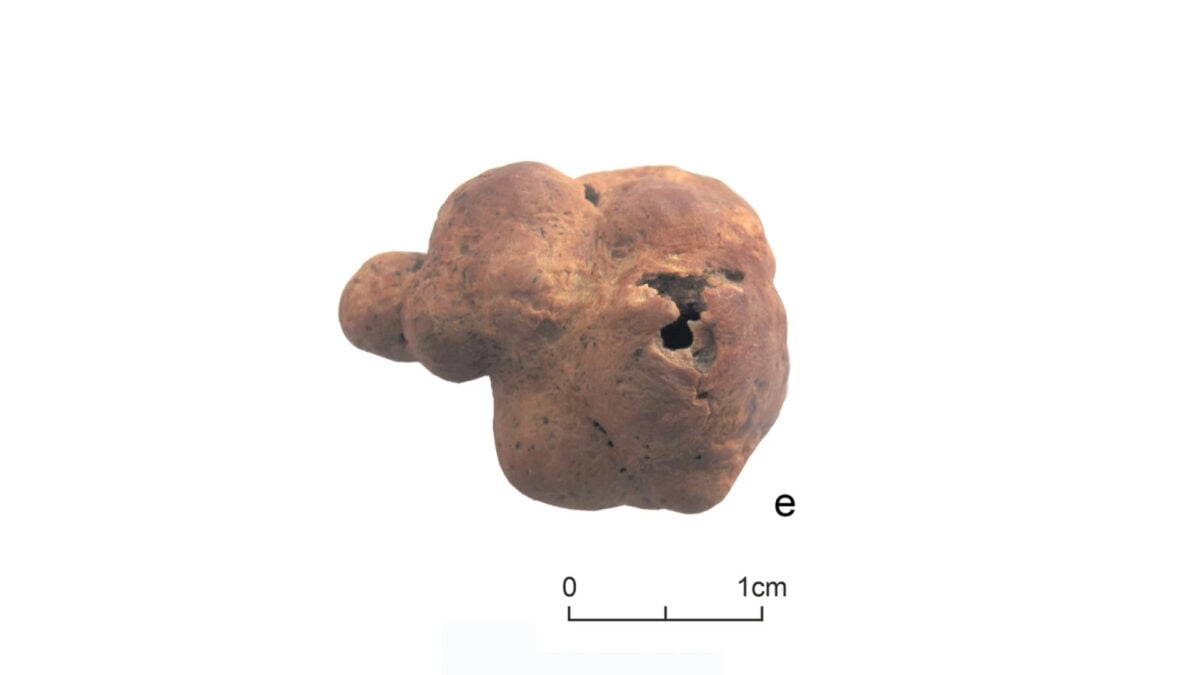
Life wasn’t easy for folks in the Bronze Age, but it seems to have been especially difficult for a particular man whose remains were discovered in Russia. His bones showed various fractures and cysts, pointing to a physically laborious lifestyle. But worst of all, he suffered from something many of us dread—kidney stones. In a study published in Archaeological and Anthropological Sciences, archaeologists report the discovery of what they call a “urinary stone of infectious origin” belonging to a man buried at the Ipatovo-5 cemetery in Russia. Based on available evidence, the team believes the stone most likely comes from the upper urinary tract, which includes the kidneys and ureters. The stone measured around 0.8 by 0.7 inches (21 by 17 millimeters) and has a brownish color with a roundish shape and several protrusions. The man was probably 40 to 49 years old at the time of death, and the potential stone points to poor urogenital health that would have greatly affected his quality of life, according to the paper. A micro-CT reconstruction of the urinary stone. © Berezina et al., 2026 The man’s urogenital infection was “not a brief episode,” Natalia Berezina, the study’s first author and an anthropologist at Lomonosov Moscow State University in Russia, told Live Science. “His last years were probably marked by considerable and more or less constant pain.” Some background This is not the first time scientists have found what the team calls “calcified biological concretions” in prehistoric and ancient human remains. That said, these findings are still rare due to the fragile nature of these stones, which provide “exceptional opportunities to investigate ancient pathology and lifestyle” when they do pop up, according to the paper. A Sarmatian kurgan (burial mound) in Russia’s southern Urals, shown here as an example. © Barefact via Wikimedia Commons (Public Domain) The skeleton was excavated at a cemetery near the town of Ipatovo in western Russia some time ago, as the study refers to there being “earlier” measurements of the cranial features in 2007. This cemetery was part of a field with extensive kurgans, a type of burial in which a large amount of dirt was placed over a grave. Small and sinister? The individual’s bones were relatively complete and well-preserved, which allowed the team to gather a lot of information about his sex, age, and signs of trauma and deformation on his spine, shoulder, pelvis, and joints. There were multiple cysts around the joints of his hands and feet that most likely point to gout. The man was likely part of a community that lived a physically demanding life on the steppes of what is now Russia, Berezina told Live Science. The in situ placement of the skeleton inside the grave (d) and the urinary stone (e). © Berezina et al., 2026 When the team first encountered the stone, it was inside a bag containing hand bones retrieved from the burial—literally, it stuck out from the rest. There was a slight break on the surface that showed crystal-like structures, which the team investigated via advanced X-ray and scanning techniques. The researchers identified a variety of common minerals in addition to whitlockite. This is a calcium salt associated with bacterial activity, which strongly suggests the stone came from some kind of infection. Whitlockite is also found in calculi—solid particles that build up in the urinary system—originating from the kidneys or the prostate, in accordance with modern classification systems for urological stones, as the team noted in the paper. Unanswered questions That said, the team couldn’t decisively identify where this stone came from or why the man had apparent urinary tract issues. This limitation is “intrinsic to the mineral” rather than to the analytical tools, the team added, as the mineralogical signatures that survived the wear of time aren’t “organ-specific.” Whitlockite occurs in both kidney stones and calculi in the prostate, and the latter can’t be ruled out, it explained. It would have been helpful had the team known where the stone was originally located within the burial. Then again, kidney stones can sometimes travel to the bladder, so there would still be a window of uncertainty there, too. Overall, the evidence weighs more in favor of the kidney due to chronic upper urinary tract infection, the team said. But all that said, the researchers think the poor guy was probably in a lot of pain.
Archaeologists Discover a Monster Kidney Stone in a Bronze Age Burial, and Boy Does It Look Painful
Full Article
Original Source
Read the full article at Gizmodo →KhanList aggregates and links to publicly available news content. We do not host full articles from third-party sources. Always verify important information with original sources.