
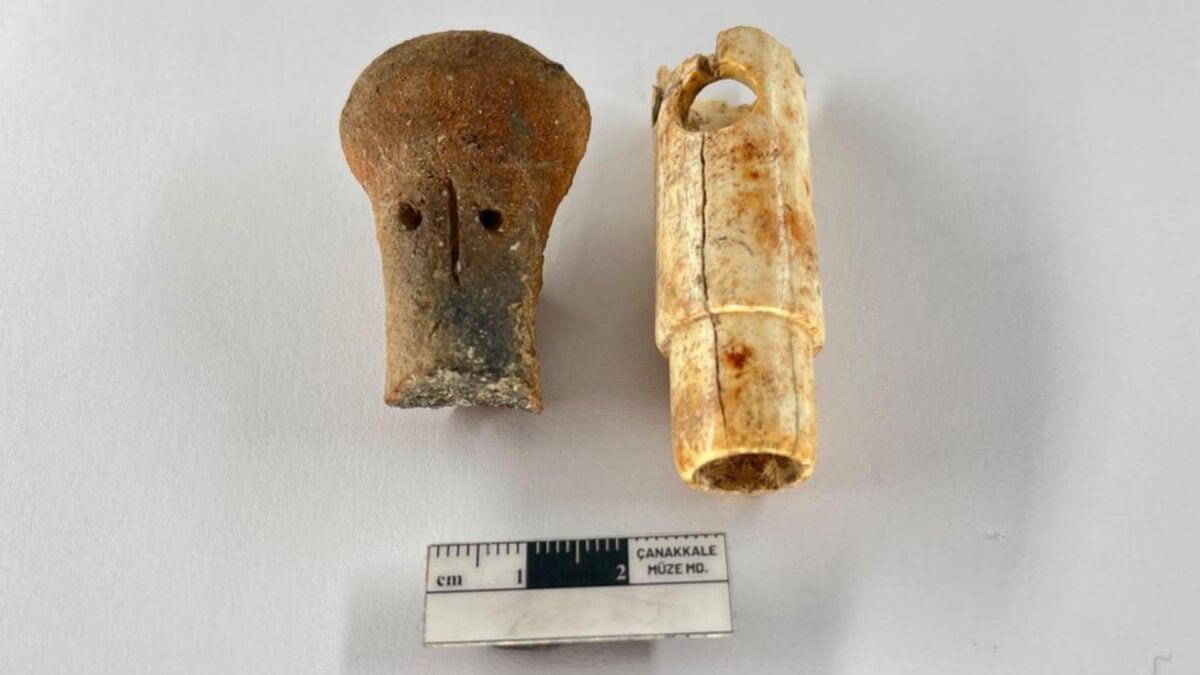
Homer’s Iliad and Odyssey have made Troy one of the most famous cities of antiquity. And while real historical events may have inspired the account of the Trojan War, two recent archaeological discoveries provide further proof that the ancient site is much more than its association with the epic poems. Archaeologists working at the archaeological site of Troy in modern-day Türkiye have discovered an approximately 4,500-year-old idol head and a roughly 2,700-year-old bone flute fragment. The two notable artifacts hail from periods before and after the era usually associated with the Troy depicted in Homer’s works, representing communities that unknowingly contributed to a now legendary city. “Troy was not simply the setting of a legendary war. It remained an important settlement for many centuries, and its archaeological remains continue to reveal new aspects of the lives of the people who inhabited it,” Reyhan Körpe, deputy director of the Troy Excavations and an archaeologist at Çanakkale Onsekiz Mart University, told Gizmodo in an email. Troy was first inhabited in 3600 BCE. And while we speak about one “Troy,” archaeological work has actually revealed nine distinct levels of occupation (Troy I–Troy IX). Experts usually set Homer’s Troy in the Late Bronze Age, especially the late 1200s BCE. At this time, actual Troy was likely the prosperous capital of a regional kingdom the neighboring Hittites called “Wilusa.” The idol head The idol head was made much earlier. It dates back to the Early Bronze Age, around 2500 BCE in Troy II. Troy was likely already the capital of a small kingdom at the time, and the city was experiencing technological and economic developments, such as a greater reliance on wheel-made pottery, according to Körpe. The idol head has eyes, a nose, and a headdress. © Troy Excavation Project The idol head consists of a bulbous-looking artifact marked with two small holes and a straight line (the eyes and nose) and a headdress. These kinds of idols are frequently linked with female figures and religious beliefs, Körpe explained. Their typically small and portable nature suggests that they could have been objects of personal devotion or worship, though this idol’s exact use is unclear. While the idol itself isn’t an unusual finding for Troy, its archaeological context is interesting. It was found under the floor of the entrance to the citadel of that time: the FN Gate. “Was the idol deliberately broken and deposited beneath the entrance? Or was there once a sacred place associated with the protection of the gate? We do not yet know,” said Körpe. “The discovery raises new questions about the religious significance of monumental entrances in Early Bronze Age Troy.” The bone flute fragment, on the other hand, is approximately from the 700s BCE, the beginning of Troy VIII. Troy VII and VIII were separated by centuries of near-abandonment, after which Greeks settled into the city. Körpe and his colleagues’ recent excavations, however, indicate that the resettlement may have actually started much earlier than previously thought. The bone flute would have been attached to another part of the instrument. © Troy Excavation Project Either way, the artifact came from this new community, and “to the best of our current knowledge, the bone flute fragment is the first identifiable musical instrument discovered during archaeological excavations at Troy,” said Körpe. Wind instruments were common in antiquity, especially at festivals, religious ceremonies, and public celebrations. One of its ends is clearly shaped to fit into another tube. The fragment likely consists of the upper section of a wind instrument, most of which was made from wood or reed that has likely since decayed. Researchers are still unsure about how it would have been played. Nonetheless, it “provides direct archaeological evidence for the presence of a wind instrument at Troy during the early first millennium BC,” Körpe explained. And while where, when, and why it was played remains uncertain, the artifact still “adds an important piece of evidence to our understanding of musical life in ancient Troy.” More than just the Trojan War Ultimately, the fascinating discoveries shine a spotlight on the time periods of ancient Troy that the average person surely overlooks, particularly in the wake of Christopher Nolan’s blockbuster release. “Although Troy is best known throughout the world for the Trojan War described in Homer’s Iliad,” Körpe concluded, “archaeological excavations at the site are not simply concerned with finding evidence of this legendary conflict.”
Archaeologists at Ancient Troy Unearth a 2,700-Year-Old Bone Flute. Odysseus Never Heard It
Full Article
Original Source
Read the full article at Gizmodo →KhanList aggregates and links to publicly available news content. We do not host full articles from third-party sources. Always verify important information with original sources.