
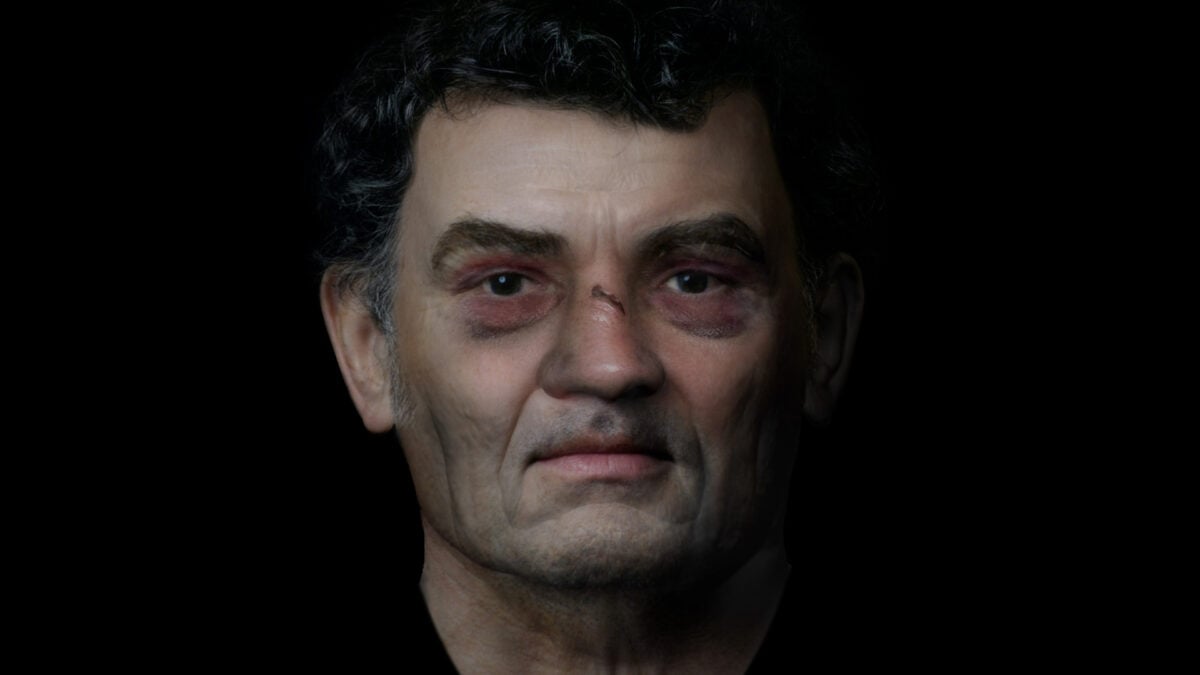
It’s not easy to visualize the past. What’s typically available is a fractured skull or, if we’re lucky, paleoart depicting an artist’s imagined version of times long gone. I’m a real connoisseur of paleoart, but even I must admit: a “real” face truly goes a long way in making the past feel so much more intimate—like this one of a man found in a strange grave. In a recent statement, National Museums Scotland shared the striking image you see above. This is what scientists believe was the face of a man who lived in Roman Scotland 2,000 years ago. Notably, he was buried in a grave where four of the six individuals were decapitated after they died, although the announcement doesn’t specify whether he was among those four. However, the man’s skeleton pointed to injuries to his nose and right arm that he sustained while alive—overall, signs that the team interpreted as hardships that may have made him look older than his age (most likely his early 50s at the time of death). “Taking an interdisciplinary approach to the analysis of human remains allows us to understand the physical attributes of these individuals as well as their life stories,” Jess Thompson, a curator of osteoarchaeology at the museum, said in the statement. “We can investigate where these men had travelled from to reach the frontier, what they were doing there and what became of them.” ‘Extreme’ justice The grave was dug around a Roman fort at Inveresk in eastern Scotland. In a 2021 commentary, Cambridge archaeologist Rob Wiseman explained that around 2 to 3% of Roman burials in Britain were found with decapitated bodies. Although archaeological evidence has been limited, researchers generally hypothesize decapitation was part of a burial ritual, Wiseman wrote. “The rite of post-mortem decapitation was not uncommon but the reasons for it are hard to identify and probably changed over time,” the museum explained in its statement. “It may have been used as a form of punishment, linked to beliefs around the way a person died, or motivated by supernatural concerns.” That said, the burials at Inveresk were actually the first Scottish examples of this gruesome ritual, the museum added. This is in part because Scotland’s soil rarely preserves human skeletons, John H. Reid, an archaeologist at the Trimontium Trust uninvolved in the new work, told Live Science. Rest in pieces? According to the museum, the man likely died sometime between 140 and 165 CE. He “lived a hard and physically active life” and appears to have traveled to the Firth of Forth in Scotland from southern Britain, where the team believes he was born. His nose showed signs of breaking and healing, and extensive bone growth around his right elbow bone—perhaps due to septic arthritis—probably limited the use of his arm. Curator Jess Thompson examines the skull of a man from Roman Scotland. Credit: Duncan McGlynn/National Museums Scotland The team identified “pronounced wear” on his front teeth, which could mean he “compensated for this reduced mobility by holding objects between his teeth.” Overall, the team doesn’t think he was a soldier—at least, not when he died—since he would have struggled to swing a sword with his right arm. Coming soon An alternative version of the man’s face, without the injuries. Credit: Chris Rynn/National Museums Scotland The museum statement said that the reconstruction was informed by an osteoarchaeological assessment, previous isotopic analyses, and ancient DNA. It’s noted that the investigation involved determining the man’s “genetic make-up, geographic origin, and life history.” It was from this that Chris Rynn, a freelance forensic archaeologist, reconstructed the man’s appearance. And the image truly is striking. If you’re nearby, National Museums Scotland will feature the face and the original skeletons in a new exhibition starting from November 14. “Archaeology tells us about people who had hopes and fears just like us, and it is a privilege to present a vision of this resident of Inveresk using contemporary scientific techniques,” said Fraser Hunter, the museum’s principal curator of prehistory and Roman archaeology. “We cannot know how exactly he looked, but we think his family and friends would have spotted the likeness.”
A Broken Nose, a Damaged Arm, and a Gruesome Grave. This Man From Roman Scotland Now Has a Face
Full Article
Original Source
Read the full article at Gizmodo →KhanList aggregates and links to publicly available news content. We do not host full articles from third-party sources. Always verify important information with original sources.