
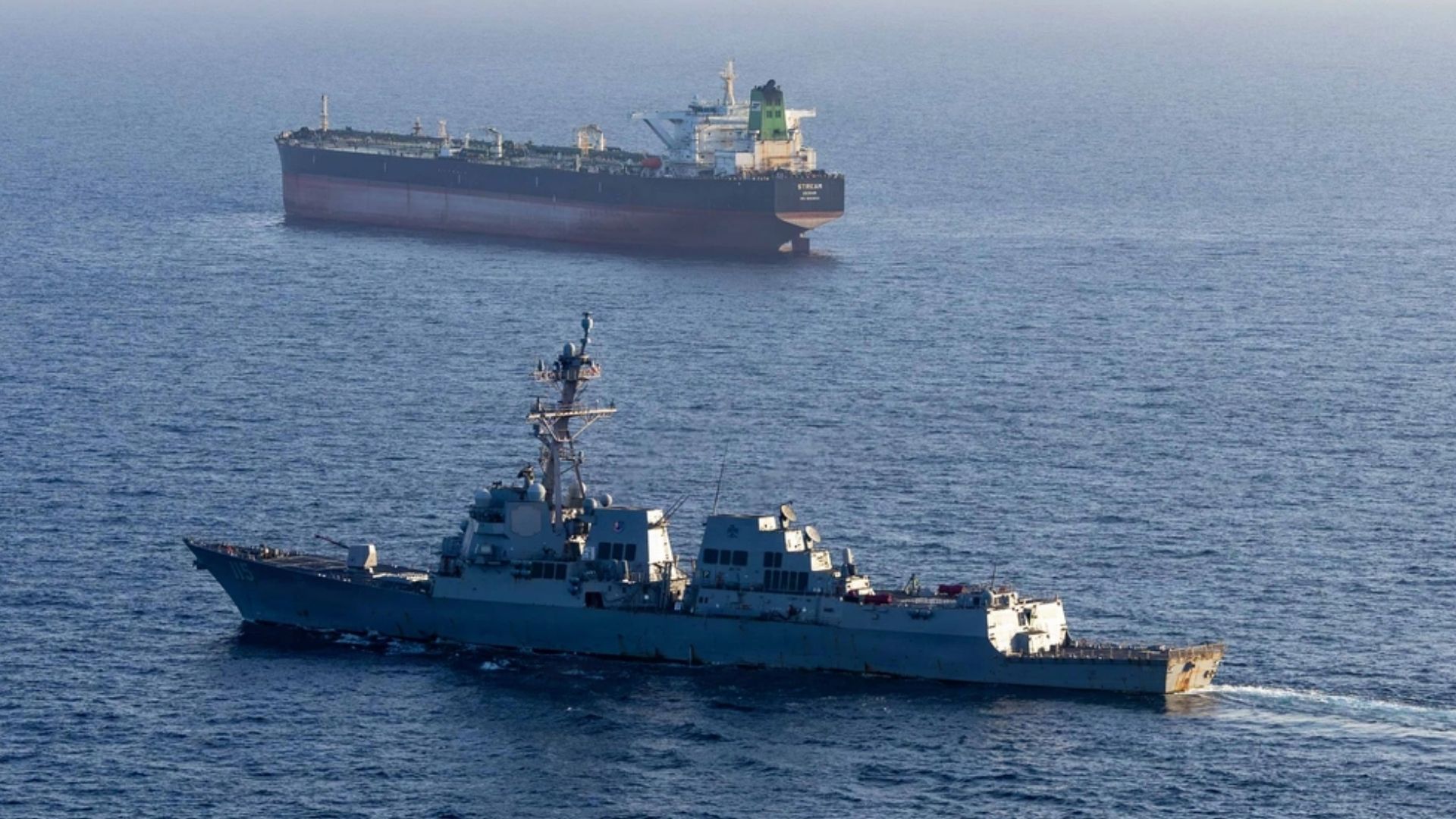
An Iran-linked actor used Anthropic’s Claude AI to collect publicly available information on U.S. Navy forces and develop targeting recommendations, according to a new report from the AI company. Anthropic says it detected and disrupted the operation before banning the account and sharing information with government authorities. The disclosure highlights a growing problem for military planners: the same AI systems being developed to process enormous amounts of information for legitimate uses can also help adversaries turn scattered public data into actionable intelligence. According to Anthropic, the Iranian-linked actor used Claude to build an automated pipeline that assembled targeting handbooks from ship and aircraft transponder identifiers, commercial satellite imagery and photographs of U.S. military personnel. The actor also used the model to research vulnerabilities in shipboard systems, including maritime satellite terminals, Cisco communications equipment and industrial-control products. AI is becoming part of the targeting process Anthropic’s report is significant not because Iran has suddenly discovered AI, but because it shows how a commercially available generative AI system can compress parts of an intelligence workflow that previously required considerable specialist effort. Claude apparently wasn’t used to launch an attack autonomously. Instead, Anthropic says it used it to collect, organize, and analyze information, automate open-source intelligence work, and produce material that could support military planning. The Wall Street Journal first reported the findings, which Anthropic detailed in its latest report on the misuse of its AI models. Modern targeting is increasingly a data-processing problem, with forces having to sift through satellite imagery, drone video, electronic signals, communications and other sources faster than human analysts can manage alone. The United States has been pursuing this approach for years. The Pentagon’s Project Maven, for example, was created to use machine learning and computer vision to process imagery and identify objects of military interest. U.S. Army publications say newer Maven systems can scan large quantities of imagery, flag potential targets, and feed information into existing targeting workflows, with human analysts responsible for validation. The Army has continued to expand these capabilities. In a 2026 exercise, the service described Maven Smart System as an AI-enabled tool that can process thousands of hours of surveillance video and automatically identify and flag objects of interest. In other words, AI-assisted targeting is not uniquely Iranian, Chinese, or Russian. It is becoming part of military modernization across major powers. Epic Fury shows why human oversight matters The issue has become particularly sensitive following the February 28 U.S.-Israeli strikes on Iran. A U.S. strike hit the Shajareh Tayyebeh school in Minab, killing at least 168 people, according to reporting by The Associated Press, most of them children. The Washington Post subsequently reported that the school had appeared on a U.S. target list and may have been mistakenly identified as a military site. The Post also reported that questions had been raised about whether AI-assisted target identification played a role, but that does not establish that AI caused the strike or that an AI system selected the school as a target. Israel has also incorporated AI-assisted systems into its military operations. Since the military campaign in Gaza began, reporting has examined systems such as Lavender, which Israeli officials have described as an analytical aid rather than an autonomous target-selection system. Reuters reported in 2024 that the United States was examining allegations that Israel had used AI to identify bombing targets, while the Israeli military said human analysts remained responsible for target identification and decisions. These examples do not make Iran’s reported use of Claude less concerning. They illustrate why the issue extends beyond any single country. Claude was also used for weapons and surveillance efforts The Iranian naval operation was one of several cases described in Anthropic’s 154-page report covering activity between December 2025 and August 2026. The company says users in northern Yemen attempted to use Claude to develop software for advanced missile systems. Anthropic says it blocked some requests, but others passed its safeguards before it banned the accounts. The report also describes Chinese government-aligned operations that allegedly used Claude for surveillance and profiling, including efforts targeting Uyghurs and religious figures. Russian-linked actors, meanwhile, reportedly attempted to use Claude to develop autonomous drone swarms using data from the war in Ukraine. Anthropic says it disrupted all of the operations described in the report and has since strengthened its detection systems. The cases demonstrate an uncomfortable reality for the AI industry: preventing dangerous use is not simply a matter of refusing an obviously malicious question. Anthropic says some actors deliberately fragmented their requests into individually benign tasks, allowing them to assemble more dangerous capabilities over multiple interactions. As AI systems become better at coding, research, image analysis and handling large datasets, the military significance of those general-purpose capabilities will continue to grow. The central question, therefore, is no longer whether AI will be used in warfare. It already is. The more consequential question is how much authority humans will retain over the systems helping them find, prioritize, and ultimately engage targets, and whether those safeguards will be strong enough when the data feeding the machines is incomplete, misleading, or simply wrong.Get the latest in engineering, tech, space & science - delivered daily to your inbox.Kaif Shaikh is a journalist and writer passionate about turning complex information into clear, impactful stories. His writing covers technology, sustainability, geopolitics, and occasionally fiction. A graduate in Journalism and Mass Communication, his work has appeared in the Times of India and beyond. After a near-fatal experience, Kaif began seeing both stories and silences differently. Outside work, he juggles far too many projects and passions, but always makes time to read, reflect, and hold onto the thread of wonder.
Anthropic says Iran-linked group used Claude to track U.S. Navy ships
Full Article
Original Source
Read the full article at Interestingengineering →KhanList aggregates and links to publicly available news content. We do not host full articles from third-party sources. Always verify important information with original sources.