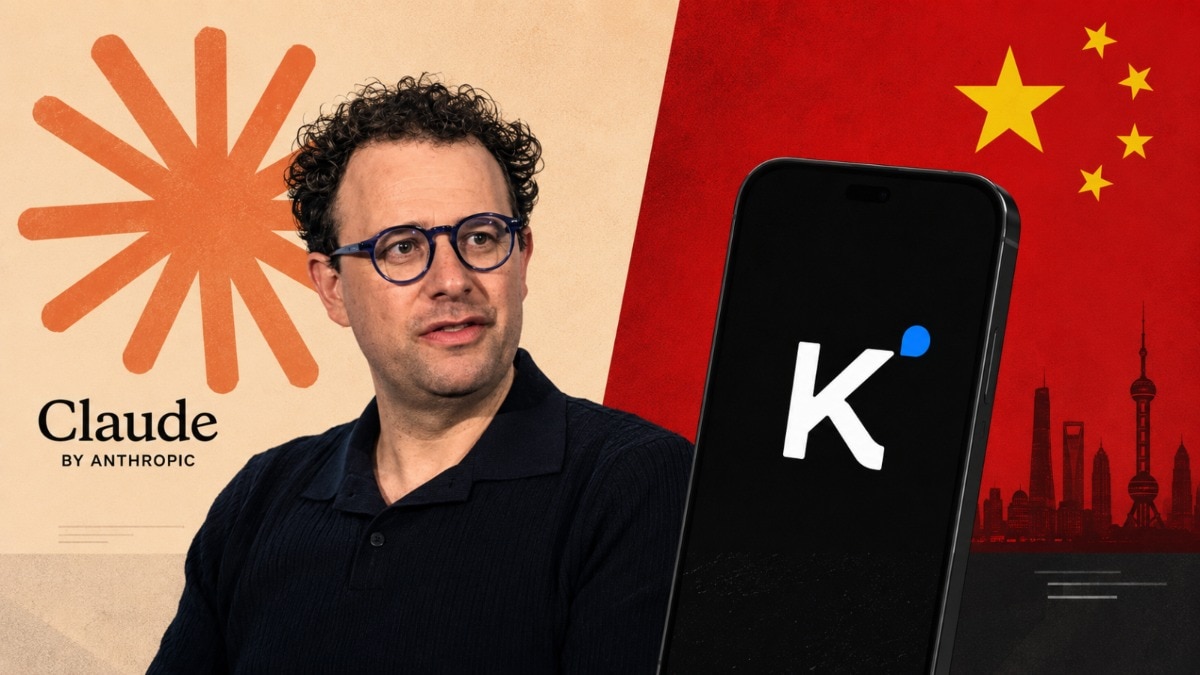
Anthropic CEO Dario Amodei has addressed critics over not signing a letter to the White House for not banning Chinese open-weight models. Dario say that while he supports open-weight models in general, he is worried about how China may use them.Dario Amodei says that Anthropic was never against open-weight models, but it is concerned about China. (Representational image made with AI)In the past few days, a rift has appeared in Silicon Valley. Companies like Nvidia and Microsoft have welcomed Chinese open-weight models as models like Kimi K3 deliver strong performance. So much so, that over 50 companies have sent a letter to the White House, urging it to not ban Chinese open-weight models. However, Anthropic was conspicuously missing from this list. And now, Anthropic CEO Dario Amodei has addressed rumours, claiming that his AI startup is not against open-weight models, but is worried about China.In a blog post, Dario claimed that Anthropic "never advocated for a ban on open-weights models." The Anthropic chief accepted that open-weight models had advantages. “They don’t cost anything besides the compute needed to run them, and they provide value to businesses, developers, and researchers,” he explained.But Dario Amodei said that he was worried about “two nightmare scenarios” when it comes to open-weight models.Before we begin, do note that open-weight models like Kimi K3 or GLM 5.2 are much cheaper to run than closed models like Claude or GPT-5.6. These open-weight models can also be run locally on your own devices. Dario Amodei’s nightmare China scenarioA major concern for Dario was the risk of authoritarian governments gaining control of powerful models, and in particular, China. He explained, “The Chinese Communist Party (CCP) is clearly the most capable threat to build AI models that are more powerful than those built by the US.”Dario Amodei says that if China gets access to more powerful models than the US, it can use them to “achieve permanent military superiority” or use the models to repress its citizens. That is, Dario is worried that the Chinese government may use AI models to crack down on its own citizens or use AI in warfare – think a murderbot that may kill without needing human inputs.Open-weights easier to misuse, says Dario AmodeiBut China was not the only fear for the Anthropic CEO. He pointed out that as AI models get more powerful, they can potentially be misused – think cyberattacks or biological attacks. According to Dario, the risk for such misuse is much higher for open-weight models.He explained, “Open-weights models—it does not matter whether they come from China or anywhere else—do potentially present a higher risk than closed models, because it is very difficult to apply guardrails to them or monitor their usage, and once weights are released they cannot be withdrawn.”Do note that Anthropic was at the centre of the debate regarding cybersecurity with the launch of Claude Mythos. The US even banned the Mythos and Fable models citing these concerns. Anthropic later released the models back to the public after implementing more safeguards.Dario Amodei’s solutionInstead of a blanket ban on Chinese open-weight models, Dario Amodei believes that the US should put certain restrictions that limit AI development in China.The Anthropic CEO says, “We should not sell powerful chips or chipmaking equipment to China, and we should crack down on the rampant smuggling and workarounds used to obtain access to such chips.” Keep in mind that while the US has restricted chip exports to China, Chinese companies have continued to make progress.Recently, DeepSeek’s CEO claimed that such limits were only making Chinese AI labs work with companies like Huawei to improve AI chips.The second thing Dario wants the US to do is to “crack down on industrial-scale distillation operations.” Distillation refers to the process of training a smaller model on the responses of a larger model. Anthropic has accused Chinese AI labs of distilling AI models to train their own. Dario Amodei adds, “Distillation does not allow the CCP to obtain equivalent or superior AI capabilities to the US, but it can bring the Chinese frontier to within a few months of the US frontier.”And lastly, the Anthropic CEO wants safety testing of all AI models, not just open-weights. “The best way to address threats is to just directly test models for cyber, biological, and alignment risks before release,” he explained.The Anthropic CEO claimed that he was “heartened” to see moves being made by the Trump administration in this direction recently.Regarding the letter, Dario claimed that he didn’t agree with some of its assertions. He claimed that “open-weights models necessarily make it easier to develop safeguards or that broad access to capabilities necessarily helps defenders more than attackers.”Amodei’s post comes at a time when tech companies lined up on opposite sides of the policy argument in Washington. Dozens of companies, including OpenAI, have backed the letter. Industry leaders, including Nvidia chief Jensen Huang and Microsoft CEO Satya Nadella said open systems make advanced AI more accessible, adaptable and widely available.Anthropic did not sign the letter, prompting criticism from some, including former White House AI czar David Sacks, who said the company was trying to weaken Chinese rivals and protect the business model of closed-weight firms.The debate has widened after Chinese startups released a series of models that have unsettled Silicon Valley’s long-held belief that US firms would remain comfortably ahead. From DeepSeek and Z.ai’s GLM 5.2 to Moonshot AI’s Kimi K3, Chinese companies have put out cheaper models that rival or in some cases beat leading American systems on benchmarks.- EndsPublished On: Jul 28, 2026 09:42 IST
Anthropic doesn't want to ban open-weight models, it is concerned about China
Full Article
Original Source
Read the full article at Indiatoday →KhanList aggregates and links to publicly available news content. We do not host full articles from third-party sources. Always verify important information with original sources.