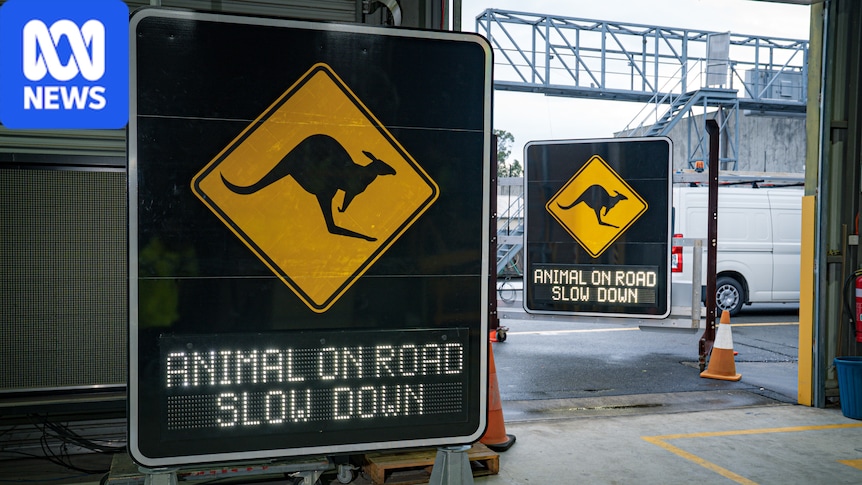
An artificial intelligence-powered alert system is being trialled on a stretch of the Monaro Highway between Canberra and the Snowy Mountains in a bid to stop wildlife from becoming roadkill.The Protective Animal Warning System (PAWS) uses thermal and optical roadside cameras to detect animals close to the roadside, and an AI computer vision-aided model identifies common species such as kangaroos, deer and wombats.When an animal is detected, a smart road sign then flashes up the words "Animal on road slow down", to alert approaching motorists in real time."This new technology enables us to give motorists early warning that there would be a target species on the road ahead of them," New South Wales Roads Minister Jenny Aitchison said."It gives them time to slow down and be ready for the animal, so that the animal can hopefully get off the road in time."Roadkill hot spotIt's the first time the technology has been used in New South Wales, with the trial being conducted on a 300 metre section of the Monaro Highway at Michelago, between Canberra and Cooma."This is an area that has been assessed as having one of the highest rates of animal wildlife strikes on the network in New South Wales," Ms Aitchinson said.Wildcare Queanbeyan president Elena Guarracino described the area is "an incredible hot spot" for kangaroos in particular.The trial area covers 300 metres of the Monaro Highway at Michelago. (ABC News: Lish Fejer)"There are a couple of dams on one side of the Monaro Highway, and they're continually crossing there and it's just a very … horrible area," she said."I've counted up to 30 dead kangaroos at that spot. Along that road towards Williamsdale every 10 metres you'll see a dead kangaroo."That's partly fuelled by the ski traffic, but also there's a lot of traffic just generally that commutes to Canberra along that road."What we see from the road is just a fraction of what's been hit and moved away from the road until it succumbs to its injuries."Wildcare Queanbeyan president Elena Guarracino is hopeful the new technology will help reduce animal-vehicle collisions. (ABC News: Lish Fejer)An estimated 10 million animals are killed on Australian roads each year at a huge cost to motorists, insurers and native animals — as well as to wildlife volunteers. "When those animals are struck, the wildlife group has to send people out to rescue that injured animal or potentially euthanise it," Ms Guarracino said."And then there's the impact of the joey that's in the pouch which, when it's rescued, can take up to two years to rehabilitate before it can be old enough to be released."That costs at least $1,200 and enormous volunteer hours — that's if everything goes well and vets aren't involved."Wildcare Queanbeyan's Elena Guarracino and Christian McDonald are regularly called to the Monaro Highway to attend to injured wildlife. (ABC News: Mark Moore)'Smart' version of traditional sign Ms Guarracino said research had shown the traditional yellow and black wildlife warning signs along roads and highways "don't work"."They might initially warn the motorists that there is wildlife in that area, but drivers get habituated to those signs," she said.The digital sign being used as part of the trial, on the other hand, will only display words when activated to alert drivers. "What this is about is targeting the message so that it's exactly correct for what is happening on the network," Ms Aitchinson said."So it just means that drivers will get more of a warning that will be more appropriate to actually whether there's animals there or not."The smart signs will activate when there is wildlife activity nearby. (Supplied: Transport for NSW)The development of PAWS and the subsequent trial is a result of recommendations from the 2024 Wildlife Symposium in Sydney, exploring how emerging technology could be used to reduce wildlife-vehicle collisions.The AI model behind PAWS has been developed by Transport for NSW's technology and biodiversity teams, combined with animal data from the Symbio Wildlife Park near Wollongong.Specialist cameras filmed how different species moved and behaved in a controlled setting to build an image library, which was then cross-referenced with time-of-day and weather data to sharpen the system's accuracy in different types of conditions."This is an investment of around half a million dollars in just developing the technology," Ms Aitchison said."And the benefit of it being done and developed in-house with Transport for New South Wales is that we can ensure that we have the technology, we can use it."Passengers urged to help lookout for wildlife The trial at Michelago is due to begin next month, and Transport for NSW will track whether there is a reduction in wildlife strikes in the test area.Ms Guarracino is hopeful that if the technology proves successful it will not only be rolled out to other hot spots, but also expanded to bring real-time alerts into cars as they drive past."It'd be great if the cameras could be integrated into guideposts and give a warning to a driver [via Bluetooth] through their warning devices in their cars," she said.Wildcare Queanbeyan volunteers Christian McDonald and Elena Guarracino say the trial area on the Monaro Highway is a wildlife hot spot. (ABC News: Mark Moore)In the meantime, she continues to urge drivers and passengers to keep their eyes peeled for animal activity, especially during dusk and dawn. "I drive very carefully and scan the sides of the road the whole time, even in the daytime," she said."And instead of having passengers watching their phone, they need to be scanning the road and helping the driver and going, 'Oh, kangaroo on the left, slow down'."
'Animal on road': AI-assisted cameras and smart signs to warn drivers
Full Article
Original Source
Read the full article at Abc →KhanList aggregates and links to publicly available news content. We do not host full articles from third-party sources. Always verify important information with original sources.