
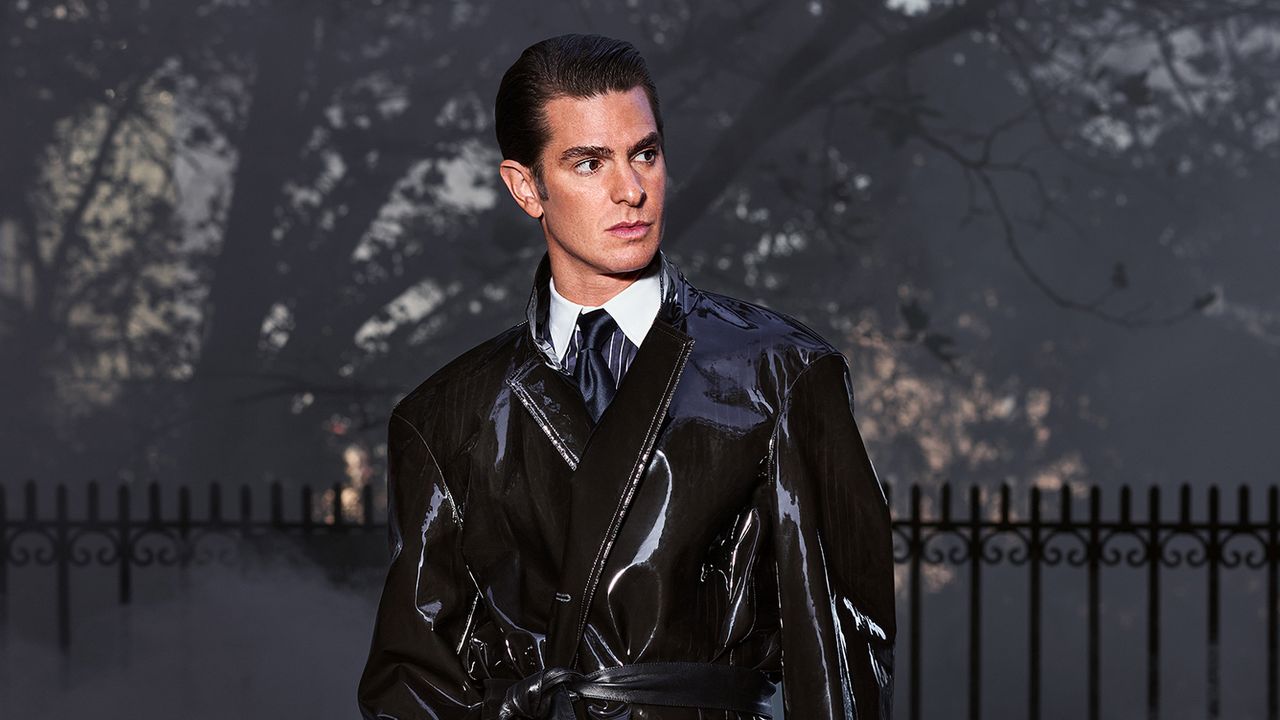
In 2009, Andrew Garfield found a thread. He was preparing to play Facebook CEO Mark Zuckerberg in a little-hyped film called The Social Network, and he had located the thing in Zuckerberg’s story that he could pull on—the through line that turns personal experience into empathic performance and on into universal storytelling. Then he lost the part to Jesse Eisenberg. Director David Fincher had seen what, today, is obvious: Humanity flows fast and deep through Andrew Garfield. Fincher cast him instead as Eduardo Saverin, the betrayed cofounder and emotional counterweight to Zuckerberg’s opacity, who cries, sneers, throws a feint, and smashes a laptop (that’s one scene).The movie made him a celebrity, and he brought an unusual depth of emotion to this job too. While serving as Spider-Man, he begged the public, via a handwritten sign held up for paparazzi, to care about a more important cause than what’s up with famous people. While promoting 2021’s Tick, Tick…Boom! on The Late Show With Stephen Colbert, he talked about the death of his mother; the clip still gets shared by grieving people.Boxers by Hermès. Sneakers by Bottega Veneta. Socks by Jacques. Watch by Rolex. Our latest issue is here. Subscribe now to secure your copy and get one year of GQ for $1/month. Now, 15 years after The Social Network, Garfield has picked back up the tech-CEO thread to play Sam Altman in Artificial, Luca Guadagnino’s film that covers the founding of OpenAI up to the coup that led to Altman’s firing—and his re-entrenchment. (OpenAI has an agreement with Condé Nast, the owner of GQ, which allows OpenAI to display its content in search results for a limited term.) The movie seems destined to occupy the same orienting role as The Social Network, helping us understand the technology and the men who are shaping our futures, almost in real time. But whereas that film was a legal drama about status (Harvard guy vs. hotter, richer-born Harvard guys), Artificial plays as a horror movie where the monster, AI, is real. (And it just learned how to do theoretical physics.)Garfield brings Altman to life as a mad guidance counselor: rubbing the shoulders of engineers, taking security meetings cross-legged, and sucking green juice in the faces of his adversaries. Here, finally, is an ascendant tech overlord that makes unsettling use of Garfield’s famous sensitivity. When Garfield-as-Altman cries, you’re not sure whether they’re the tears of a true superintelligence believer or a duplicitous power-seeker. Or which one would be scarier.When we meet in early October, Garfield is transformed by a beard and shoulder-length hair. He grew it all out to play the magician Roy Horn, of Siegfried and Roy, in next year’s show Wild Things, though they ended up putting a wig on him anyway. He was filming that limited series in Berlin immediately after wrapping The Uprising, a Paul Greengrass movie about the Peasants’ Revolt of 1381, which shot before Artificial was even technically wrapped. “I did these three things back to back last year, and I did have a bit of burnout, to be honest. I was kind of sleepless in Berlin for a while, and not in a romantic way,” he says. “It was rough, dude. I should have just gone to Berghain and just rode it out.” Now, though, Garfield is visibly buzzing, both from watching Artificial with an audience at the New York Film Festival the night before—and from the chatter coming out of Silicon Valley.This interview has been condensed and edited.GQ: Artificial premiered last night here in New York, but back in San Francisco they are still reacting to the trailer. Jack Altman, Sam Altman’s younger brother—Andrew Garfield: I’ve listened to his podcast.He writes on X, “Look, you all know I’d love nothing more than a feature-length film making fun of my brother. Unfortunately, based on the preview, it looks like the only thing they got right”—Is the walk.How did you nail the walk?The walk was a key for me, and the clothes and the physicality. He’s a very slight, slim guy, Sam, and seems to be very image-conscious. Which is interesting to me, which is something that I felt compelled by. There’s a great video of Sam, in what looks like a diner, when he’s talking about Loopt [the company he cofounded before running Y Combinator and cofounding OpenAI], when he’s in his early 20s, and he was much freer with his physicality back then.Sam did an interview with Vanity Fair [for the magazine’s New Establishment issue]. I think it came out yesterday, the day of our premiere, where he was very sweet about the walk as well. It’s a very generous thing for the boys to acknowledge that the walk was close, a good approximation of Sam and his vibe. I think that’s a very classy thing, to acknowledge the thing that seems to be working. But who knows what’s happening in their hearts and minds right now or within the family? I can project myself into that experience and imagine what it must feel like for an actor to be so presumptuous to play a character called Sam Altman in a major film. I can imagine that must be really strange, and I feel for…. I don’t know. In terms of taking it on, what outweighed that sense of responsibility for me was this sense of it is the defining inevitable invention of our times. It felt like a great responsibility to interrogate not just the machine, if you can even call it that, the kind of the consciousness or the technology itself, but to interrogate the people who are building it and who are putting their hearts and souls and life’s work into it, and where they may or may not be leading us.Coat by Celine. Pants by Dunhill. Sunglasses by Jacques Marie Mage. Watch (throughout) by Audemars Piguet. Vintage ring from Foundwell.Artificial is the story of the dawn of AI. It’s very abstract. But it’s a very physical performance that you’re doing. You’re doing some highly unconventional, athletic sitting on chairs.That was deeply researched. This is what I gleaned. There’s a lot of people that know Sam. There’s a lot of people that are happy to talk about Sam. Some very, very protective; others, slightly more inside information. And I’m not going to name who these people are. But it was a kind of adding to the cauldron and through my lens of the interpretation of who this person is, combined with what was on the page and the specific cinematic story we’re telling and how we’re telling it, and Luca’s tastes and sensibilities. And, yeah, a lot of people said he would never sit conventionally. He was always sitting like a little boy.And sitting that way invites some sort of intimacy?Intimacy, but also ownership of a space—a kind of subtle, very soft dominance of a space. But also, as you say, a kind of, “Hey, we’re all just hanging out doing the coolest job ever. So why can’t we just sit like we’re in a dorm room?” It’s very psychologically interesting to me and smart. And who knows if it’s all calculated? Who knows if it’s not? I don’t know. What was interesting, in tracking his physicality in all the videos I saw is, at the beginning, he’s very free in how he twitches and moves. He’s just freer in his ability to be his true self maybe. And then as he starts to become more and more powerful, and ultimately becoming the face of the new world, this behemoth company that’s going to define where we are going—even if he doesn’t know where we are going, and none of them do—he becomes a slightly more homogenized version of a tech CEO. That was a really, really interesting kind of journey. And you can see, now, in [Altman’s recent interview with Vanity Fair], he’s very image-conscious, and I am too. I think we all are.Did you relate to Sam Altman?I mean, yes. One has to. This is the job. And this is why I wanted to do it: Because with The Social Network, I was getting ready to play Mark Zuckerberg, and then David Fincher calls me in and says, “We found someone that is just going to do it better. It’s Jesse, but we think you could also play this part. And you’re a very emotional actor, Andrew, so why would we waste all of that on someone who doesn’t seem to feel many emotions?” So Eduardo became my kind of guy, and I was very happy with that. But it left a little dangling thread, and I was like, “I need to understand.” Because I started to explore what it takes to win, to win on that level.I think I’m a competitive person. I’m an athlete. I was raised by a swimming-coach father and, at that time, a proud capitalist. My dad has evolved his view of the world over the course of the last decades, which I find very moving and touching, as I have evolved my view of winning and losing and the beauty of losing and how humility is the only thing that actually grows us. It’s fucking awful. I hate losing.Is it harder to find ways to get your butt kicked the more successful you get?No. It’s so much easier. Because you’re on this fucking false pedestal and it’s so much easier for the shit to get kicked out. It’s like, Oh, wait a minute. I forgot that I got above my station for a minute, and it’s a wonderful, horrible gift to be forced to crawl back down into the mud of what it is to be a human being. And actually I think it does relate to the story that we’re talking about, the film that we’re talking about.Shirt by Tom Ford. Pants by Saint Laurent by Anthony Vaccarello. Suspenders by Turnbull & Asser.You said that as you’ve matured, you’ve changed how you think about winning and losing. What does winning mean for you now?When I was in my 20s, 30s, it was a time of slaying dragons and trying to plant flags and say, “This is who I am.” And then I think maybe as you enter middle age, a bunch of unresolved wounds from childhood that you kind of patched over with success just go, “Hey, we’re still here, dude.” And then it’s time to realize that there’s still a lot of work to do on maturation. I’m sorry, but to keep bringing it back to the film, I think what we’re dealing with is we’re in a very immature culture. We’re being still defined by this kind of adolescent impulse to win at all costs and that losing is weak and vulnerability is weak and that humility is actually not allowed.What was that T-shirt in the fashion show that was happening recently? “Bring Back Shame” [in designer Conner Ives’s spring-summer show this past September]. I mean, people will respond to that as they do, but how I respond to it, positively, is, Bring back accountability. Bring back accountability for our inhumanity to each other. Humility is a surefire way to get us back to our collective humanity, I feel. But it’s hard. It’s hard. I love winning. It’s so much easier when things are going great, but I think it’s probably better for your soul when things aren’t going so great.When was the last time things weren’t going great for you?I’ve had a weird few years just in my own life, in a way that I don’t think it’s appropriate for me to go into, just because it’s my private life that I really care about protecting and holding on [to] for myself. But I think it is related to what I feel in the world in terms of the transition we’re in. It feels like we’re in a falling-apart culture, that there is no center anymore. It’s hard to find our own center within that lack-of-center in the world. A lot of people my age who I speak to are feeling a similar sense of a kind of falling apart, which feels right, because as a thing falls apart, the seeds of the future put back together start to get planted. Something else being born. I don’t mean to be glib, I don’t mean to be evasive, because I do like talking. I remember being a young person and wanting people I saw on magazine covers to say something real. So I feel a responsibility to that young person that is out there as well.You have private parts of your life, but you also are very emotionally expressive. You’re a sharer. You go deep. Have you always been that way?I think I was a real pain in the ass to my family because I was like, “What’s that? What’s happening there? That’s fucked-up.” And they’re like, “Shut the fuck up, Andy. Shut the fuck up.” I was that kid pointing out the stuff that wasn’t being said and was being felt, because I could just feel it all. It’s mysterious to me, but it was a hassle for me as well. I was like, “I don’t want to be so sensitive. I don’t want to hug my bully after he beats the shit out of me.” I could just feel his pain. It would be a lot easier to not have to see and feel all of these things that I may just be making up, but I’m pretty sure I’m not. It was a radar that I’ve had since I was a kid, I guess. I think my family would say the same thing, and I think they would also agree that it was a bit of a pain in the ass.You were emotionally expressive in interviews before it was fashionable, then when it was fashionable for men to get in touch with their feelings, and you are still that way now that there are parts of culture that are saying, Let men be men again. How has this not been beaten out of you by public life, by the demands of masculinity?I need a place to go and express all of the most difficult shit about me to other people in private where they’re expressing their most difficult shit about them. I would venture to say, and this is a bit of a bold statement, that we all need that. I happen to have that in my life because I fucking sought it out and I searched it out and I crawled through the woods and into the dirt to find it. I have a really great group of people.Can you say a little bit more about how you found them?It really happened when I was doing Spider-Man, and I was like, Oh shit, I’m in danger of losing myself. It’s like what they say about famous, really, really famous people. They walk into any room and they’re like, “Everyone’s so nice.” And it’s like, no. I don’t know this person, but you could say, “No, you’re just Tom Cruise, and everyone wants to hang out with Tom Cruise.” I mean, I do know Tom, and I haven’t seen him in a long time. I only bring him up because he’s one of the most famous people in the world and I happen to know him a little bit and really have enjoyed and have a lot of admiration for him. But for me, it was a big danger that I would start to think that was a reflection of who I am. Do you know what I mean? And so I think in order to hold on to my ability to be messy, my ability to lose, my ability to be “weak,” my ability to be all of the things that our culture says a man should not be or even a person should not be, I sought out places and people and spaces and groups that would allow for me just to stay in touch with all of the messiest parts of myself, all the stuff that I’m not going to talk about here because it’s not safe to talk about them here.You’ve been going viral for approximately five years for talking about grief on Colbert. Are you surprised how much that’s been a part of your role in culture?Pleasantly. It was completely unintentional. Literally before I was going on to do the show, Stephen’s assistant came into the dressing room with me and my dad and my brother and said, “Hey, he might bring up this. Is that okay?” And I’m like, “Give me a second.” And I checked in with myself. I was like, “Yeah, sure.” Because I love Stephen, I trust him, and I know that he’s very good with those kinds of topics. He’s a really great container in that way. So it was very spontaneous. And then I think I said a prayer before I went on. I was just like, “Hey, Mom, whatever you got, just let me be the channel. Whatever you want me to say, whatever you don’t want me to say, just use me. I’m here to be used for the good, whatever that means.” And then the rest is just kind of a spontaneous moment that was lucky enough to get captured. I got texts about it yesterday, people who lose people, they get sent that clip. There’s a taboo around the subject in our culture—“No, come on, get on with it. Move forward, move forward, move forward”—and also people are just so scared of dying. We’re all so fucking scared of dying because we’ve somehow been led to believe that “Well, not me. I shouldn’t have to fucking die. I know we’re all going to fucking….” It’s this ascension obsession.Jacket and pants by Tom Ford. Shirt by Dunhill. Tie by Emporio Armani. Pocket square by Charvet. Shoes by John Lobb. Sunglasses by Jacques Marie Mage.I do find the fact that some of the most powerful people in the world right now literally don’t think they’re going to die pretty unsettling.Well, it’s immature, and it’s deluded, and it’s a little adorable. It’s like, Oh, that’s so cute. You think you can outsmart the great mystery? Oh my God, it’s adorable. And it’s kind of sweet, but it’s infantile. And it’s cowardly. It’s the scariest adventure, and we’re all going to go on it. Every single one of us, every single one of us, and it doesn’t make sense. I think that’s the place that I find really exciting, is the not knowing. That’s when people get interesting. And I say that with some irony, I suppose, because we are being led by a bunch of younger guys right now who don’t know where this technology is taking us.The crisis of Artificial is that Sam Altman’s colleagues come to feel that he has misled them in a way that makes them uncomfortable with him at the top of this very consequential endeavor. What’s your relationship to lying?There was an overwhelming amount of reporting done about Sam having a specific relationship with the truth. And it was obviously a really vital ingredient in our story. And so I had to get into that for myself. Because he’s very charming by all accounts. There’s the quote in the movie that if Sam Altman was dropped into an island of cannibals, he would be their king in five years. All of these things were so juicy for me to imagine and to merge with and to interpret. I had to look at myself with my relationship to the truth, to universal truth, to personal truth, to objective truth, to subjective, someone else’s truth about me.But my relationship to the truth, I try to be rigorous with myself. I try to do a fearless searching moral inventory of myself in every single moment of difficulty or tension. I try my hardest. I’m a human being. I’ve definitely not been a perfect human being. I sound like Sam right now. I think in that Vanity Fair interview, he was like, “I’m not a saint.” I’m the same. I mean, maybe this is a question better asked to people who are closest to me in my life, to be honest. I would say that I wouldn’t be a reliable narrator in terms of that. I think there’s a survival instinct in lying. There’s a self-preservation in the lies we tell each other and the lies we tell ourselves, but I wonder how that plays out in terms of the technology that it’s being baked into.When you think about the release of The Social Network, compared to the release of Artificial, do you feel the difference between those two moments in terms of the power of tech?Yes, I do. I think at that time, before The Social Network came out, people were scoffing at the idea of a Facebook movie. No one was really onto the tech industry and the people that were governing it in the same way, because they didn’t consciously pose as much of a threat to our existence. Now we’re all a bit more hip to it. By the public becoming more hip to it, but also powerful people becoming more hip to it, realizing that that’s where the power lies, means that a company like OpenAI will have much more authority and power. For regular people like you and I, it’s higher stakes because we all feel like we have our eyes slightly more open now to the real-world personal consequences of these technologies. So we’re healthily more invested in shining light where that power lies and where we’re giving our autonomy, but also simultaneously there’s a much larger vested interest in protecting those people and their technology.Jacket, vest, and pants by Dunhill. Shirt by Turnbull & Asser. Tie by Eton. Pocket square by Charvet. Shoes by Carmina. Socks by Boloria. Vintage sunglasses by Ray-Ban, from Selima Optique.Taking on this part, did you ever feel afraid?I feel afraid now. But it’s outweighed by a faith in humanity, but also a faith in the mystery of life. It’s the artist’s responsibility to reflect the times we’re in, and I think it’s getting harder and harder to do that without fear of consequences from those in power who you are rocking the boat for. I was excited the morning of the premiere yesterday. I woke up because I saw Sam’s interview on Vanity Fair and I was like, Oh shit, I’m playing that guy and people are going to see it tonight. And he’s just been named the most powerful man in the world by this publication. And it was kind of like, this is genuinely a cool thing to be a part of and feels courageous being led by Luca, because he says he’s not afraid, which I really admire and respect. I am afraid, but I’m still willing to put it on the line, but we’ll see.That being said, there’s another part of me that’s like, “I don’t think this is going to touch them in a way.” You know what I mean? There’s a part that’s like, “I wonder if they’re too big to fail, they’re too big.” They’re able to go, “Well, they got the walk right, but everything else is kind of bullshit.” And then they move on because it’s small potatoes to them. I’m not sure. I’m not in their sphere, but I’m really, really, really curious to see how it all plays out.There was something really great about just seeing the AI guys depicted. It was like, “Oh yeah, we do still live in a society where you can make fun of Elon Musk a little bit.”But then there’s always people that come out and defend them. It’s so strange. Whether they’re bots or otherwise, I’m not sure, but there’s just an army of people that are like, “Leave those rich guys alone.” I’m like, “What?”In Vanity Fair, Sam Altman told a remarkable story about walking out of his home and running into the production of Artificial and seeing you. What did that moment feel like from the other side?I wasn’t there.Did you have a body double?No, I didn’t have a body double. No, I saw that interview and I replayed it a few times to try and discern what he was actually saying, because I was very confused by that. I never had any interaction with him. I’ve never seen him in real life. We were shooting outside of his house. It was an eerie day, for sure. We were told that he wasn’t home and his security people were there. I think I saw one security guard. But, no, I never saw Sam, so he maybe mistook someone else for me. I have no idea, but I’ve never waved at Sam. I’ve never seen him. I was curious about that. [A representative for OpenAI told GQ that Altman was home during the filming and reiterated that he waved at Garfield.]You’ve played a lot of real people. What is your relationship to them after the movie’s done? I think you might be forever linked with Sam Altman in the imagination of the culture.Yikes. That’s scary. It’s not scary in terms of the link. It’s fine by me. It’s more maybe I’m getting into some survival stuff for myself. I don’t want to make really powerful enemies. I don’t want to do that, but I’m not saying that that’s certainly what’s going to happen, but I don’t know if he’s going to feel warm towards me, and that’s okay. But there’s still a part of me that wants everyone to be okay all the time and therefore I’m okay. You know what I mean? It’s a slightly backtracking impulse, but it’s an interesting position to be in.Jesse Eisenberg has said that he doesn’t want to be associated with Mark Zuckerberg for the rest of his life.I’m not concerned about that. And I don’t think Jesse should be either. I think he’s such an incredible artist and an actor and director [and] writer. I feel safe in that I will make other things and this will be a part of my work and that’s that. And there’ll be other things that take away from that. I know the beginning of my obituary will be “Erstwhile Spider-Man.” You know what I mean?Is it freeing having been Spider-Man, the biggest character in the entire world, knowing that everything else won’t be that?I haven’t really considered it. My desire is to make work that I feel is speaking from my soul every time. That’s kind of where I’m trying to get to in terms of the feeling of relationship with failure and success. You know what something feels like for you, and you know what it means to you, and then the rest is kind of none of my business. So I’ll make a movie and I love it, and then it just doesn’t work for people or it just doesn’t hit in the same way that something that felt very difficult.And I’m really glad I had the experience, because it was the ultimate version of fame and visibility. To taste that, and to know what that is, felt really healthy in all of its unhealthiness.Coat by Rick Owens. T-shirt by Zimmerli. Gloves by Seymoure.You’ve talked about longing for children and described sadness at the idea of not having children, and then you did this big AI project. How are you feeling about the future and fatherhood right now?I think I’m the same as everyone else who’s even remotely cognizant of where we are and where we’re heading. I look at my friends who do have kids and the beauty of it obviously, but also the struggle of it and the inescapable agony of young people’s longing to belong to the screen rather than longing to belong to the real world. It gives me pause for sure, like any person, I suppose. That being said, there is that kind of biological imperative, and there is that just kind of instinct, and there’s an image that you live with for so long—I have, anyway—of the concept of being a dad and going on that adventure. It’s mysterious to me.Kids constantly remind you about what’s great about humanity.I know that all tech-CEO people, they’re very, very anti-technology in the house across the board. That just is objectively dark, because they know what it does.You have talked a lot lately about how you think AI in particular, but maybe social media, too, technology more broadly, has been corrosive to humanity. When are you feeling hopeful, like culture is soulful?It’s the most obvious cliché stuff. I went to an Ezra Collective gig at the Roundhouse in London. It’s a British kind of conglomerate of amazing musicians in the realm of Afrobeat, jazz-inspired. That was a night where you go, Oh, life and humans and arts and bodies and sweat and creativity. I was in Devon recently with my nephews, and we were surfing and swimming and playing American football on the beach. And eating fish and chips. We had a friends-and-family screening in London for this other film I did with Paul Greengrass called The Uprising, which I’m really proud of and I really love, and I love Paul…. And it’s moments like that when a bunch of friends and family come up, and I don’t care how they feel about the film, but the fact that they want to support and be there and that I can be vulnerable with them after the screening and they can be vulnerable with me. And my friends who I hadn’t seen in a long time, we can catch up and be like, “How you doing?” “I’m struggling a little bit.” “Me, too.” Just as simple as that. ✦PRODUCTION CREDITS:Photography by Richard BurbridgeStyling George CortinaHair by Joey George for LaifenSkin by Aaron de Mey for Haus LabsTailoring by Martin KeehnSets by Gerard SantosProduction by Kendal Steensen and Felix Cadieu for NEIGHBORSA version of this story originally appeared in the December 2026 issue of GQ with the title “Andrew Garfield Is the Scariest Thing You’ll See This Year.”
Andrew Garfield as Sam Altman Is the Scariest Thing You’ll See All Year
Full Article
Original Source
Read the full article at Gq →KhanList aggregates and links to publicly available news content. We do not host full articles from third-party sources. Always verify important information with original sources.