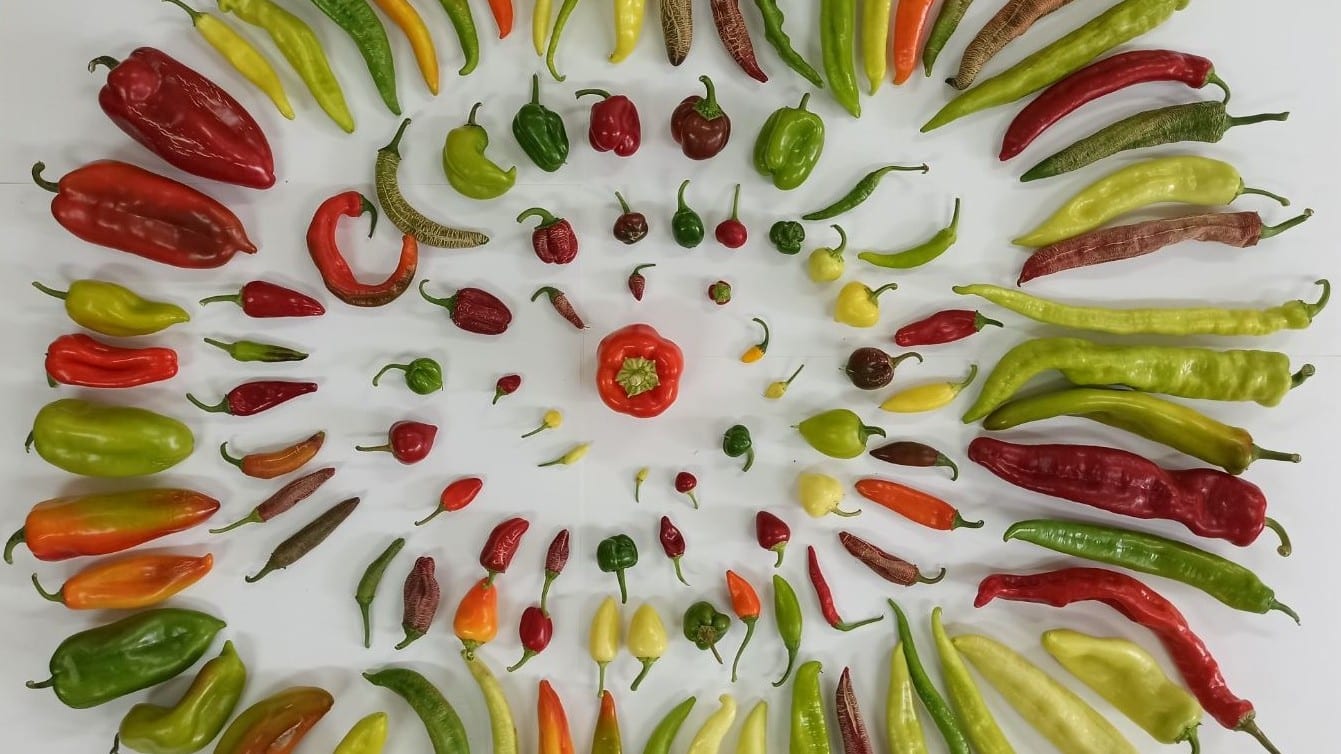
Mirjana Jankulovska tells BIRN about her 15-year struggle to rescue rare crop varieties from oblivion that have survived only in North Macedonia’s remote villages. They are grown only in a handful of villages across North Macedonia – yellow, pear-shaped cherry tomatoes used to make sweet preserves, popcorn corn with black kernels, vivid pink beans, metre-long green beans, and melons and bean varieties found nowhere else in the world. This is the little-known, almost exotic agricultural wealth of the country, preserved in the seeds of old local varieties that have survived thanks to a mission launched some 15 years ago by Professor Mirjana Jankulovska from the Faculty of Agricultural Sciences and Food in Skopje, together with her colleagues. Their goal was to visit every village in North Macedonia and preserve the rare seeds they found before they disappeared entirely, as villages emptied and fewer people grow their own food. This genetic material could prove invaluable in an era of climate change. Over centuries, these plants have adapted to the environments in which they were cultivated, enabling them to survive under local conditions. “When you look at a seed, it may seem insignificant, but without it we cannot survive, we would starve. If we lose these varieties, if we lose this seed, there is no way back,” Jankulovska warns. Passed down over generations “If we don’t have seeds, we will die of hunger,” says professor Mirjana Jankulovska (R). Photo: BIRN.The diversity of plant life they discovered far exceeded their expectations. Jankulovska recalls her surprise when she first saw a woman at a local market selling black popcorn corn, a variety whose seed had been preserved within her family for decades and replanted year after year. Another remarkable discovery was a type of melon that villagers called shkoravki or badatki. The fruit was exceptionally sweet, while its seeds were clustered into a hard, compact mass in the centre of the melon – a highly unusual characteristic. “We searched through all the available literature, but to this day we have not found another example like it,” the professor says. High in the mountains above the town of Strumica, in the village of Dorlombas, reached only by driving along an unpaved road, the researchers found an old local variety of yellow, pear-shaped cherry tomato that locals traditionally used to make sweet preserves. Because the village was so isolated from the nearby town, residents had long relied on growing their own food, inadvertently preserving a remarkable wealth of traditional crop varieties. “They had everything you could imagine, and all the seed had been passed down from their grandmothers and great-grandmothers,” Jankulovska recalls. During another seed-collecting expedition, they received poppy seed that had been stored in a glass jar for more than 20 years. When they planted it, only a handful of plants germinated. Yet even a single surviving plant was enough to begin a new cycle of seed regeneration. “Sometimes people cannot spare much seed for us, so we receive only three or five grains,” she explains. The result of this work is a collection of around 10,000 seed samples representing 80 plant species, gathered from more than 600 villages across every municipality in North Macedonia, all of which they visited in person. They achieved all of this without any support from the state. Preserving these seeds also means preserving plant biodiversity, which is gradually disappearing as conventional agriculture expands and more people buy their food from supermarkets instead of growing it themselves. At the same time, crop diversity increases the chances of identifying plants capable of thriving in poor soils or resistant to drought, pests and disease. Jankulovska is witnessing that loss unfold before her eyes. Fifteen years ago, when the team embarked on their mission full of enthusiasm, they encountered an abundance of seeds. Over the past five years, however, “finding surviving local varieties has become progressively harder”, she says. Initially, helped in part by foreign-funded projects, they believed they would be able to visit every village within a few years. Those plans were dramatically delayed once they realised they would have to continue the work on their own. The seed-collecting expeditions represented only one part of a job that was always unpredictable, Jankulovska says. Sometimes they returned from expeditions with a car full of samples that had to be processed within two or three days, so the seeds could be extracted. That often meant spending entire nights at the faculty removing seeds before the melons, watermelons, tomatoes and other fruit began to rot. Aubergines from the dawn of history Seed researchers in their experimental field. Photo: M. Jankulovska.One of the team’s most surprising discoveries was what local villagers called “white aubergines”, whose seeds they obtained during one of their collecting missions. In reality, the fruit was not white but green. When the researchers planted the seeds in experimental plots at the faculty, they were astonished to see a bush covered in sharp thorns extending not only along the stems but even on the flowers. “Only later did we realise these were among the oldest aubergine varieties known historically. One of the earliest goals of plant breeders had been to eliminate precisely these undesirable traits,” Jankulovska says. To determine whether newly collected seeds represented distinct varieties or duplicates, the team had to carry out molecular analyses, tests that are costly and which they often paid for out of their own pockets. The researchers were equally fascinated by the diversity of beans, eventually assembling a collection of more than 2,200 samples. The white bean commonly found in supermarkets represents only a tiny fraction of that diversity. Their collection includes green beans and varieties displaying an extraordinary range of shapes and colours, like purple, black, brown and beige, as well as striking bright pink beans that have now become almost impossible to find in villages. Two years ago, to study their characteristics, the researchers planted around 400 bean varieties on a one-hectare experimental field. From May until December, a handful of women from the department spent their days in the field. And nature had one more surprise in store. Bean plants normally produce leaves made up of three leaflets. Yet among the collected seeds, they discovered plants bearing four, five, or even more leaflets. “It is the first time such a phenomenon has been documented anywhere in the world,” Jankulovska says. Following the publication of a monography on North Macedonia’s bean varieties, the team plans to produce similar publications on peppers and tomatoes. There are still some villages they have not visited. They plan to in hope something worth saving is still there. But that is where the gathering mission will likely end. The researchers have already accepted that they will not be able to rescue everything they once hoped to conserve. So far, they have sent more than 5,000 seed samples to foreign gene banks, confident that they will remain safely preserved there and permanently identified as originating from North Macedonia. Within the country, seed collections are maintained at the national gene bank at the Agricultural Institute, which currently holds 721 accessions representing 43 botanical species. Additional collections are kept at the Faculty of Agriculture in Stip and at the Tobacco Institute in Prilep. Even so, these collections are considerably smaller than the material gathered by Jankulovska’s department. “If we, ourselves do not collect, study, preserve and continue using our local varieties, nobody will need to steal them from us – we will lose them through our own neglect,” Jankulovska warns. She says she has lost count of the promises of support and words of encouragement offered over the years by both public institutions and private companies. None of those promises has translated into meaningful action. She finds it difficult to understand how, when preserving Macedonian identity has become such a prominent public issue, something fundamentally tied to that identity continues to be overlooked. “These seeds carry the memory of the past. They preserve traditional recipes, local knowledge, and the way of life of people in specific rural communities,” the professor says. Bound for an Arctic vault Some of the seed samples in Skopje. Photo: BIRN.One of the team’s latest ambitions is to preserve part of their rich collection deep beneath the Arctic ice in Norway. There lies the Svalbard Global Seed Vault, home to seed collections from almost every country in the world, designed to safeguard crop diversity against global catastrophes, from war to climate collapse. It was through this vault, for example, that Syria was able to restore seed collections after its national gene bank was destroyed during the war. “This is where we want to send what I would call, our security collection, our insurance policy. If any kind of disaster were to strike tomorrow and we lost our own seed stocks, we would be able to retrieve them from there,” Jankulovska says. Getting seeds into Svalbard, however, is far from straightforward. Each variety must be represented by a minimum quantity of seed, something the team does not yet have. Their next task will therefore be to select the most valuable accessions and multiply them until sufficient quantities are available. “Our problem is not a complete lack of activity, but a lack of a system. We have seeds, collections, expertise and qualified professionals. What we lack is sustained political commitment, long-term funding and national coordination. The wealth exists, but its future is not secure,” Jankulovska concludes.
Ancient Seeds, Lost Beans: The Professor Saving North Macedonia’s Vanishing Crops
Full Article
Original Source
Read the full article at Balkaninsight →KhanList aggregates and links to publicly available news content. We do not host full articles from third-party sources. Always verify important information with original sources.