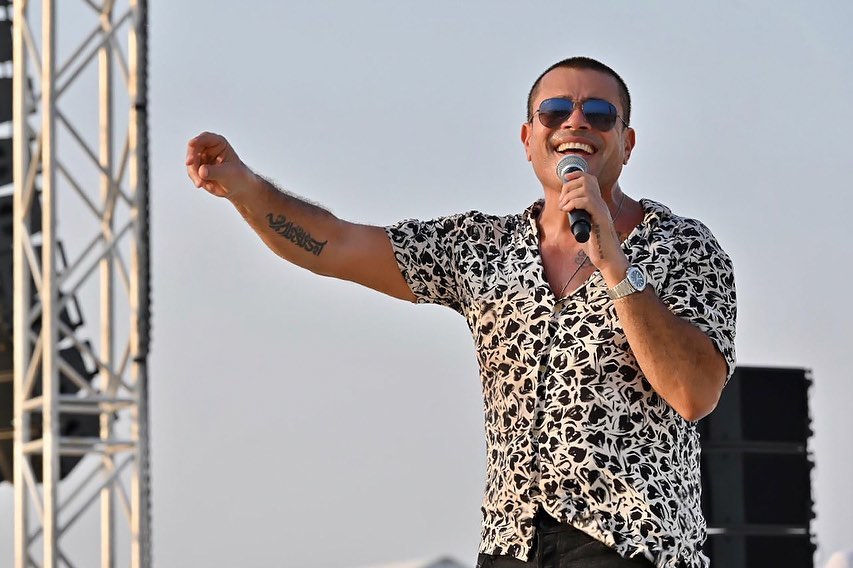
With almost every new album release, Amr Diab faces a remarkably predictable wall of criticism—much of it filtered through a rigidly moralistic lens. Yet Diab remains entirely unfazed by these judgments. He lives every single day laser-focused on one goal: creating the next jaw-dropping release that forces all eyes and ears back onto him. He makes no attempt to hide the fact that he is approaching 65. Instead, he operates with the conviction that his biological age is at least 25 years younger. But that agelessness doesn’t come cheap – he pays a steep price for it. His gym sessions only lengthen as the years roll on, driven by the reality that physical fitness accounts for at least half of a performer’s staying power—after all, audiences listen with their eyes, too. Diab keeps a sharp, relentless eye on emerging trends in both the global and local music scenes. His personal doctrine is simple: never waste energy outside the realm of art. Above all, he is fearless when it comes to taking risks. He knows that people—or at least the majority—instinctively push back against anything new or unconventional. Yet, before long, that same audience adapts to the fresh sound, left wondering why it took them so long to embrace it in the first place. Inevitably, Diab’s fanbase is split into two camps: the loyalists of his early era, and the post-2000s generation—his “new audience.” The late legendary composer Mohamed Abdel Wahab once faced a similar dilemma, caught between purists who adored his early classics like “Ahwan Aleyk” and “Elli Yihebb El Gamal,” and fans who embraced his modern hits like “Ana Wel ‘Azab Wa Hawak” and “Ah Mennak Ya Garehni.” While Abdel Wahab constantly tried to strike a middle ground to please both sides, Diab understands that in today’s era, reinvention is the key to survival. He thereby chooses to lean entirely into the current cultural moment. In his latest album, “Habbaitak”, Diab dives headfirst into the most current trends in songwriting and production. As a listener, you might find some of the lyrics and melodies disconcerting at first—and that is entirely by design. Diab does nothing by accident. Moustafa Hadouta, the undisputed king of Mahraganat lyricists who penned Hassan Shakosh’s breakout hit “Bint El Geeran”, has now become a permanent fixture in Diab’s creative circle. On this record alone, Hadouta boasts three tracks—the most provocative on the album, and predictably, the ones drawing the most online criticism. Their collaboration began two years ago with “Ya Qamar” and continued with “Qafalti El Leaba”, but on this latest release, Hadouta pulled off a lyrical hat-trick with “Wa Enti Gambi”, “12 Bel Lail”, and “El Alwan”. The latter two tracks, in particular, immediately set social media ablaze. Diab undoubtedly knew they would invite wild interpretations, over-analysis, and moral outrage—so much so that the initial shock value turned them into prime material for internet memes and caricatures. The 12-track album features a rich mix of composers, including Mohamed Yehia, Amr Mostafa, and Ehab Abdel Wahed, alongside a major comeback from Nader Nour. It also introduces the project’s youngest talent—15-year-old Adham Ayman Bahgat Qamar—while drawing on lyricists like Amir Teima, Tamer Hussein, Menna El Kiey, Razam, Ayman Bahgat Qamar, and Moustafa El Prince. Notably, Diab himself composed the track “Lola El Banat.” Diab’s composing talent is both innate and profound, yet he is far too shrewd to limit his catalog to his own melodies. He possesses a remarkably sharp ear, allowing him to hunt down and claim the absolute best work from others. Never letting external distractions throw him off course, he has held the secret to staying consistently at the top for over forty years. Author’s biography: Tarek al-Shenawy is a journalist, film critic, and professor of film criticism at the Faculty of Mass Communication, Cairo University. He holds a Bachelor’s degree from the Faculty of Mass Communication in Cairo University, and a Bachelor’s degree from the Institute of Cinema. Shenawy has won numerous awards for best critical article from the Syndicate of Journalists multiple times, as well as from film societies. He was awarded the title of Best Popular Film Critic by the “Der Giest” Association in 2015 – a title that has not been awarded to anyone since. He has also chaired and participated in the judging committees of numerous international film festivals, including the Valencia and Dubai Film Festivals. He began practicing film criticism nearly 35 years ago in the Rose al-Yousse magazine and continues to write a weekly column titled “Kalma we Nos” (Word and a Half) on its pages. He has written for numerous magazines, newspapers, and websites both inside and outside Egypt. He currently writes a daily column in Al-Masry Al-Youm newspaper and a weekly column in Al-Sharq al-Awsat newspaper, and has published over thirty books.
Amr Diab: Unlocking the secret of the trend
Full Article
Original Source
Read the full article at Egyptindependent →KhanList aggregates and links to publicly available news content. We do not host full articles from third-party sources. Always verify important information with original sources.