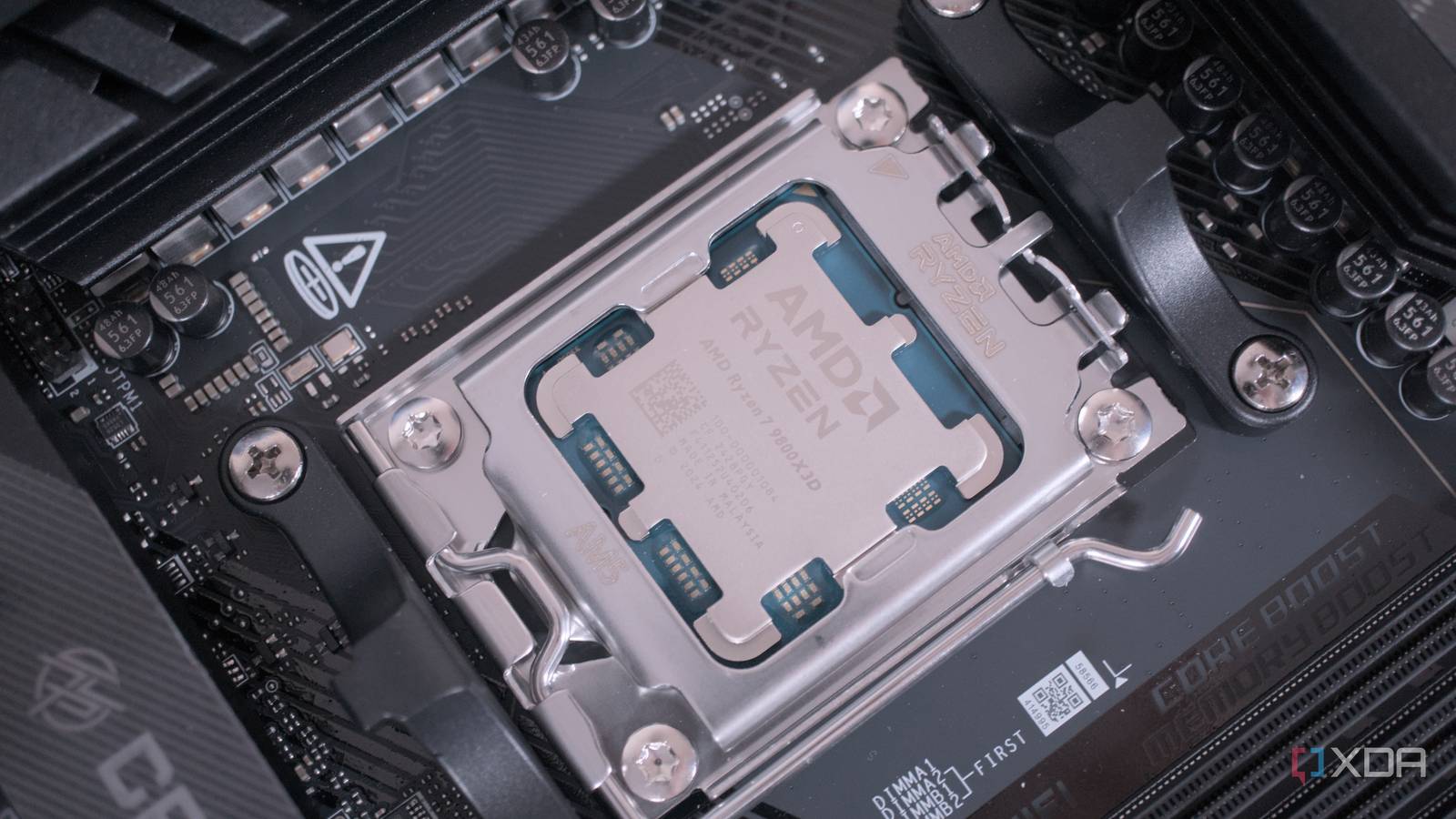
Published Jul 31, 2026, 7:00 PM EDT Abhinav pivoted from a career in banking to pursue his first love in writing. Even while working full-time, he continued contributing as an editor-at-large, a role he has held for more than 7 years. A lifelong tech enthusiast who has built three gaming and productivity powerhouse PCs since 2018, his passion for technology keeps him closely following the semiconductor industry, from NVIDIA and AMD to ARM. His MSc dissertation explored how artificial intelligence will reshape the future of work, reflecting his curiosity about the wider social impact of emerging technologies. Two years ago, when I dropped an MSI B650M motherboard in my build that I use today, I accounted for its relevance five years in the future. I calculated that I'd have at least two CPU generations worth of upgrade headroom, and perhaps even three if AMD felt generous. A platform replacement wouldn't be a consideration until somewhere around 2027, and all of these reasons formed the bargain that AM5 was sold on. I was quite content with it. Earlier at Computex this year, AMD moved the date to 2029. I now expect this B-series motherboard to take another line of processors, running architectures that had only been on AMD's internal roadmaps when I made the purchase. The reason for this has little to do with the generosity of the chipmaker, and more to do with a decision Team Red cannot make just yet, all thanks to an unprecedented shift in the consumer market. AMD keeps extending AM5, but that's only a part of the story Each socket outlasted the last, and it has generally been welcome Credit: Andrey Matveev via Unsplash Understanding the socket pattern that AMD has set beckons a walk through some hardware history. AM5 came out in 2022, and it promised support through 2025 and beyond at that time. The release of Zen 5 CPUs stretched that to 2027 and beyond in 2024. Most recently, at Computex 2026, the company landed on 2029, with the announcement coming alongside the Ryzen 7 7700X3D and a tenth anniversary celebration of AM4. Team Red has followed this precedent for a long while now. Socket AM2, released in 2006, lasted roughly 3 years before being replaced by AM3 in 2009. AM3 and AM3+, on the other hand, survived for about 7 years until AM4 hit the market in 2016. If you delve deeper into the socket economics, you'll realize that there's something different about AM4, in that, AM4 has now reached its 10-year mark in 2026 and yet it continues to receive CPU refreshes and new releases. In that sense, AM5 exists parallel to AM4, and the reason for this is anything but simple. Another curious outlier that cements this is the untimely introduction of the 10th Anniversary Ryzen 7 5800X3D; a solid processor, but a product of its time, nonetheless. AMD framed this as a milestone product and, sure enough, the framing invites you to see it as such. At Computex 2026, though, AMD VP David McAfee stated that the company wanted to reissue the chip earlier, but because the silicon bonding process for the specific chip TSMC used was no longer available, it took a while. The easier explanation for the resurgence of AM4 silicon in 2026 is the simple fact that there are still buyers who will not, or can not move to DDR5. Now, the parallel existence between AM4 and AM5 makes more sense. The two exist as separate, live product lines serving two different memory budgets, which is what is worth noticing. AMD did not pick these durations, because the number of years a platform will stay relevant is not something any individual player in the industry can plan. The socket is only as good as the memory beside it DDR2 took AM2 with it, DDR3 took AM3, and DDR5 is the only reason AM5 is relevant Credit: Source: Unsplash If you look back even further at AMD's desktop history, you'll notice yet another pattern, that I promise will seem more relevant than it does now. Every mainstream socket is effectively tied to a memory generation. We've seen AM2 launch with DDR2, AM3 introduce DDR3 support, AM4 marking AMD's move to DDR4, and finally, AM5 arriving alongside DDR5. If the precedent set so far is to be followed, AM6 should arrive with DDR6, and nothing so far in AMD's positioning seems to contradict it. The economics of upgrades, however, have witnessed a drastic change. Whenever a new standard appeared, the outgoing one became cheap, and that fall in price persuaded users to jump to the next. That fall in price, as of this moment, appears to be nowhere in sight. AMD itself recognized at Computex that DDR5 pricing may not normalize until 2028, and analysts at IDC have even gone so far to say that we may be witnessing a "potentially permanent" reallocation of global silicon wafer capacity, and because of that, the pricing floor may have been raised for even longer. So, while AMD may be positioning internally for an AM6 release in 2029, the economic forces that make the jump from DDR4 to DDR5 unviable for a vast segment of the market today may still be very much at play three years from now. AM6 may still arrive on time, but the market may not Technology can move on schedule, but consumers don't always follow DDR6 development is already underway. As a matter of fact, JEDEC's next memory standard is already taking shape, and early implementations are expected around 2027, boasting significantly higher bandwidth than today's fastest DDR5 kits. At some point, naturally, AMD will pair that transition with a new desktop socket, just as it has done for every previous memory generation. That much is not in question. What is in question, however, is "when". Even if we were to assume that happens on schedule, the standard will arrive in an economic landscape that may as well prohibit the transition, similar to the one we are witnessing now. The industry as of this moment is still struggling to finish the move from DDR4 to DDR5. Three years after AM5 launched, DDR4 remains in production after major manufacturers went back on their earlier retirement plans, while DDR5 pricing has stayed above levels that buyers anticipated. Both platforms currently coexist because, for millions of people, the cheaper platform makes more fiscal sense. This will be pertinent in 2029 when AM5 reaches seven years of age. Under normal market conditions, it would be the point where AMD introduces DDR6 and lets the previous socket fade away, but a key part of facilitating that change is consumer adoption, which is seriously lagging behind if the current conditions are taken into account. That's precisely why a new socket release in 2029 invites skepticism. AMD can choose when a new socket is launched, but it can't choose when the economics of memory make that socket viable for builders. It's also one of the reasons why AM5 may be here much longer than initially planned. AMD can choose when a new socket is launched, but it can't choose when the economics of memory make that socket viable for builders. AMD may no longer control when AM5 ends, even if it wants to It's a sign of odd times, but the consumer market may finally be at a place where socket longevity is decided less by an engineering decision that ushers users into the new era of technology, and more through the economics of the consumer market. AMD can announce a new platform whenever it's ready, but if the memory prices continue to dictate what builders can realistically afford, it may find that retiring an old socket is not entirely its own decision.
AMD promised AM5 support until 2029, and the memory crisis might not let it stop there
Full Article
Original Source
Read the full article at Xda-developers →KhanList aggregates and links to publicly available news content. We do not host full articles from third-party sources. Always verify important information with original sources.