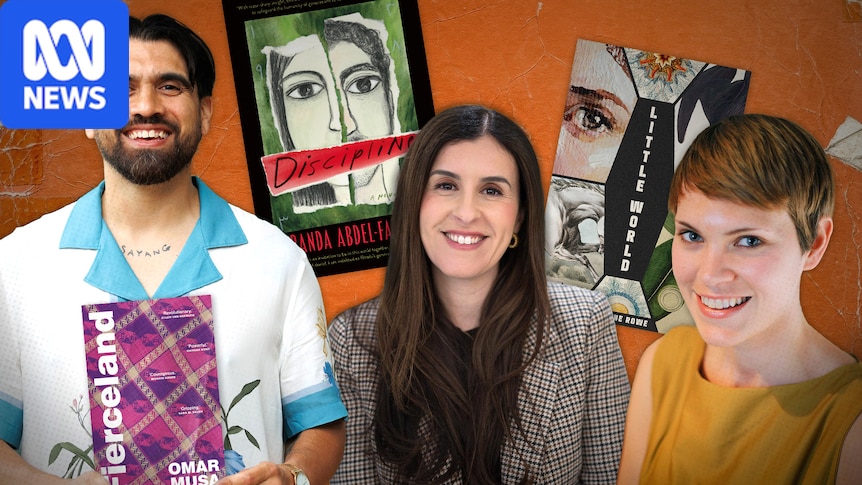
Zombies, ghosts, saints — the 2026 Miles Franklin Literary Award shortlist is not short on colour.The prestigious writing prize has been won (more than once) by the likes of Tim Winton, Thea Astley and Michelle de Kretser.This year's shortlist takes us from the forests of Malaysian Borneo to colonial-era Tasmania, with some surprising and supernatural diversions along the way.It's a year of slender books, with Josephine Rowe's novella Little World coming in at just 130 pages and Sean Wilson's sophomore novel, You Must Remember This, at 176.The six finalists share preoccupations with queerness, nature and the macabre, and many illuminate previously overlooked corners of Australian history.It's not all about the past — Discipline by Randa Abdel-Fattah, whose cancelled appearance at Adelaide Writers' Week led to a furore resulting in the axing of the 2026 event, grapples with some of the most divisive political issues of the present moment.Two of the titles are debuts: My Heart at Evening by diplomat-turned-winemaker-turned-author Konrad Muller and First Name Second Name by fellow multi-hyphenate Steve MinOn, a former advertising copywriter and restaurateur.In 2025, Siang Lu won the $60,000 prize for Ghost Stories, a meta-fictional fable that follows Xiang Lu, a translator living in Sydney, to a ghost city in China. This year's winner will be announced on August 5.To take a closer look at the shortlist, we've brought together The Book Show's Claire Nichols and Sarah L'Estrange, The Bookshelf's Kate Evans and writer Declan Fry.The overall vibeCN: This is a very fun and readable shortlist. The quality is very high and it's nice to have a list where there aren't a lot of 'worthy' books — books that make you feel like you're doing a lot of work while you're reading them. They're very enjoyable.DF: I couldn't disagree more! I felt these books did ask for work from readers. That's what makes them special. The approaches to queer characterisation in My Heart at Evening, Fierceland, Little World and First Name Second Name are fascinating. A number of books in this year's shortlist appear straightforward but they're incredibly polyvocal; they say so many things at once. They're really complex.SL: I was pleasantly surprised going into the list. Konrad Muller's My Heart at Evening is the first book published by micro press Evercreech Editions — I didn't know about this title and then opened this beautifully designed book and discovered another world. It's got the pathos and gothic noir that we associate with Tasmanian colonial fiction but there's also a Dickensian element as well. It had lots of surprises. I think each of the books have something to surprise.KE: I was really taken by the way that so many of the titles are dealing with the past in such interesting and playful ways, offering a fresh take on historical fiction.Discipline by Randa Abdel-FattahAbdel-Fattah is a sociologist and the author of several books for younger readers. (Supplied: UQP)CN: Discipline is set in 2021 amidst a round of bombings in Gaza. A teenager at a local Islamic school in Sydney is charged with terrorism offences after protesting against a university's connection to a weapons manufacturer in Israel.We meet two Muslim Australians. One is an academic working in a university and the other is a journalist working for a newspaper. The story is about these two characters and how they respond to these incidents and what it means to speak out or not speak out against censorship.KE: I found it immensely stressful as a reader, partly because of the way it took us into the domestic lives of these Australian characters, who I thought were really well delineated, and then put them in tension with this huge geopolitical situation. That's the part of the book that worked the best for me.CN: For me, the pain of having to deal with the domestic and the global at the same time was the strongest aspect of Discipline. It asks the reader to think about what it must be like to get up and be so terrified about what's happening in your ancestral home, to not know if your family is safe, to be so worried, but also have to think about what is going on the table for dinner tonight? How am I going to take care of my child today? How's the person in my work ignoring me?It's a book with a message and it doesn't hold back in delivering its message.First Name Second Name by Steve MinOnMinOn is the author of children's books, including his latest, Make Them Say Poo. (Supplied: UQP)KE: This is a novel where the main character wakes up dead. He is on a slab and lurches up and immediately is on a trajectory to return to the place where he was born in North Queensland.He is a Chinese Australian character, and what I like about this novel is that you've got a journey, you've got a family history story that is doing something fresh, taking us into Australian history and doing it through this figure of the jiāngshī, the Chinese hopping vampire. It's clever and playful at the same time.SL: I have trouble with books where one of the characters is a ghost or a zombie because I get distracted by thinking about the logistics.I was more drawn to the historical elements of the family story that build up this picture of how this family has evolved over four generations, and how the family's Chinese heritage has been whitewashed. That's what really appealed to me.I wanted to spend more time with the first two characters we meet, Pan Bo Lin and his to-be wife, Bridget. They were fascinating. I rushed through the zombie bits because I wanted to get back to the family.CN: I was also really moved by the stories from the past. I loved meeting the multiple generations of this family; I think Steve MinOn does it so well.The juxtaposition of that with this zombie who keeps losing bits of his body and attacking people and sucking the life out of them as he moves further north towards Innisfail — it's really exciting and unusual. I'm always thrilled when Aussie authors just go for it with a really bonkers idea. I found this a very pleasurable read.My Heart at Evening by Konrad MullerHenry Hellyer, a 19th-century English surveyor and architect, "was a complex historical figure", Muller told The Book Show. (Supplied: Evercreech Editions)DF: My Heart at Evening is set in 1832 in Van Diemen's Land. A man is sent to learn what's happened to Henry Hellyer, a real-life figure. We know how Hellyer died — the question is why did he die? Why did he kill himself? Various people come and reveal their interpretations of what happened in this kind of Rashomon-style set-up.One possibility is he committed suicide because he was gay, and the shame of being homosexual at that time makes it completely plausible. Or perhaps it was because of the violence and the brutalisation of colonisation. It could be all of these things or none of them — that's the heart of mystery and darkness in this very Joseph Conradian novel.KE: I loved the voice of this novel. From the very first page, I thought this is doing something so assured — the narrator is ostensibly addressing his beloved. It's almost a second-person telling of a story that she will never receive — it's like a letter that is never sent.And then there's all of that rich colonial context which, as Sarah said, almost feels Dickensian. There's a real 19th-century style to it and then overlaying it there's all this really interesting convict history. There's the Van Diemen's Land Company, which really existed and played a role similar to the East India Company, so it's not that you've got a government who's shaping this terrible, violent colonial moment; you've got corporate entities committing violence against the land and Aboriginal people.Some of it's almost happening at the edge of the main character's eyesight. He can't even quite look at it. It's so beautifully done.CN: I love that this is essentially a detective novel. We've got a mystery to solve; we're going to interview various people and figure out what happened.And I love that it's such an Australian novel in that our detective is a convict, and it's a story that could only be set in this place. I think that's really delicious.SL: It's not just a detective novel; it draws on that classic trope of Agatha Christie of the locked-room mystery as well. It's like a red herring, but it's a delightful element within the story, which gives levity to the brooding elements in the book.KE: And the rogues and the ratbags and the convict cant [street slang] that he plays around with as well.CN: I love that everyone who gets interviewed are such specific characters. There is a series of blokes, and they could all blur into one, but they're so clear, whether it be a flourish of a scarf or the way they speak. I think it's very carefully done.DF: It's incredibly impressive for a debut novelist to have such well-rounded characterisation.SL: I also found it interesting each of those interviews raised more questions than they answered. The picture gets more complicated. Even at the end, there was another revelation. Muller keeps layering different perspectives, one on top of each other.Fierceland by Omar MusaMusa won the 2026 Victorian Premier's Prize for Fiction for Fierceland. (Supplied: Penguin)SL: This is a book about complicity and history that draws on Omar Musa's own connections to his family in Borneo.It's about a palm oil baron, Yusuf, and his children. One is an artist, Rozana, who's a bit of a rebel who hasn't found her place. Her brother Harun lives in LA. He's developing some interesting technology using virtual reality to recreate forests that in the real world have been destroyed by the palm oil industry.This is a story of these two characters grappling with their father's legacy. The timeline moves around — we go back with them as children to visit the plantations, to visit the forest before it's destroyed, and then we're with them as they're reckoning with their father's death.KE: And importantly, the forest itself is one of the voices in the novel.SL: And so are the people who are working on the plantation. He's giving voice to people and things that don't often have a voice.KE: There are so many different voices and perspectives in this novel. It's so rich and one of the things that I like about it is how judicious he is about the use of things like the voice of the forest because too much of that would have been hard going. Because Musa is a musician and a rapper and a performer and a visual artist, I feel as though the narrative rhythms of this book are a really important part of it.I also liked the way that it took us into the region and placed us in it — I didn't know enough about Malaysian Borneo.CN: It's the second novel in a row where we're grappling with Joseph Conrad; we were doing that with Konrad Muller but obviously this book has very direct references to Conrad, who wrote a lot about Borneo, but also, we've got the ill-fated troop up the river. It's interesting that we're getting a Heart of Darkness theme emerging on the list.DF: And as in Muller, early on, we're told there's a traumatic event. We know what it is, but there are still questions around it. There are a few interpretations given by the people around Yusuf, but it's never concretely said exactly what happened.I really loved the way it shows familial camaraderie in what is a dysfunctional family where you have two children who are so rich they never really need to work again. I did find Rozana's adult voice a bit odd — she's 32, but she speaks like someone much younger. I don't think that was convincingly explained. In any case, I thought that Yusuf and the people around Yusuf, these side characters and their voices, were more interesting.I would love to see the working drafts of this novel's development because there's so much history, there's so much voice. There is a real richness in Musa's language, especially in those more experimental sections when he takes the brakes off. This could have been a really great work of creative non-fiction with all of its history, its languages, its different voices, including the forest. But I feel like some of the impulses animating his experimentation are constrained by the more conventional chapters. I don't think the sections quite cohere.SL: I really wanted to love this book because of all of those elements, and there's some just truly exquisite writing, but, like Declan, the pieces didn't quite come together for me.I found moving around in the timeline, also moving with perspective, it didn't build into a complete whole. This trend of using alternating chapters and voices — I just want Australian writers to go deep and give me the whole story without feeling the need to show that this is one person's perspective and this is another's. Just give me the total book.CN: I was thinking about the same thing, Sarah. With so many of these novels, there's one strand of the story I like better than the other, and sometimes I'm reading one chapter faster because I want to get back to the bit I like. That's a danger with this type of writing, right? It's the case for quite a few books on this list, that they're a little lopsided in the reading.Little World by Josephine RoweRowe's debut novel, A Loving, Faithful Animal, was longlisted for the 2017 Miles Franklin Literary Award. (Supplied: Black Inc.)DF: This book is about a saint, but she's an unusual saint in that the Vatican don't seem to be aware of her. It's a girl who has a body that does not decompose, and the story is about the ways in which her incorruptible saintly body and existence impact the lives of the people she comes into contact with, which include a retired engineer living near Broome in the 1950s and three women in the 70s who are travelling across Australia in a van, a lesbian couple and a woman who's a bit older called Mathilde.The language is stunning. Josephine Rowe writes like an angel. The novel is very elliptical; how willing the reader is to sit with its suggestive aspects will determine how much they get out of it.For me, the biggest impact the novel has is how very compactly, very succinctly, very beautifully Josephine Rowe reflects upon the lives of women. It's this communion between Mathilde and the saint, where they're women who are struggling with violence, both geopolitical and personal, and how they find some kind of solace in one another.KE: I like the fact that it's such an odd take on an Australian history. I thought it was so fresh and surprising and odd and restrained, in a good way. It worked as a really short novel. If it had been a sprawling 400-page novel doing this, taking all these perspectives, I think I would've needed to lie down. But having it compressed and poetic like this worked for me.CN: It works for me too. Anyone who can put that much into 130 pages is just so clever. I think it's a pretty perfect little object.You Must Remember This by Sean WilsonYou Must Remember This started out as a play inspired by Wilson's observations of his grandmother's experience of dementia. (Supplied: Simon & Schuster)CN: We're with a character called Grace. She is an elderly woman and at the start of the book, we're remembering things with her when, all of a sudden, we look down with her at her feet and we realise that she is walking along a highway, there are cars whizzing by, it's in the middle of the night and she had no idea how she got there.We realise this is a character with Alzheimer's disease, and we are with her as time and memory shifts. There are some really clever ways that Sean Wilson does this, including starting the book at chapter 10, and the chapters shift as we move around in time and Grace's memory.We have scenes in the modern day where her daughter is trying to connect with her and is getting increasingly frustrated. But we also go back to Grace's childhood in Perth, which we learn was incredibly difficult, with an alcoholic, cruel mother.This is a really short, beautiful book that tells the story of dementia in a really beautiful and important way, because I don't think there's a lot of fiction that tries to take dementia head on and give the characters respect and time to really explore what it might be like to experience it.SL: I felt like its biggest strength was taking us into the confusing world of a person with dementia but giving that person a history and a present and situating them in a place, not just disregarding them because they no longer make sense to the outside world.CN: Again, we've got that alternating chapter approach, with Grace in the present day and going back to different parts of her story. Once again, I was more drawn to the stuff in the past than the present day.The character of her mother, Annie, reminded me of Dolly Pickles from Cloudstreet: this very loud, once beautiful and now cruel alcoholic woman. She was such a strong character that at times I felt she wanted to become our main character. I wanted more of Annie.SL: I thought the writing was exquisite. Being at sea is something I don't typically enjoy, but I liked being at sea with Grace and discovering what's going on with her. I felt safe in the author's hands and trusted that he was going to take me somewhere.I found it a very satisfying read for those reasons. Claire says that Little World was a perfect book — for me, You Must Remember This was a perfect nugget of a book. It didn't overextend itself and while the remembrances of the past were very vibrant and alive, I felt the danger of Grace's present situation very much.CN: It's another book that doesn't overstay its welcome, much like Little World and My Heart at Evening. I think Australian fiction can get really shaggy and sometimes needs another edit and to see some books that actually tell the story they need to tell and then finish is really lovely.CN: I would have loved to have seen Toni Jordan make the shortlist for her novel Tenderfoot. I think it's the best novel she's ever written.I still think this is an excellent list. I don't know what will win but I would enjoy it if First Name Second Name won just for being weird and wonderful.DF: My snub is Olivia De Zilva's Plastic Budgie, put out by Pink Shorts Press, a great small publisher. It reminded me of [American novelist] Lynne Tillman who I adore. Elegy, Southwest by Madeleine Watts was quite moving and I would have also liked to see that on the shortlist.The winner I think is going to be Omar Musa. Prize judging tends to be splitting the difference between books people love and books they can agree upon. I don't know what the judges will love, but I think they'll probably agree upon Omar Musa.I think Konrad Muller should win. It was just such a wow debut.SL: I would have liked to see Charlotte McConnaghy's Wild Dark Shore on the list — it's nice to see Miles Franklin being a little bit more popular and I really loved that book.While I'd like You Must Remember This to win, I also think Fierceland will win.KE: I would love to see My Heart at Evening win, but I can never guess these things. I think it's a really interesting shortlist.
All the snubs and surprises from this year's Miles Franklin shortlist
Full Article
Original Source
Read the full article at Abc →KhanList aggregates and links to publicly available news content. We do not host full articles from third-party sources. Always verify important information with original sources.