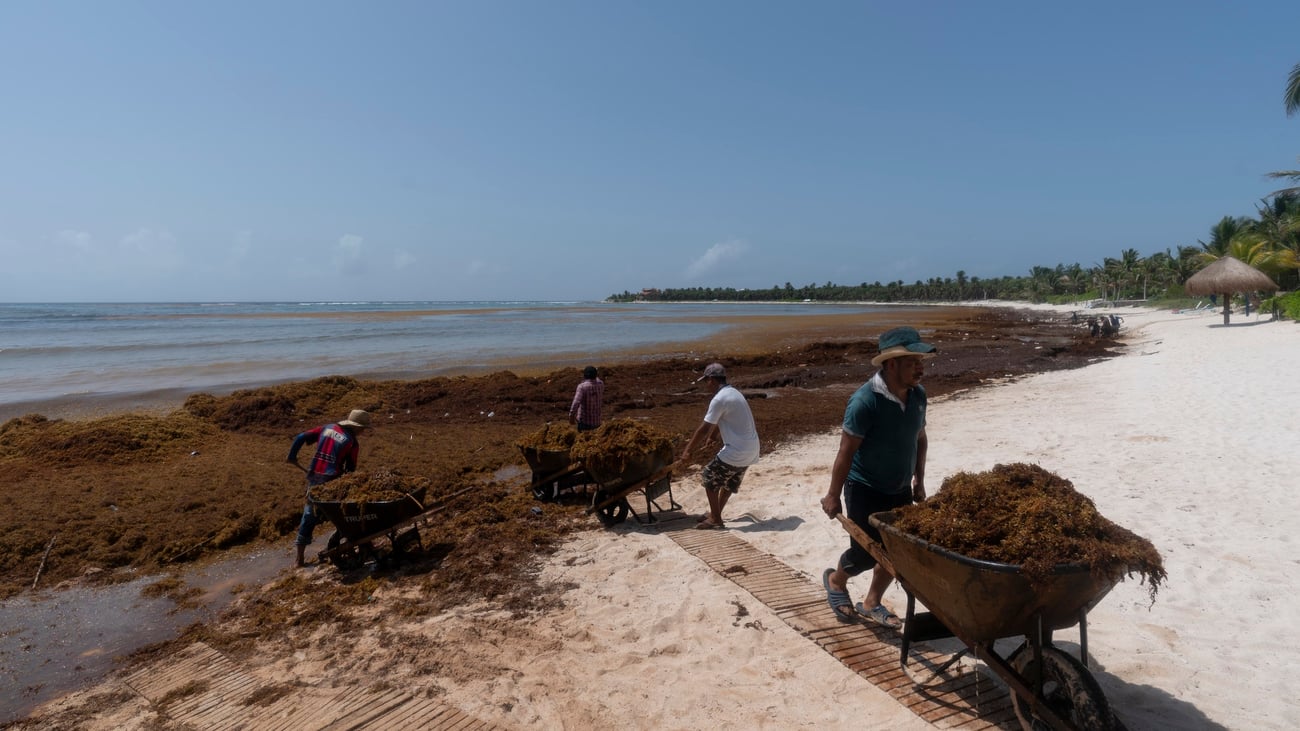
MEXICO CITY (CN) — Mexican President Claudia Sheinbaum outlined a $115 million plan on Thursday to manage up to 9 million tons of sargassum that wash onto beaches of the Riviera Maya in the state of Quintana Roo every day.“What are we going to do? Capture more in the sea — that is why more sargassum-harvesting vessels are being acquired; Two: more barriers, the best barriers available in Quintana Roo and the entire world; and three: beach collection,” she said of the plan spearheaded by the Mexican Navy.“How should it be done? By following the best practices. Environmental regulations already dictate how it should be collected, but we are now informing all hoteliers about the best practices for removing it from the beach without taking the sand along with it. That is it, in a nutshell,” she said.Efforts will be concentrated on Cancún, Playa del Carmen, Puerto Morelos, Tulum and Mahahual, a 30-mile stretch of beach.“There are many sargassum species that are in the intertidal zone that are fixed to the ground. This special sargassum that is causing the problem is one that’s free-floating. So it comes from what’s called the Great Atlantic Sargassum Belt,” Debashish Bhattacharya, a Rutgers Department of Biochemistry and Microbiology Distinguished Professor and Schmidt Sciences researcher, said in a phone interview.He said the Great Atlantic Sargassum Belt is the massive sargassum population that extends from West Africa to the mouth of the Amazon, where the waste sargassum comes from. He said it can reproduce quickly and asexually by fragmenting off.Bhattacharya said the Great Atlantic Sargassum Belt is fed by drought in West Africa, where the Sahara Desert and other regions have dried.“The winds blow all that dry dust into the oceans. They’re essentially seed, it’s like a fertilizer. And so it seeds the ocean and these sea plants like the sargassums out there, and they get these nutrients they need to grow through photosynthesis. So they grow and grow and grow and then, the currents bring them across the ocean, and then they end up piled up there,” he said.Rising water temperatures and pollution are a perfect environment for sargassum in the Caribbean.“You’re essentially giving it warm conditions, lots of light and nutrients in the water. So that’s sort of the reason for the uncontrollable growth of it,” Bhattacharya said. “So when you take a seaweed that can live in high light, and then give it a lot of nutrients, well, you’ve created essentially a really, really fast-growing sort of problem.”The Mexican Navy is pulling out all the stops to control it. It has employed 11 specialized coastal vessels for sargassum collection, other amphibious sargassum collection units, various smaller vessels, vehicles, and personnel, all to collect 1,227 tons of sargassum in the sea and 950 tons on the beach daily.Raymundo Morales Ángeles, Secretary of the Navy, explained Thursday that the 2 billion peso investment, or $115 million, will be divided into two stages to acquire two tugboats, six specialized coastal vessels, more dynamic barriers and 31 miles of containment booms to increase collection capacity to 1,870 tons daily, with an eventual increase to 4,000 tons.“On the beaches, we rely on personnel, mainly manual equipment, and the support of municipal governments,” he added.Sargassum has already cost the Quintana Roo state government $44.4 million, Quintana Roo Governor Mara Lezama said during the Thursday press conference. Part of the investment goes into satellite monitoring of sargassum at 140 beaches.Secretary of the Environment and Natural Resources of Mexico Alicia Bárcena said the sargassum problem has evolved from a temporary phenomenon lasting a few months into one with a long-lasting continuous presence. The amount of sargassum hitting the shores is 27 times the historical average and four times more than last year.She said 9,054 tons are arriving daily to the coasts.“When it is medium or average, 4,000; and when it is moderate or low, there are 2,640 tons,” said Bárcena. “This has been a really difficult, atypical year.”Bárcena also mentioned that the Secretariat of Environment and Natural Resources is working to create a circular economy out of sargassum harvesting, where sargassum ceases to be a waste product and becomes a resource, something that Bhattacharya is directly involved in.Schmidt Sciences works with a company called CarbonWave that operates in Mexico, specifically in Quintana Roo, to upcycle sargassum into agricultural products and sustainable biomaterials.Due to the sheer quantity of sargassum, Bhattacharya said, it’s important to use the product on something that could use a lot of biomass as opposed to a single commercial item.“Otherwise, you’re solving maybe a commercial problem, but you’re not solving the ecological disaster problem,” he said. “So that’s why we’re turning sargassum into something like a biostimulant — one of the things that we’re doing in our lab with our colleagues.”The process involves pressing “the juice” out of the sargassum, and then using that as a plant biostimulant to add to crops to help them grow faster.“Another use is to dry it out and try to convert it into kind of a mulch that can be added to soils as a sort of a growth enhancer. So these are the sorts of less complicated ways of dealing with a lot more biomass and trying to do something good with it that’s useful to humans,” Bhattacharya said.Subscribe to our free newslettersOur weekly newsletter Closing Arguments offers the latest about ongoing trials, major litigation and rulings in courthouses around the U.S. and the world, while the monthly Under the Lights dishes the legal dirt from Hollywood, sports, Big Tech and the arts.Additional Reads
All hands on deck to tackle Mexico’s sargassum seaweed crisis
Full Article
Original Source
Read the full article at Courthousenews →KhanList aggregates and links to publicly available news content. We do not host full articles from third-party sources. Always verify important information with original sources.