
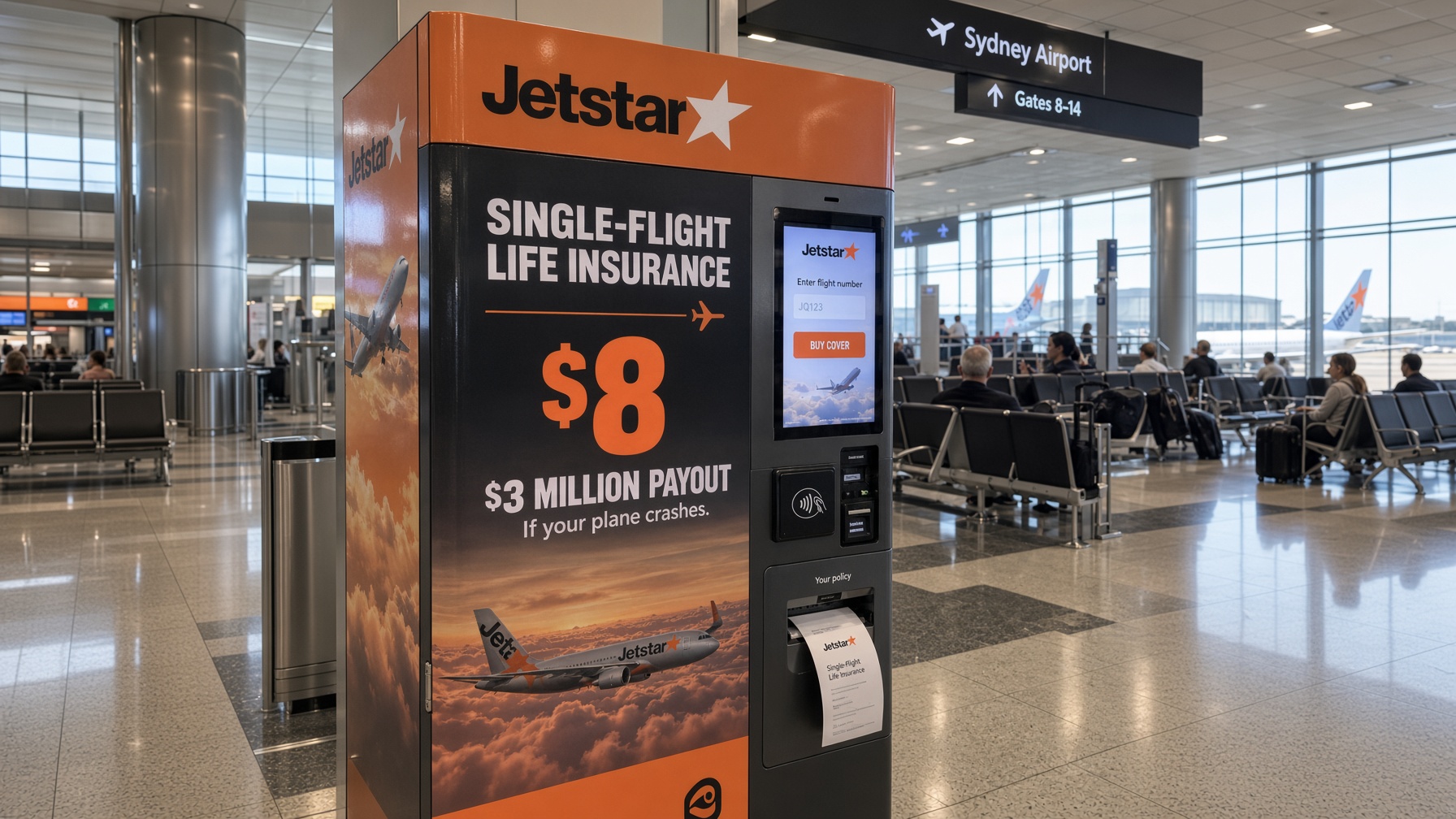
An image circulating on Twitter advertises a Jetstar-branded airport machine selling life insurance for a single flight: $8 for a $3 million payout “if your plane crashes.” I remember seeing flight boxes in airports when I was a kid. And people really did buy policies – some then deliberately brought down the planes. This specific image looks AI-generated. I haven’t found a Jetstar product matching it and the marketing seems unlike what you’d find even from a cheeky airline. They do have an insurance product but it isn’t this. The Jetstar-branded flight insurance image circulating on Twitter The price in the image is plausible! Flying is so safe that selling millions of dollars in coverage for a few dollars is about right. But does anyone actually need this coverage, does selling it at the gate make financial sense, and is ‘you might die’ a message airlines want to pitch to customers as they’re about to board? I remember reading Thomas Petzinger’s Hard Landing about 30 years ago and coming away with the idea that insurers’ willingness to cover airline passengers was evidence that flying had become safe. In the U.S. though there was actually an air passenger policy as early as 1919, and Woodrow Wilson received a $5,000 accidental death or disability policy for $5 from Travelers. By the late 1930s ordinary life insurers expanded coverage to passengers on regularly scheduled airlines. Earlier policies often excluded aviation deaths. While risk of air travel had fallen, a 1954 Yale Law Journal article claimed this was largely a function of courts rejecting the exclusions. In 1946 the first coin-operated flight insurance machines were installed at New York’s Central Air Terminal. Dedicated staffed counters followed in 1948. Before that, ticket agents sold the policies, but rising demand overwhelmed that process. The machines generally sold accidental death and dismemberment coverage for a particular trip. You’d buy a policy, designate a beneficiary, and head off to your flight. By 1985, Mutual of Omaha still had about 200 machines at 130 airports. In 1996, its Tele-Trip subsidiary was selling about 100,000 policies a year through 90 U.S. airports and seven Canadian airports, mostly using kiosks or drop boxes. The replies to the tweet bring up something that sounds too awful to be true: people buying coverage and then causing the crash to collect. That actually happened repeatedly. Sometimes the killer stayed on the ground and insured someone else. Sometimes they boarded themselves, hoping their family would get paid. Canadian Pacific Flight 108, September 9, 1949. Albert Guay arranged a bombing to kill his wife, so he could pursue another relationship and collect C$10,000 in insurance. All 23 people aboard died. He tried to collect afterward. Guay and two accomplices were convicted and executed. United Flight 629, November 1, 1955. Jack Gilbert Graham bombed the plane carrying his mother, killing all 44 aboard. The FBI found a $37,500 flight insurance policy naming him as beneficiary. He also stood to inherit from her. Graham was convicted and executed. Continental Flight 11, May 22, 1962. Thomas Doty bought substantial flight accident coverage naming his pregnant wife as beneficiary, then bombed the Boeing 707. All 45 people aboard died. Pacific Air Lines Flight 773, May 7, 1964. Francisco Gonzales bought $105,000 of insurance at San Francisco airport before his trip. Investigators concluded that he shot the pilots, causing the crash and killing all 44 aboard. The official accident report found debts, marital problems and statements anticipating his death. China Northern Flight 6136, May 7, 2002. Passenger Zhang Pilin deliberately started the fire that brought down the aircraft, killing 112 people. He’d bought seven aviation accident policies from six insurers, totaling about 1.4 million yuan. His family sued an insurer for payment and lost. A passenger on Western Air Lines Flight 39 in July 1957 detonated an explosive that killed him in a suicide-for-insurance scheme while everyone else survived. Colorado banned insurance vending machines after one of the bombings. The expected payout on a policy (from ordinary flight risk) is exceptionally small, with about one death per 13.7 million passenger boardings worldwide during 2018–2022. In safer countries it’s actually about one in 80 million. An $8 premium with $3 million death payout would yield an average of 22 cents per policy purchased (4 cents in safer countries). Airport rent can eat into the margin, though, even for a small machine. Thirty years ago high airport rents were cited as a reason for the decline of this business. There’s still demand for the product, though. Travelex sells flight accidental death coverage up to $1 million. And actual insurance machines remain in airports around the world: Tokyo Haneda Tokyo Narita Seoul Incheon Ordinary life insurance, card benefits, broader travel policies and online sales all replace the need to purchase at the gate and safer flying means the product is no longer focal for travelers. An airline putting its name on a machine like the one in this image could still have a… marketing problem. Rather than passengers thinking ‘wow, insurance companies are pretty confident in the safety of my airline’ the marketing message seems more likely to be taken by most as a reminder that they might die on the flight. I’ve been offered 50% commissions to recommend travel insurance. That helps explain why an airline may want to sell insurance, and why they sell trip coverage during the booking flow. Topics on this page
Airports Sold Flight Insurance From Vending Machines—Some Buyers Then Bombed Planes For The Payout
Full Article
Original Source
Read the full article at Viewfromthewing →KhanList aggregates and links to publicly available news content. We do not host full articles from third-party sources. Always verify important information with original sources.