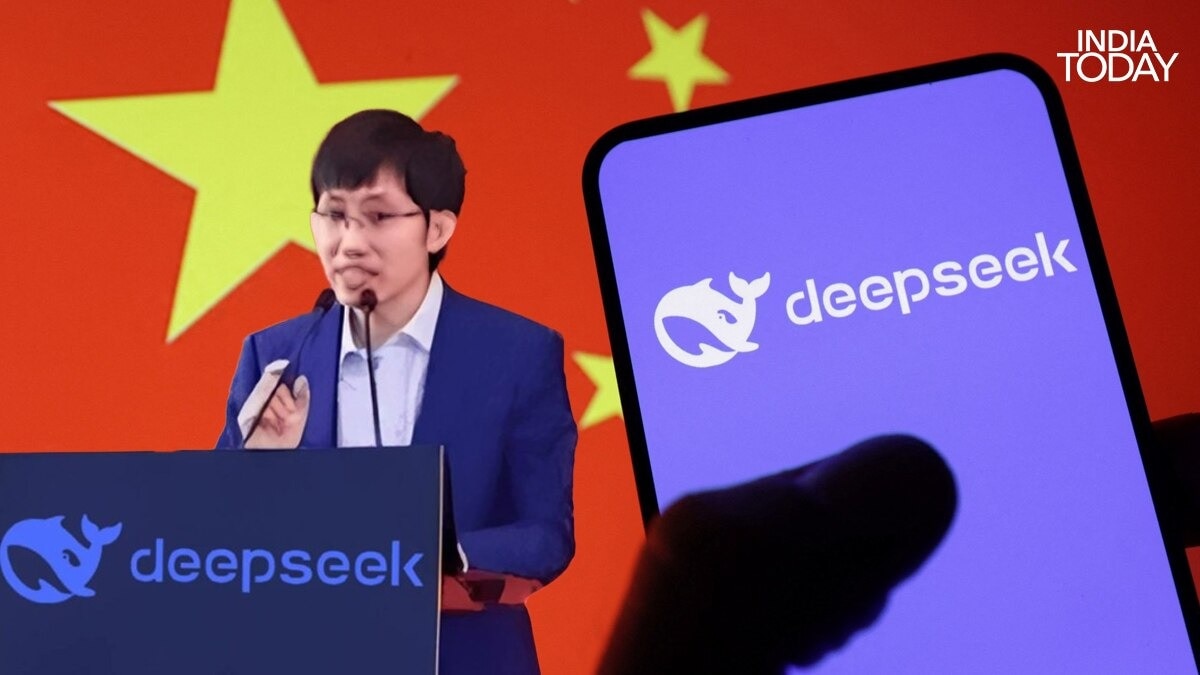
DeepSeek CEO Liang Wenfeng has finally opened up on what he thinks about the future of AI. Unlike AI leaders from the West like Sam Altman or Dario Amodei, Liang doesn't seem to be worried about revenue. Instead, he just has one goal – AGI.DeepSeek CEO Liang Wenfeng just declared war on Silicon Valley.It is not common to see Chinese tech pioneers express their thoughts publicly. But that is exactly what DeepSeek CEO Liang Wenfeng has done, giving us a glimpse of the person behind one of China’s leading AI labs. You see, unlike OpenAI CEO Sam Altman or Anthropic’s Dario Amodei, Liang Wenfeng does not care about revenue or profit. The DeepSeek chief says that he has only one goal – artificial general intelligence, or AGI, a state where AI can start thinking like humans.Recently, a record of a nearly four-hour exchange between Liang Wenfeng DeepSeek’s investors was made public. In the discussion, Liang set out his view of DeepSeek’s purpose, and almost declared war on Silicon Valley, not only in the race for powerful AI models, but also when it comes to advanced AI chips.No IPO, DeepSeek doing this for goodwillAt a time when OpenAI and Anthropic are planning to go public at trillion-dollar valuations, Liang Wenfeng dismissed the idea of an IPO for DeepSeek. He says that he never cared about making money. “Our original intention was not that I ultimately wanted to make a certain amount of money, to go to the capital markets, to IPO, or anything like that. So we didn’t have that original intention,” the DeepSeek CEO said.So much so, that the DeepSeek chief labelled revenue as “sesame seeds” that he is not too concerned about picking up. He said, “The sesame seeds in front, we’ll pick some up, but we just pick up a bit casually – we won’t stop, or treat it as an important matter.” Instead, Liang Wenfeng had eyes on the “watermelons” that may be there in the future. Rather than money, Liang believes that DeepSeek exists to be useful for humanity, something which he says is far more important than money. He explained,"So overall, we’re doing this with tremendous goodwill toward the world, and then we feel this is useful for humanity—this is something beyond money."Do note that OpenAI, which started as a non-profit, turned into a for-profit organisation last year, though its non-profit arm retains a 26 per cent stake. Liang Wenfeng insisted that any large company needs a vision to stick to, but this doesn’t come simply by words said by its leaders. Rather, a vision is only realised by the way a company operates. "What is vision? Vision is not a slogan hanging on the wall—vision is how you do things, not how you talk, that is, how you actually operate,” he added.AGI is the goalAs AI labs in the US chase enterprise users in hopes of getting returns on their investments, Liang Wenfeng says that there is just one goal for DeepSeek – AGI.He explained, "Then next is the company’s long-term vision – I think our goal should be AGI.” He acknowledged that the definition of AGI differed depending on who you ask. “Everyone’s definition of AI isn’t necessarily the same, but that doesn’t stop us from treating AGI as our goal,” the DeepSeek CEO said.According to Liang, AI’s development is like a “staircase” that progresses gradually. That is one advancement can help reach the next step. He explained, “Why is it a staircase? Because each subsequent step is based on the previous foundation. Agent uses CoT (chain of thought), and CoT also uses the previous step, which is the language model – so no step is wasted.”That is, with time, Liang Wenfeng says, that AI agents too will develop further, and we will reach the next step, and eventually progress towards AGI. Once an AI system could learn continuously, he said, it would reach singularity. “It could then develop its own version, could research on its own, then develop its own next version, developing more advanced AI models. So it would reach a singularity, able to achieve its own iteration,” he explained.Liang said this was also why DeepSeek wanted its models to be useful first to DeepSeek itself. If a model could help the company build the next model, then the route to AGI would become faster. He said AI did not fundamentally lack “taste and intuition” but it still lacked the ability to learn continuously. That, rather than style or imagination, was the key technical barrier he saw.Nvidia digging its grave, Huawei to catch upTo train an AI model, however, you need the most advanced GPUs out there. Due to trade restrictions imposed by the US, DeepSeek too faces limits on what kind of chips and how many it can buy from Nvidia -- the largest player in this space. This, Liang says, will likely push China to build a robust ecosystem for AI chips.The DeepSeek CEO said, “If it were in a normal business environment where I could buy Nvidia cards, then domestic substitution would be relatively hard, but when Nvidia cards can’t be bought, everyone is forced into it – everyone has to do domestic chips.”Liang Wenfeng says that with the restrictions, Nvidia was actually digging its own grave as Chinese players worked on building more advanced chips. “I’m relatively optimistic about domestic compute. I think on this point, Nvidia is digging its own grave. Huawei’s supernode, Huawei’s 950 supernode, in performance and price can completely substitute for Nvidia's GB200, GB300,” he explained.That is, instead of restrictions on Nvidia chips pausing AI development in China, Chinese companies were now building their own chips to meet their needs. DeepSeek is already working with Huawei to design advanced chips that can train AI models. Liang Wenfeng explained, “We currently mainly cooperate with Huawei. Huawei does their own adaptation, but we ourselves will participate in this ecosystem, and will deeply participate within Huawei.”And another factor in the reducing dependence on Nvidia was the fact that DeepSeek no longer needed the Nvidia ecosystem, as it was able to write code on its own. Liang said, “When DeepSeek V3 was trained, it still used Nvidia cards, but it already didn’t use Nvidia’s ecosystem. We first wrote a high-level compiler called TileLang, then, based on TileLang’s ecosystem completed everything else.”But there is still a long way to go before Huawei or any other Chinese player can provide like-for-like replacements for Nvidia chips. Denfeng said, “The only cost is that four Huawei cards equal one NVIDIA card, and simultaneously lagging by two years.”Like how Huawei was able to create advanced AI chips, the DeepSeek CEO believes that Chinese AI labs too will create models that are not only powerful, but also much cheaper. He said, “Chinese people will make this product the cheapest, and then, in terms of effect – after all, foreign goods, now many goods where the Chinese-made and American versions don’t have much difference.”“In the future AI might be like this too, but Chinese-made AI might have a cheaper price. This cheapness might be systematically low, just like in other industries where China provides cheaper services,” Liang Wenfeng said.While companies like OpenAI and Anthropic have closed-source models that usually are costlier to run due to token-based pricing, DeepSeek has open-weight models that are much cheaper to use. Like DeepSeek’s models, other Chinese AI models like Moonshot AI’s Kimi K3 and Zai’s GLM 5.2 are also open-weight models.- EndsPublished On: Jul 24, 2026 09:49 IST
AGI at all cost, Nvidia is digging its own grave: DeepSeek CEO just declared war on Silicon Valley
Full Article
Original Source
Read the full article at Indiatoday →KhanList aggregates and links to publicly available news content. We do not host full articles from third-party sources. Always verify important information with original sources.