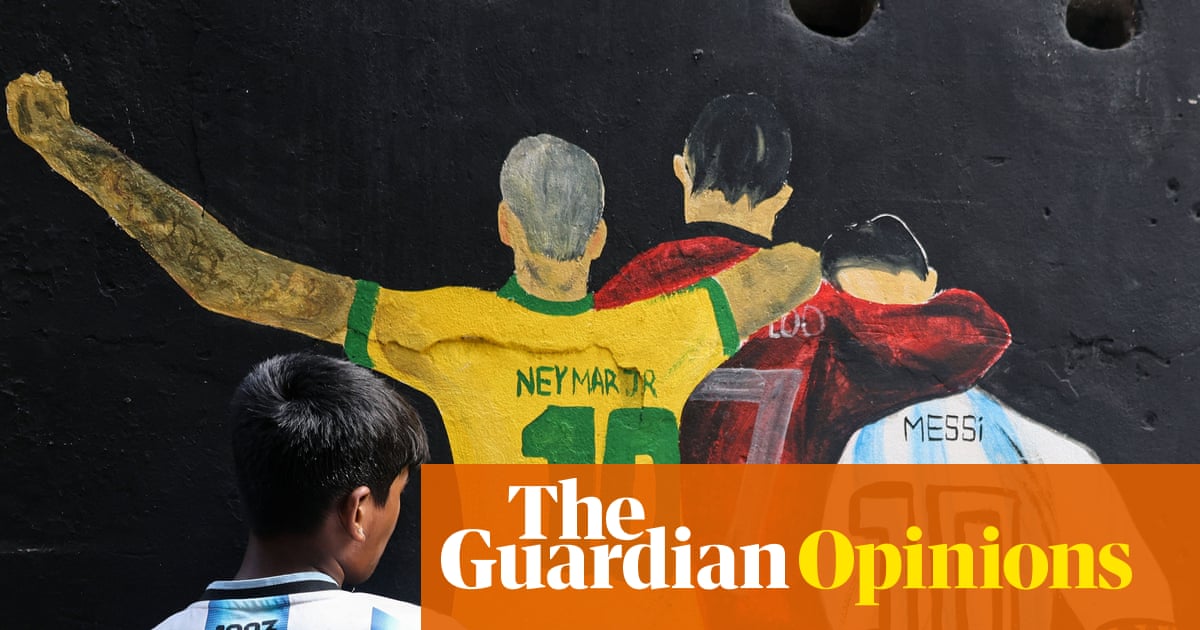
It’s the World Cup final, so you pick a side. And don’t worry if you happen to be part of the 98.9% of the human race that is neither Spanish nor Argentinian – just make something up. Maybe you like the Spain kit. Maybe you’ve always been an admirer of Lionel Messi. Maybe you’re still raw about the Falklands or Diego Maradona, maybe you disagree with the Pedro Sánchez government’s stance on Palestine/Israel, maybe you once ate a dodgy empanada on your gap year. Nobody needs to see your working. Only two rules really apply: be partisan and be quick about it.The MetLife Stadium on Sunday night was a melting pot of colliding incongruities and temporary identities. The former heavyweight boxing champion Mike Tyson was wearing an Argentina shirt. The comedian Trevor Noah wore a Spain shirt. Indeed, ticket sales data suggests that an overwhelming proportion of the crowd was American. The most consequential fixture in international sport was, as it turned out, little more than a grand cosplay for the New Jersey leisure market.And beyond the final, perhaps this has been one of the hidden stories of the World Cup: the gradual reimagining of national allegiance as a kind of single-use consumer brand. For six weeks, the entire nation of Bangladesh went crazy for Argentina. A group of central Asian friends in north London put aside their internecine rivalries to cheer for Uzbekistan. The Arab diaspora swung firmly behind Morocco and Egypt as the tournament progressed. Leftwing progressives who revile the cross of St George when painted on a mini-roundabout were suddenly daubing it on their cheeks.All of which upends what we have been told for decades about the World Cup, and international sport in general. A tournament that should in theory be the ultimate playground for nationalism has in fact demonstrated the very opposite: the increasing fragility of nationhood as an idea. What the social psychologist Michael Billig termed banal nationalism – the subliminal everyday symbols of nationhood – has now become so banal as to be in essence disposable. If national identity is now something that can be slipped on and off as easily as a football shirt, then what use is it, really?We live in an age where the boundaries of nationhood are both ever-more piercingly evoked and ever-more hazily defined. Again, football illustrates this confusion better than almost any other human endeavour. Across western Europe, far-right voices preach the doctrine of nationalism while reviling their own national teams for having too many black players. In Colombia and Brazil, many leftwing fans have chosen to spurn the national team shirt as a result of its appropriation by rightwing populists.This is before we even address the teams themselves: in many cases not so much cogent expressions of national identity or even recognisable products of a system as they are snapshots of a sprawling diaspora at a particular moment in time, splintered on multiple planes by globalisation and migration, assembled out of convenience and expediency. Forty of the 48 competing nations contained a player born overseas. Only one member of the Curaçao squad was actually born on the Caribbean island. The Cape Verde squad that held the eventual champions, Spain, to a heroic 0-0 draw in the group phase featured more players born in Rotterdam than in the country’s capital.And so the modern World Cup serves two abrupt functions. First, it forces us to confront the idea that most of us have multiple identities cutting across or even against national boundaries, that everywhere is the product of everywhere. Second, it interrogates the criteria by which we pledge allegiance to a country, a process that most of the time lies latent and unspoken, only bursting to the surface in the form of an urgent binary question: “Who do I support for this game?” The historian Eric Hobsbawm’s famous quote about football gestating an “imagined community of millions” takes on a subtly different resonance when you realise that very often this is a community with no defined borders or polity, a community that for 90 minutes draws its number from every corner of the planet.skip past newsletter promotionafter newsletter promotionWeirdly, this is a phenomenon that has become neither exclusively left- nor right-coded. If nationalism was long regarded as the preserve of the populist right and internationalism as the preserve of the intellectual left, these days the picture is far more nuanced. Today’s rightwing agitators are as likely to pledge allegiance to Donald Trump or wave an Israeli flag as they are to champion the country they’re actually from. The Trump administration has consistently demonstrated greater solidarity with white South Africans than with Black Americans. Across the English-speaking world, conservative outlets freely make alliances across national borders and appeal to abstract concepts such as “Judeo-Christian values” or “western civilisation” while denouncing and dehumanising many of their fellow citizens as traitors and scum.Football’s role as a nation builder is often overstated. France’s World Cup triumph in 1998 was hailed as a vindication of the country’s multiethnic identity, but four years later it sent Jean-Marie Le Pen into the final round of the presidential election. Argentina’s 1978 victory on home soil generated a surge of popularity for the country’s military dictatorship, but by 1983 it had collapsed. England’s run to the European Championship final in 2021 did not, for all the good vibes and open letters, arrest our wider descent into gutter politics and culture war.But occasionally it can hold up a mirror. And perhaps what this World Cup reflects back at us is a kind of messy hope: that a world of hardening physical borders is doomed to disintegrate on contact with reality. That for all the flags and pageantry, nationality is ultimately little more than a brand, a consumer choice, a piece of content – a mask anyone can happily wear for six weeks, and shed just as easily. Jonathan Liew is a Guardian columnist
After this World Cup, here’s what I feel: a kind of messy hope | Jonathan Liew
Full Article
Original Source
Read the full article at Theguardian →KhanList aggregates and links to publicly available news content. We do not host full articles from third-party sources. Always verify important information with original sources.