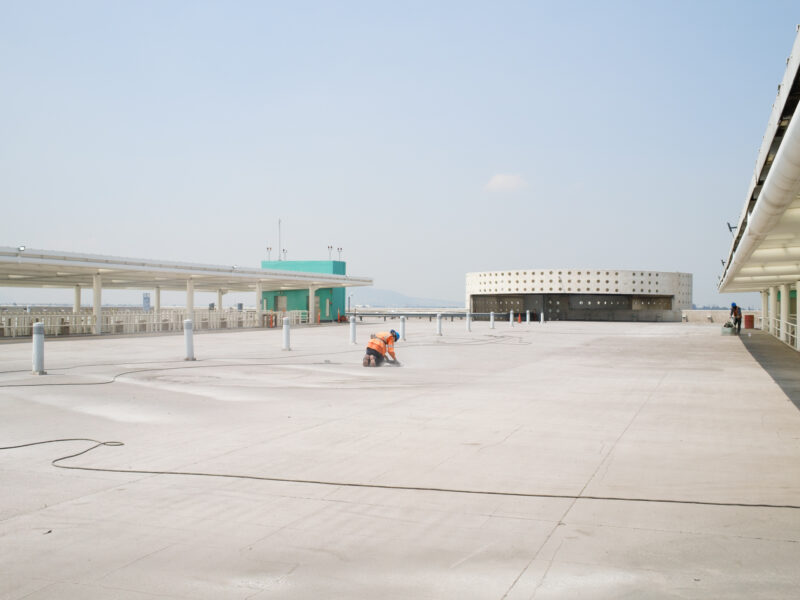
MEXICO CITY (CN) — Mexico City residents did their fair share of celebrating as one of three Mexican host cities of the 2026 FIFA World Cup. Close to 1.5 million people took to the streets last month when Mexico beat Ecuador for the team’s first World Cup knockout win in 40 years.Mexico’s dream ended when the team, also known as “El Tri,” lost to England, 3-2, earlier this month at Mexico City’s newly renovated Azteca Stadium. Construction workers, however, still labored on with the capital’s two main infrastructure projects, well after Mexico’s World Cup fan slogan of “y si sí?” — or “what if we can?” — was answered with a resounding “no.”One project is the transformation of Tlalpan Avenue, a chaotic main Mexico City thoroughfare leading directly to Azteca Stadium through the neighborhoods of Obrera, Tránsito and El Centro. According to the Mexican government’s rollout, the project aims “to prepare Mexico City to receive the world while leaving permanent benefits that improve the daily lives of millions of people.”Though the garden itself, the Tlallipan Floating Garden, was inaugurated by Mexico City Mayor Clara Brugada on June 7, the entire project wasn’t completed until Monday with access to two metro stations connected by the elevated garden and a walkway above Tlalpan Avenue.The elevated "Tlallpian" garden and walkway over Tlalpan Avenue on July 23, 2026. (William Savinar/Courthouse News)The original government investment for the walkway and garden was $38 million, according to the Mexico City government’s official log, but the final cost tripled to nearly $115 million, according to an official document accessed via the Mexico City government’s transparency portal.Construction on the walkway began in September 2025, creating tension among some informal workers in the area and closing down two metro stations for a month.Despite protesters’ fears of gentrification leading up to the World Cup, many chilangos — slang for Mexico City residents — expressed their delight with the final project.The floating walkway and garden from Tlalpan Avenue in Mexico City on July 23, 2026. (William Savinar/Courthouse News)José Juan Estrada, a Colonia Obrera resident for 25 years, was taking in the newly installed statues and flowerbeds on the elevated walkway that cuts through the bustling metropolis.“The truth is, this project they did is very, very useful, very beneficial, and it’s beautiful for us residents here in La Obrera and the surrounding neighborhoods, because it’s a place for recreation and leisure. There’s security and everything. And that’s a benefit for the citizens in general and for the country as well,” he said Friday on the elevated pathway Friday.Juan Estrada called the World Cup a success despite Mexico’s team not winning it all.“I hope there are more sporting events, because this — this is where we won. This was a benefit, even though we didn’t win the World Cup, we won with these beautiful projects, and that gives us a lot of pleasure,” he said.Visitors enjoyed the scenery while some other residents had their doubts. Tragedies caused by rushed infrastructure projects like the Line 12 metro collapse in 2021 are never a distant memory.Making matters worse, part of a pedestrian walkway in a newly remodeled airport terminal collapsed last month, leaving one woman injured.Mexico City Metro Chabacano station finishing construction on July 23, 2026. (William Savinar/Courthouse News)Ricardo Rodríguez stood on the labyrinthine platform of Metro Chabacano on Friday, observing the final construction touches of the floating walkway metro connection. Rodríguez, a former resident of the area who used to take the metro from this station daily, said the project has left him worried.“First, basically, the drainage system lacks proper flow for the water to run off from. The rainy seasons made that clear. This whole section of platform flooded on both sides,” said Rodríguez.On July 17, less than a month after the station reopened after its remodel, users recorded water falling from the pipes onto the platform and tracks.Rodríguez claimed this part of the piping was not replaced and the remodeling is purely aesthetic.“If that piping had been replaced, if it had been maybe maintained, there wouldn’t have been the problems with the rain, well, with the water runoff, like there were last week with that strong rainstorm,” he said.“The water table is already gone; we’ve already used it up. I felt a 5.0 magnitude earthquake very strongly here. And the truth is, this whole area shakes horribly. It’s a very strong swaying. If an earthquake like the one in ‘17 comes, it’s going to fall. It’s going to fall because it’s already being held up by the last bit of support,” he said.Still, like Juan Estrada, Mexico City residents are enjoying the immediate benefits of projects originally criticized as being built only for tourists. And so-called aesthetics can go a long way in a noisy, chaotic metropolis.Back out on the floating garden, Estefanía Espino from Iztacalco was enjoying the sights of the newly painted apartment buildings towering over the flowerbeds on the raised pathway.“I came to check out the garden while I was passing by. It’s really cool. It has a lot of recreational areas, a lot of places to come with the family, to play, to come and chat. Lots of green areas and it’s very quiet,” said Espino. “Plus, you get to see part of the city in a different way. It’s really great, actually.”The second major World Cup construction project underway is the Mexico City Benito Juárez International Airport, or AICM.Neri Alejandro Martínez Hernández, assistant director of corporate coordination, and Captain Arturo Flores Melgoza, remodeling coordinator, led Courthouse News on a tour of the AICM last week.Martínez Hernández said the airport received 3.5 million travelers in June during the World Cup.Though that figure puts the airport in the high-passenger zone globally — about the equivalent of New York City’s John F. Kennedy International Airport — it is actually a decrease from theJune 2025 passenger tally of 3.6 million and from May 2026 with nearly 3.9 million.According to Brugada’s administration, the two airports that serve Mexico City — Mexico City Benito Juárez International Airport and the newer Felipe Ángeles International Airport — received 4.4 million international visitors between June 1 and the first half of July. November 2025 estimates placed the number of international visitors for the World Cup at 5.5 million.Initial renovations to the nearly century-old Mexico City International Airport began in May 2025 with an estimated $458 million investment. The second phase of construction stretches from September through December.The first phase was cosmetic and comfort upgrades like new interior facades, expanded bathrooms and waiting areas, expanded parking and car circulation, security camera updates, new luggage carousels and check-in ID scanners for faster access to the gates. The second phase will focus more on infrastructure, runway improvements and a new parking garage.Flores Melgoza said a third phase may be announced in December for next year involving more infrastructure improvements.In a facility handling 120,000 passengers a day, car traffic and parking is one of the airport’s main hurdles. The airport itself can no longer expand outward because it is surrounded by the dense urban megalopolis of Mexico City. It has to expand upward instead.Outside one of two metro stations that connect with the Mexico City airport on July 23, 2026. (William Savinar/Courthouse News)Martínez Hernández said they are still working with the city government to grow awareness of the metro connection.“You have an airport in your city and you have the mass transit system, right? Which is the metro. So, if we manage to bring those two aspects together, people will no longer just have the option of arriving by car or by taxi, but they’ll also be able to arrive safely by public transportation, which costs five pesos. I mean, imagine that in the city, right? Easier, cheaper,” said Martínez Hernández.The airport also added passport-scanning kiosks and addressed the issue of runway flooding.“The green areas used to be 50 centimeters above the runways. This meant that the water falling on those areas, instead of being absorbed, was directed onto the runways and taxiways,” said Flores Melgoza.The level was lowered so runoff would be channeled through those green areas, which span 86 hectares and have 70 centimeters of rainwater capacity.Flores Melgoza explained that a network of canals and six pumping stations along the airport bridge, in addition to three more recently acquired hydro excavation trucks, further aid in removing water from the runway.“As of today, we no longer have problems with runway flooding,” he said.Inside one of the airport’s two terminals, he pointed to where new pipes were installed to handle rainfall.The newly renovated Terminal 2 of the Mexico City airport on July 23, 2026. (William Savinar/Courthouse News)Though Mexico received a $2.5 million World Cup economic boost according to international accounting firm Deloitte, the same firm’s report stated that this was 7% below its February forecast.It remains to be seen how the major construction projects will benefit the 25 million residents living in Mexico City’s metropolitan area now that the World Cup tourism boom — however small — has passed. There will be divided opinions about the long-term benefit after the final coat of paint has dried.Back on the Chabacano station platform, Rodríguez explained his doubts.“Aesthetics don’t work; aesthetics will wear off. They only work for a while, and then, boom! They fall apart. And if you want something that really works, you have to do it from the inside out, from the very core, from the gut. Replacing pipes, making expansions in some areas, making sure your pilings are sound,” said Rodríguez.Courthouse News reporter William Savinar is based in Mexico City.Subscribe to our free newslettersOur weekly newsletter Closing Arguments offers the latest about ongoing trials, major litigation and rulings in courthouses around the U.S. and the world, while the monthly Under the Lights dishes the legal dirt from Hollywood, sports, Big Tech and the arts.Additional Reads
After final whistle, World Cup construction carries on in Mexico City
Full Article
Original Source
Read the full article at Courthousenews →KhanList aggregates and links to publicly available news content. We do not host full articles from third-party sources. Always verify important information with original sources.