
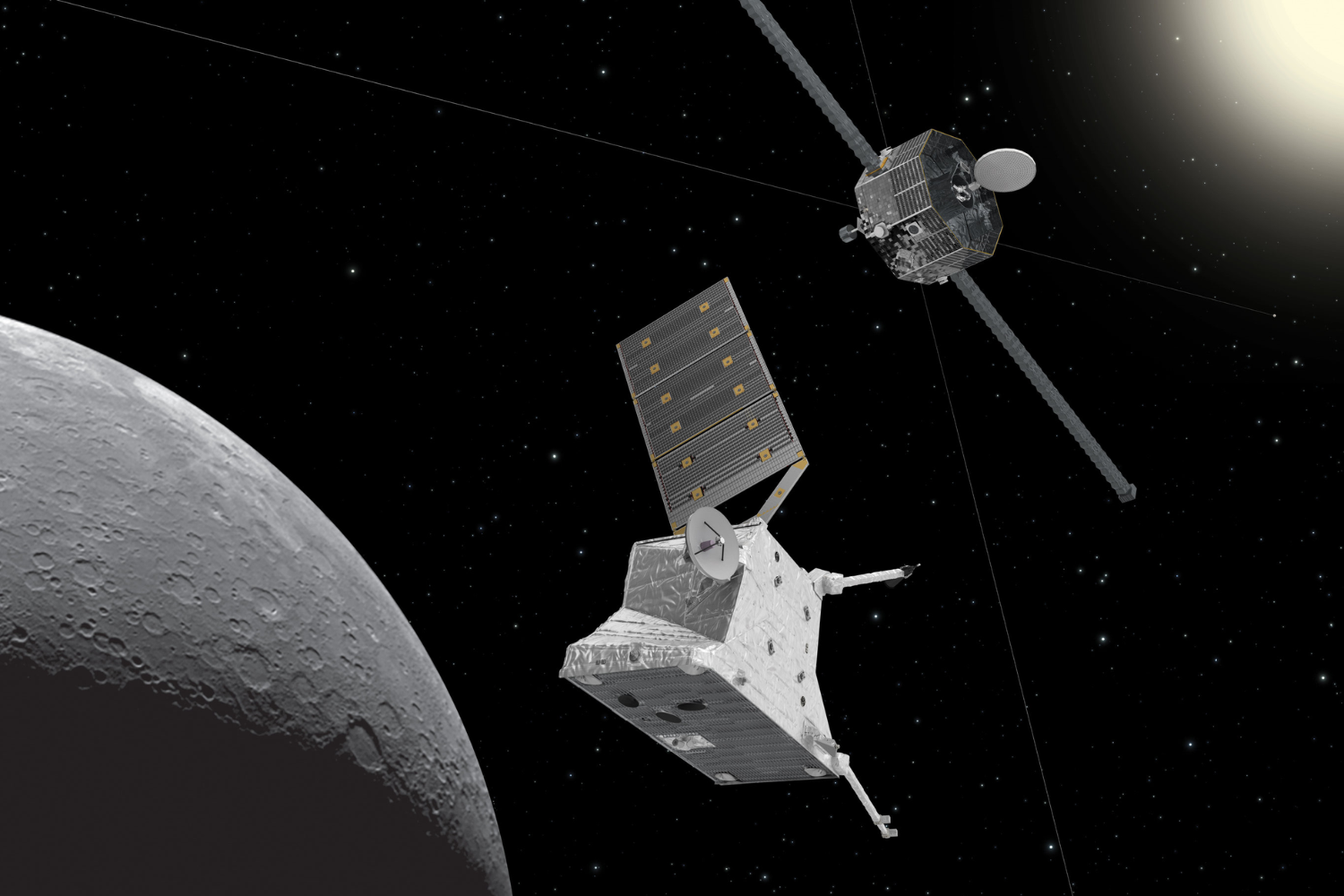
The BepiColombo mission, by the European Space Agency and the Japan Aerospace Exploration Agency, is only the third to study our smallest planetary neighbor September 4, 2026 2:48 p.m. An artistic rendering of the ESA's Mercury Planetary Orbiter in the foreground and JAXA's Mercury Magnetospheric Orbiter in the background near Mercury. Spacecraft: ESA / ATG medialab; Mercury: NASA / Johns Hopkins University Applied Physics Laboratory / Carnegie Institution of Washington Mercury, the solar system’s smallest planet and the one closest to the sun, hasn’t received as much love as its celestial neighbors. It’s the least explored of the inner solar system planets, which also include Venus, Earth and Mars. But the BepiColombo mission, by the European Space Agency (ESA) and the Japan Aerospace Exploration Agency (JAXA), will help change that. It’s finally in the homestretch of an eight-year-long voyage to the tiny planet. On September 3, BepiColombo initiated its arrival phase, when the module that powered and propelled the journey separated from two spacecraft that will collect data about our planetary sibling. They include ESA’s Mercury Planetary Orbiter (MPO) and JAXA’s Mercury Magnetospheric Orbiter (Mio). The occasion marks the start of one of the most complex planetary arrival sequences ESA has ever attempted. If all goes according to plan, the connected spacecraft will start looping around the planet on November 21 and separate from each other about three weeks later. They’ll begin collecting scientific data in April 2027. “It’s a very difficult mission and very challenging because we are flying into a very, very harsh environment,” said Bruno Sousa, ESA’s head of the operations definition and engineering team, during yesterday’s broadcast of BepiColombo’s initiation of the arrival phase. “We are flying in the vicinity of the sun. That poses challenges in terms of the thermal behavior of the spacecraft, in terms of the radiation levels we get from the sun.” For comparison, ESA’s Solar Orbiter also gets very close to the sun, but it then has six months to cool down when it nears Venus, Sousa explained. BepiColombo won’t have any such respite, because its distance from the sun will remain roughly the same year-round. Quick fact: Our solar system’s pint-size planet Mercury is about one-third the width of Earth. It’s only a bit bigger than our moon. Its journey to the planet, which began with an October 2018 launch, was tough too. It required a lot of energy because Mercury is so close to the sun, and so spacecraft headed there must frequently brake to resist our star’s strong gravitational pull. In fact, experts suspect that this trip requires more energy than getting to the dwarf planet Pluto. For BepiColombo, “we obtain most of the energy to get to Mercury from the flybys” near other planets, whose gravity slowed the orbiters, says Johannes Benkhoff, ESA’s project scientist for the mission, in a statement. “We use our fuel mainly to get the flyby right, to bring the spacecraft into the correct position when we fly past a planet in order to get maximum energy out of it in order to brake and go in the right direction to the sun.” The sun’s gravity will also make it difficult for the two spacecraft to get trapped in Mercury’s orbit. They must slow to just the right speed; if they’re traveling too fast, they’ll shoot past the planet. From top to bottom: Mio, Mio's Sunshield and Interface Structure, MPO and the module that powered and propelled the spacecrafts' journey to Mercury. ESA / ATG medialab Mercury’s proximity to the sun also makes it notoriously challenging to study from Earth, so the orbiters will help researchers uncover many of the planet’s secrets. BepiColombo is designed to reveal Mercury’s composition, geophysics, atmosphere, magnetic bubble, gravitational field and history. MPO will mainly map the planet itself, while Mio will study the rocky body’s surroundings. “I think being able to see new data come out about Mercury is going to be so fantastic,” Rachel Klima, a planetary geologist at the Johns Hopkins Applied Physics Laboratory, tells Space.com’s Meghan Bartels. The planet is “just so weird and beautiful and interesting.” For example, how Mercury’s gravity tugs on MPO and Mio should allow researchers to validate—or challenge—predictions about the gravitational field that are based on computer simulations, Larry Nittler, a planetary scientist at Arizona State University, told Forbes’ Bruce Dorminey in 2023. BepiColombo, which honors Italian mathematician and engineer Giuseppe “Bepi” Colombo, will be only the third mission to visit Mercury. NASA’s Mariner 10 flew by the planet three times in the mid-1970s, and NASA’s MESSENGER orbited it from 2011 to 2015. You Might Also Like Get the latest stories in your inbox every weekday. More about: Mercury Planets Solar System Space Travel Sun
After an Eight-Year Journey, Two Spacecraft Have Begun Their Arrival to Mercury, the Inner Solar System's Most Mysterious Planet
Full Article
Original Source
Read the full article at Smithsonianmag →KhanList aggregates and links to publicly available news content. We do not host full articles from third-party sources. Always verify important information with original sources.